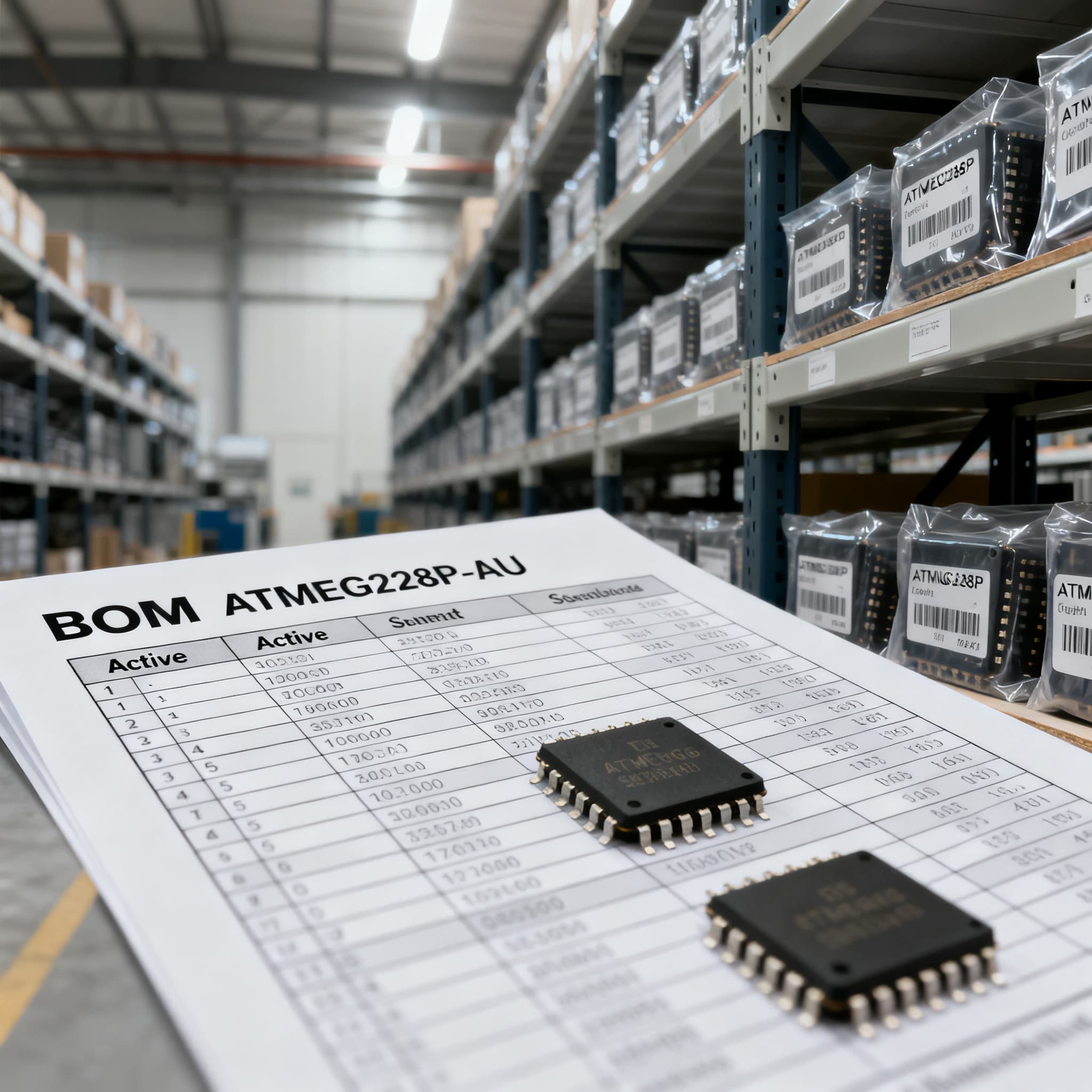
ATMEGA328P-AU is Active — What Procurement Teams Should Do
ATMEGA328P-AU procurement and RFQ considerations for professional buyers. Need this part — or a full BOM? Request a quote on BOMNow.
For procurement teams managing multi-line BOMs with legacy AVR cores, the ATMEGA328P-AU presents a classic sourcing dilemma: conflicting lifecycle signals, package-specific availability, and a migration path that isn’t a simple drop-in. This playbook cuts through the noise, giving you a clear plan to verify status, evaluate alternatives, and protect your supply chain without disrupting active production.
Mixed Signals on ATMEGA328P-AU: Active, NRND, or Both?
If you pull up the ATMEGA328P-AU on Mouser, the product page carries an unambiguous NRND flag: “Not recommended for new designs” (source). Yet cross-check with Findchips and you’ll see Rochester Electronics listing the part as Active with no NRND or EOL flag as of mid-2026 (source). That disconnect is exactly why procurement teams need to move beyond surface-level distributor badges and understand the lifecycle mechanics at play.
Microchip’s NRND designation doesn’t mean the part is obsolete. It means the manufacturer is discouraging its use in new designs while continuing to support existing customers. The ATMEGA328P-AU remains in production, but the NRND flag is a leading indicator that the clock is ticking. As the TT Electronics lifecycle guide explains, “Not Recommended for New Designs” sits between the “mature” and “decline” phases, where the manufacturer may still produce the part but will not invest in new mask sets, shrink the die, or qualify the part for new processes (TT Electronics).
Key takeaway: The ATMEGA328P-AU is active today, but NRND signals that the last-time-buy window could open in the next few years. For production BOMs, that means you need a plan now—not when the PCN drops.
What’s Inside the ATMEGA328P-AU: Specs, Package, and the NRND Puzzle
Before you can frame a sourcing strategy, you need to ground the part’s technical identity. The ATMEGA328P-AU is an 8-bit AVR microcontroller from Microchip Technology (originally Atmel). It packs 32 KB of in-system programmable Flash, 2 KB SRAM, and 1 KB EEPROM, running at up to 20 MHz across a wide 1.8–5.5 V operating range. The “AU” suffix denotes the 32-lead TQFP (Thin Quad Flat Pack) package, the surface-mount version that dominates volume production. The full datasheet is available from Atmel (Atmel) and Microchip (Microchip), with the most recent 662-page revision capturing the entire family (AllAboutCircuits).
| Parameter | Value/Range | Unit/Notes |
|---|---|---|
| MCU Architecture | 8-bit AVR RISC | — |
| Flash Memory | 32 | KB (ISP, self-programming) |
| SRAM | 2 | KB |
| EEPROM | 1 | KB |
| Maximum CPU Speed | 20 | MHz |
| Operating Voltage | 1.8 – 5.5 | V |
| Package | 32-lead TQFP (AU) | 7 × 7 mm body |
| Temperature Range | -40 to +85 | °C (industrial) |
| I/O Pins | 23 | Programmable I/O lines |
| Peripherals | SPI, I²C, USART, ADC, PWM, timers | — |
The TQFP package is the real workhorse in automated assembly lines, while the through-hole DIP variant (ATmega328P-PU) is popular on Arduino Uno boards and prototyping (Bettlink). For production BOMs, the PU variant is rarely specified; the AU version is what you’ll see on pick-and-place machines. Critically, the NRND status applies to the entire ATMEGA328P family, so both AU and PU face the same long-term lifecycle risk. Your package choice affects assembly process, not long-term availability. The ATMEGA328P-AU remains the primary procurement target, but its NRND flag means you should be evaluating migration paths for any new design that hasn’t yet been locked.
ATMEGA328P-AU vs. ATMEGA328PB and Other Migration Candidates: What to Verify Before Committing
The most frequently cited replacement for the ATMEGA328P-AU is the ATMEGA328PB. The “B” variant adds a few peripherals and tweaks two pins, but the core and instruction set are identical. As one Reddit discussion notes, “the code/fuses are compatibility must be verified case by case with the 328P,” but you must check pins 3 and 6: on the PB, these pins are used for a second I²C interface or an oscillator, while they were simple GPIO on the original P. If your PCB leaves those pins disconnected, the PB can be a near-drop-in; otherwise, a board revision is needed (Reddit). The Kynix migration table reinforces that no alternative is a compatibility must be verified (package, pinout, firmware) without a full design review against the exact orderable part number (Kynix).
Other architectures, such as the STM8 family or even an STM32 Cortex-M0, have been discussed in the Arduino community for data-logging projects (Arduino forum). Those represent a complete redesign, not a migration. The table below compares the two most practical options for a procurement-led migration discussion.
| Comparison Metric | ATMEGA328P-AU (Current) | ATMEGA328PB (Closest Candidate) | Selection Criteria & Failure Boundary |
|---|---|---|---|
| Core / ISA | AVR 8-bit | AVR 8-bit (identical) | Code compatibility is high; recompilation typically not needed. |
| Flash / SRAM / EEPROM | 32 KB / 2 KB / 1 KB | 32 KB / 2 KB / 1 KB | Memory footprint unchanged; no firmware rework for storage. |
| Package | 32-pin TQFP | 32-pin TQFP (same footprint) | PCB footprint is identical; no board layout change required. |
| Pin Compatibility | — | Pins 3 & 6 conflict (PE0, PE1) – must be verified | If these pins are used as GPIO, a schematic review is mandatory; if unconnected, migration is straightforward. |
| Peripherals | 1x USART, 1x SPI, 1x I²C, 10-bit ADC | 2x USART, 2x SPI, 2x I²C, additional PTC, 10-bit ADC | Extra peripherals can be ignored if not needed; no firmware change required for existing functions. |
| Voltage Range | 1.8–5.5 V | 1.8–5.5 V | Same; no PMIC redesign. |
| Lifecycle Status | NRND | Active (check manufacturer portal) | PB is the recommended forward path for new designs; currently in full production. |
| Migration Effort | — | Low–medium (pin review + re-qualification) | If pin conflict exists, a PCB spin is required; otherwise, a qualification run is the main cost. |
A separate branch is the ATmega328 (without “P”) or the ATmega328P in other packages, but the NRND umbrella covers the classic P family. The key decision point for procurement is whether your engineering team can accept the ATMEGA328PB with a minimal pin review, or if you need to start a full redesign with a different MCU family. Engaging engineering early based on the NRND signal prevents a last-minute scramble.
What Procurement Teams Should Do Now: Sourcing, Inventory, and Design Review
The dual Active/NRND status of the ATMEGA328P-AU means you can’t just watch stock levels and relax. A proactive procurement playbook includes three parallel tracks: securing current production, planning for a possible last-time buy, and evaluating a migration path for new designs. Authorized distributors like Mouser and Rochester remain the primary source for authentic parts; monitor their inventory regularly and cross-check lead times. During periods of tight supply, older parts like this can see lead times spike to 26 weeks or more, driven by batch manufacturing cycles (Kynix).
Microchip publishes product change notifications (PCNs) and lifecycle updates through its customer portal. The Kynix article reminds buyers to check the manufacturer’s active lifecycle portal before designing this into a new 10-year product—and that same portal is your early warning system for the transition from NRND to EOL. The TT Electronics guide explains that YTEOL (Years to End of Life) estimates are reviewed at least annually and capped at a five-year horizon (TT Electronics). For the ATMEGA328P-AU, that means each annual review cycle could trigger a last-time-buy notice, so you should treat the current window as a probabilistic planning horizon.
The table below structures the actions you can take now, along with trade-offs.
| Action | When to Use | Trade-off |
|---|---|---|
| Cross-check authorized distributor stock & lead times | Immediately, for all active BOMs using this MPN | Spot buys may be limited; longer lead times can delay production if not buffered. |
| Register for PCN/PDN alerts from Microchip | If the part is in any production or sustaining BOM | Requires monitoring; missing a PCN could mean you lose the last-time-buy window. |
| Buffer inventory for existing products | When annual consumption is stable and the product lifecycle is >2 years | Carrying cost and risk of obsolescence if the product is cancelled earlier than expected. |
| Initiate migration path to ATMEGA328PB or alternative | For all new designs and any product revision | Engineering effort, PCB re-spin, and re-qualification; must be done before the last-time-buy date. |
| Evaluate second-source or pin-compatible options | If the product is a high-runner or has a long service life | True second sources for this MCU are rare; most alternatives require a redesign, so start early. |
If you’re carrying the ATMEGA328P-AU in sustaining products with no immediate redesign budget, a safety buffer calculated from annual consumption and the five-year YTEOL cap is a prudent first step. Meanwhile, push engineering to evaluate the ATMEGA328PB in the next revision cycle. The NRND flag is not a stop-ship order, but ignoring it is a supply chain risk you can’t afford.
ATMEGA328P-AU Procurement FAQs: Lifecycle, Alternatives, and Lead-Time Reality
Q: Is the ATMEGA328P-AU really NRND, and what does that mean for my production bill of materials?
Microchip has marked the part as Not Recommended for New Designs, as visible on Mouser’s product page (NRND). The ATMEGA328P-AU remains in active production for existing customers, but the NRND status means no new designs should use it. For your production BOM, this is a signal to plan for eventual obsolescence. Confirm the official status via Microchip’s lifecycle portal and watch for any PCN updates that could shorten the supported window.
Q: How do I verify the official lifecycle status directly from Microchip?
Use the microprocessor manufacturer’s EOL/PCN portal or request a lifecycle statement from your authorized distributor. The TT Electronics guide explains how to interpret YTEOL estimates and latest PCN dates (TT Electronics). The Kynix article also emphasizes checking the manufacturer’s active lifecycle portal, a practice that applies here as well (Kynix).
Q: What is the best alternative if I need to redesign: ATMEGA328PB, STM8, or something else?
The ATMEGA328PB is the closest migration candidate—code and fuses are compatible, but pins 3 and 6 must be checked for conflicts (Reddit). The Kynix migration table lists other options, each requiring a full design review against the exact orderable part number (Kynix). Switching to a completely different architecture like STM8 or STM32 is a full redesign, not a simple alternative. The Arduino forum also discusses such replacements in the context of data-logging projects, but those should be treated as new designs (Arduino forum).
Q: What lead-time and MOQ challenges should I plan for with this part?
Standard IC lead times apply, but during shortages lead times can spike to 26+ weeks due to batch manufacturing (Kynix). MOQ is typical for a mature TQFP microcontroller, but older parts can suffer from sporadic availability. Monitor authorized distributor inventory on Mouser and Findchips regularly, and factor extended lead times into your production schedule.
Q: Does the package variant (AU vs. PU) affect availability or sourcing risk?
The AU package (32-pin TQFP) is the surface-mount version used in volume production; the PU is a through-hole DIP favored for prototyping (Bettlink). The AU variant generally has wider availability in distribution channels, but the NRND status applies to the entire ATMEGA328P family, so both variants face the same long-term life-cycle risk. Your choice should match your assembly process, not just short-term stock.
Q: If I stay with ATMEGA328P-AU, how should I manage inventory to avoid sudden obsolescence?
Build a safety buffer based on your annual consumption and the estimated product lifetime. Since the YTEOL estimate is reviewed at least annually and capped at five years (TT Electronics), treat each year as a potential last-time-buy trigger. Register for PCN alerts from Microchip and maintain a second-source evaluation plan for the next design revision. For a consolidated quote on the ATMEGA328P-AU or migration candidates, upload your multi-line BOM to BOMnow.
References & Further Reading
- ATMEGA328P-AU on Mouser (NRND flag)
- Findchips: ATmega328P availability and lifecycle status
- TT Electronics: Lifecycle and Obsolete Product Data Guide
- Atmel ATMEGA328P-AU datasheet
- Microchip ATMEGA328P-AU datasheet (662 pages)
- AllAboutCircuits: ATMEGA328P-AU datasheet & specs
- Bettlink: ATmega328P guide (AU vs. PU packages)
- Reddit: alternative for ATmega328P (ATMEGA328PB)
- Kynix: ATMEGA328P-AU migration candidates and lead-time notes
- Arduino forum: replacement for ATmega328P discussion
The ATMEGA328P-AU is still shipping, but the NRND designation is a clear message to procurement: start planning now. Whether you need to buffer inventory for existing products, qualify the ATMEGA328PB, or evaluate a completely new MCU architecture, the first step is a consolidated view of your BOM. Upload your multi-line BOM to BOMnow for a single, consolidated quote, or request a quote for the ATMEGA328P-AU and its migration candidates. One BOM, one quote, one sourcing partner—so you can focus on the redesign, not the paperwork.