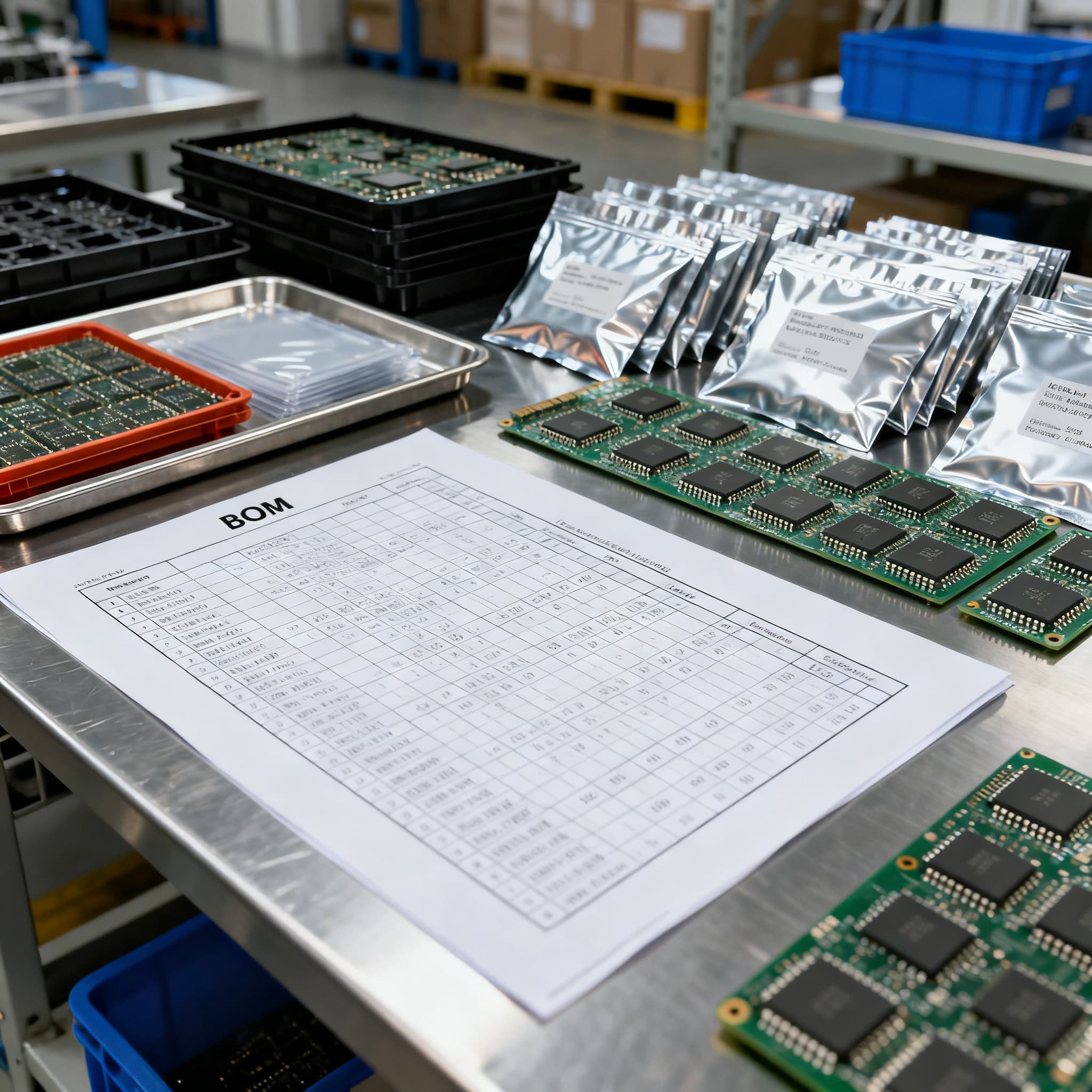
Multi-Line BOM RFQ Checklist for Electronics Procurement
Practical BOM sourcing guidance for OEM and EMS buyers. Prepare your component list, consolidate suppliers, and upload a BOM for one quote.
When a multi-line BOM RFQ lands on your desk with 200 line items, three different revision dates, and a note that says "please quote ASAP," the real work hasn't even started. You still need to validate every MPN against current manufacturer datasheets, cross-reference the approved vendor list, normalize quotes from suppliers who each cover a different subset of the BOM, and somehow reconcile conflicting lead-time assumptions before the production schedule slips. That's the reality of electronics procurement in 2026 — and the gap between a well-prepared RFQ package and a messy one is measured in weeks of lost cycle time, not hours.
This article walks through a practical multi-line BOM RFQ checklist that addresses the friction points buyers face daily: fragmented data, missing attributes, single-sourced lines with no alternates, and the manual reconciliation tax that spreadsheets impose. We'll ground each section in recent industry research and real workflow observations, without pretending every problem has a one-click fix.
Why Multi-Line BOM RFQs Are Bleeding Time and Money Right Now
The component allocation landscape hasn't exactly relaxed. Buyers are still scrambling to secure supply for lines that were once comfortably multi-sourced, and the 2026 shortage update from IC Online makes one recommendation that cuts to the core of RFQ efficiency: work with engineering to identify the top 20% of BOM line items that are single-sourced and map out drop-in replacements or minor layout changes before the RFQ even goes out. When you skip that step, you're not just risking availability — you're guaranteeing that the quoting process will stall the moment a supplier flags a 30-week lead time on an MPN with no qualified alternate.
The hidden cost, however, isn't only in the shortage itself. Elisa IndustrIQ's RFQ process deep-dive reveals that most cycle time is lost at the pre-quote stage due to context switching between systems — PLM for BOM data, ERP for vendor records, spreadsheets for pricing, and email for clarifications. A buyer might spend 40% of their RFQ preparation time simply hunting down missing attributes: Is this MPN still active? Which package variant does the engineering team actually need? Did the contract manufacturer default to a different temperature grade in their last quote? Each of these questions triggers a round of emails that can stretch a three-day RFQ cycle into two weeks.
Key Takeaway: The most expensive RFQ is the one that looks complete on the surface but triggers a cascade of clarification requests once suppliers start quoting. The damage compounds with every line item that lacks a verified MPN, a known alternate, or a clear revision reference.
BOM-aware assistants and procurement platforms are beginning to address this — detecting missing attributes, comparing supplier deltas, and answering context-specific questions without forcing buyers to leave the RFQ workspace. But the foundation remains the same: a complete, revision-locked RFQ package that leaves minimal room for guesswork. Before you can evaluate any tool, you need to know what "complete" actually means for a multi-line electronics BOM.
The Anatomy of a Complete Multi-Line Electronics BOM RFQ Package
A proactive RFQ package does more than list part numbers. It communicates sourcing intent, commercial boundaries, and technical constraints in a way that lets suppliers respond with accurate, comparable quotes. LightSource's research on BOM data integrity puts it bluntly: for operations, the BOM is the "law of physics." Corrupted or siloed data causes major disruption — assembly lines stop due to mismatched ERP and PLM revisions, operators pull incorrect alternates, and batch processing halts from wrong blending ratios. In procurement, the same data corruption translates to quotes built on the wrong revision, quantities that don't match the build plan, and suppliers who assume a tolerance the design never intended.
CalcuQuote's BOM validation and quoting workflow emphasizes that the RFQ package must be validated before distribution — checking MPN formats, manufacturer names, and quantity breakpoints against known databases so that suppliers aren't decoding inconsistent spreadsheets. The PCBCart HMLV PCBA RFQ checklist reinforces this with a practical milestone: confirm that lead time assumptions in the quote reflect actual component availability, particularly for any parts flagged as long-lead or subject to allocation, and verify that packaging and kitting instructions were captured as submitted, not defaulted.
Below is a checklist table that maps the essential elements of a multi-line BOM RFQ package — not as a theoretical ideal, but as the minimum that prevents the back-and-forth that consumes procurement calendars.
| RFQ Element | What It Must Contain | Why It Matters for Multi-Line BOMs |
|---|---|---|
| BOM with verified MPNs | Exact manufacturer part numbers, not internal codes or descriptions alone; revision date and revision number per line | Prevents quoting on obsolete, NRND, or incorrect package variants; the #1 source of re-quoting |
| Approved Vendor List (AVL) | Manufacturer names and authorized distributor preferences per line; explicit allowance or restriction of alternates | Anchors sourcing to qualified supply chains; without it, suppliers default to lowest-cost open market options |
| Quantities & delivery schedule | Per-line quantity, annual volume estimate, requested delivery dates, and whether partial shipments are acceptable | Multi-line BOMs often span different lead-time profiles; ambiguous quantities force conservative (expensive) quoting |
| Packaging & kitting instructions | Reel/tray/tube/cut-tape preference, moisture sensitivity handling, dry-pack requirements, kitting grouping | Default packaging assumptions can add hidden costs or create line-down situations at SMT |
| Test & inspection requirements | Acceptance criteria, any required test reports (e.g., functional test, ICT, AOI scope), incoming inspection notes | Sets the quality floor before suppliers assume "standard" inspection that may not match your build |
| Evaluation criteria | How quotes will be compared: landed cost, coverage percentage, lead time, payment terms, warranty | Transparent criteria reduce negotiation friction; suppliers can optimize their offer against what you actually value |
| Revision metadata | BOM revision number, PLM/ERP document ID, date of export, engineering approval status | Single source of truth; prevents quoting against a stale revision that engineering updated two days prior |
| Alternate component policy | Whether alternates are accepted, qualification process required, and timeline for approval | Unlocks supply flexibility without compromising design integrity; suppliers need clear rules to propose |
Each of these elements becomes more critical as the BOM grows. A 50-line BOM with three missing MPN suffixes might generate 15 clarification emails. A 500-line BOM with the same error rate generates 150 — and by then, nobody is comparing quotes on a level playing field because each supplier made different assumptions about the ambiguous lines.
Tip: Before sending any RFQ, run a quick completeness check: scan every line for a manufacturer name, a full MPN, a quantity, and a revision date. If any of those four fields is empty or placeholder text, the RFQ isn't ready. This five-minute audit can save days of rework.
Spreadsheets vs. BOM-Aware Platforms: How RFQ Tools Stack Up for Multi-Line Sourcing
The spreadsheet-and-email workflow is the default not because it's efficient, but because it's familiar. You export a BOM from PLM, format it in Excel, attach it to an email template, and send it to five suppliers. Then you wait. The responses come back in five different formats — some as Excel attachments with supplier-specific columns, some as PDFs, some inline in email body text. To compare quotes, you manually re-enter line items into a master spreadsheet, normalize currencies, account for different quantity breakpoints, and try to reconstruct which supplier quoted on which subset of the BOM.
ProcureKey's BOM sourcing analysis captures the core challenge: how do you compare quotes across dozens of suppliers when each one is quoting on a different subset of the BOM in a different format? That question alone justifies evaluating whether your current RFQ workflow is scaling with your sourcing complexity.
Elisa IndustrIQ's research notes that top-performing procurement teams balance approved suppliers with new candidates to expand capacity, reduce risk, or meet ESG requirements — but only when the RFQ package is complete enough that new suppliers can quote without extensive hand-holding. In aerospace electronics manufacturing, where programs run for decades and components rarely last a fraction of that, the RFQ tool must also maintain an audit trail of sourcing commitments — which parts, from which approved sources, at what cost, under which assumptions. The same rigor increasingly applies to industrial and medical electronics procurement.
The comparison table below evaluates the two approaches against criteria that matter for multi-line BOM sourcing. It's not a vendor comparison — it's a workflow comparison that helps you decide when the spreadsheet tax has become unsustainable.
| Comparison Metric | Manual Spreadsheet + Email | BOM-Aware RFQ Platform | When the Gap Matters Most |
|---|---|---|---|
| BOM import & validation | Manual copy-paste; no automated MPN verification against manufacturer databases | Parses BOM files directly; flags unrecognized MPNs, obsolete parts, and format errors before distribution | BOMs exceeding 50 lines; frequent MPN changes between revisions |
| Line-by-line supplier matching | Supplier manually reviews BOM and indicates which lines they can quote; no standardization | Platform matches lines against supplier capabilities and inventory; generates coverage reports automatically | Multi-supplier RFQs where no single source covers 100% of the BOM |
| Quote normalization | Buyer manually re-enters quotes into a master spreadsheet; currency conversion, quantity scaling, and format reconciliation are all manual | Platform normalizes quotes to a common format; landed cost comparison across suppliers on a per-line basis | Comparing 3+ suppliers quoting different subsets with different pricing models |
| PLM/ERP integration | None; BOM export is a one-time snapshot that can drift from the source of truth | Direct integration ensures revision-locked BOMs and reduces manual data entry errors | Organizations where engineering changes occur during the RFQ cycle |
| Revision control | File naming conventions (BOM_v2_final_REAL.xlsx); no audit trail of who sent what to which supplier | Versioned BOMs with timestamped distribution records; suppliers always quote against the correct revision | Regulated industries; programs with multiple prototype-to-production transitions |
| Audit trail & traceability | Email threads and file attachments; reconstructing sourcing decisions is time-consuming | Complete record of RFQ distribution, supplier responses, and sourcing decisions per line | Aerospace, medical, and automotive where sourcing commitments must be defensible |
The adoption trigger isn't always volume. Some procurement teams manage 200-line BOMs in spreadsheets for years because they work with a stable, familiar supplier base and low revision churn. The tipping point typically arrives when any of three conditions emerge: you're sending the same multi-line BOM to multiple suppliers simultaneously, managing frequent engineering changes mid-RFQ, or operating in an industry where you must prove which supplier quoted which part at which revision. The PCBCart HMLV checklist reinforces this: for high-mix, low-volume programs, the RFQ package and the quoting tool must handle variability without multiplying manual effort.
How to Build a Multi-Line BOM RFQ That Cuts Lead Time and Supplier Guesswork
A well-built RFQ doesn't just describe what you need — it actively removes the ambiguity that causes suppliers to pad lead times, add risk premiums, or exclude lines they can't confidently commit to. LightSource's guidance on early procurement integration is foundational here: procurement must engage before the BOM data is finalized. When buyers are looped in during the design phase, they can flag single-source risks, suggest alternate MPNs with better availability profiles, and ensure the BOM that eventually goes to RFQ is already optimized for sourcing — not just for electrical performance.
The following steps form a practical build sequence for a multi-line BOM RFQ that reduces supplier guesswork and shortens the quote-to-order cycle. We've drawn on Mark Zetter's RFQ tracking worksheet, Topscomp's EMS RFQ checklist, and VentureOutsource's EMS document templates to ground these recommendations in industry-standard RFQ practices.
- Involve procurement before the design freeze. Waiting until the BOM is released to procurement guarantees that single-sourced or allocation-constrained parts are locked in. Early engagement lets you swap in alternates while PCB layout changes are still inexpensive.
- Export a revision-locked BOM from a single source of truth. Whether your source is PLM or ERP, the BOM you attach to the RFQ must be frozen at a known revision. Include the revision number, export date, and an "RFQ Only — Not for Build" watermark if the revision hasn't been fully approved.
- Flag single-source lines with potential alternates. For every line where only one manufacturer is listed, add a note indicating whether alternates are acceptable and, if so, what qualification criteria apply. This prevents suppliers from silently substituting or, worse, excluding the line entirely.
- Specify packaging and kitting explicitly. Don't let suppliers default to whatever packaging minimizes their handling cost. State your requirements: full reels vs. cut tape, dry-pack for MSL 3+, kitting grouped by assembly step. The Topscomp checklist includes this as a distinct RFQ line item for good reason.
- Use a tracking worksheet to manage supplier responses. A simple matrix — suppliers as columns, BOM lines as rows, with cells for quoted price, lead time, and coverage status — makes it possible to compare partial quotes across multiple suppliers. Mark Zetter's RFQ tracking worksheet provides a structured template for this.
- Include a completeness verification step before distribution. Run through a short checklist: Are all MPNs verified against current manufacturer datasheets? Is the AVL present for every line? Are quantities unambiguous? Are packaging instructions included? This is the gate that prevents a draft RFQ from reaching suppliers.
The table below maps common RFQ friction points to the actions that resolve them, along with the trade-offs to weigh.
| Friction Point | Action to Take | When to Apply | Trade-Off to Consider |
|---|---|---|---|
| Single-sourced lines with no alternates | Pre-qualify 1–2 drop-in replacements with engineering before RFQ | During design review, before BOM freeze | Qualification takes engineering time; balance against the cost of a line-down event |
| Suppliers quoting different BOM subsets | Use a coverage matrix and normalize to landed cost per line | At quote comparison stage | Splitting the BOM across suppliers adds logistics complexity and kitting coordination |
| BOM revision mismatch | Lock revision before RFQ distribution; verify against latest engineering release | Immediately before sending RFQ | Locking too early may exclude a needed design change; coordinate with engineering on timing |
| Long-lead parts delaying the entire build | Flag in RFQ; negotiate partial deliveries; request supplier alternates | At RFQ creation and supplier negotiation | Partial deliveries increase inbound logistics touchpoints and may affect production scheduling |
| Ambiguous packaging defaults | Specify reel/tray/tube and MSL handling per line in the RFQ | At RFQ creation | Over-specifying packaging for low-volume lines can increase per-unit cost unnecessarily |
These actions aren't theoretical — they're the difference between an RFQ that returns comparable quotes within a week and one that spirals into a month-long clarification cycle. The goal is to make the supplier's job easier: when every assumption is explicit, the quote they return is priced against your actual requirements, not a worst-case interpretation of ambiguous instructions.
Multi-Line BOM RFQ Questions Every Electronics Buyer Should Ask
Q: How do we handle multi-line BOM RFQs when critical parts have 30-week lead times?
Flag all long-lead items prominently in the BOM — ideally with a dedicated column or color coding — and make it clear in the RFQ cover letter that partial deliveries are acceptable. Request that suppliers propose qualified alternates for any line exceeding your lead-time threshold, and work with engineering to pre-qualify drop-in replacements so you can pivot quickly. The worst outcome is discovering a 30-week lead time only after the quote is accepted and the PO is placed; by then, your production schedule is already compromised.
Q: What's the best way to compare quotes when suppliers only quote on a subset of the BOM?
Normalize by landed cost per line and use a weighted scorecard that accounts for coverage percentage, lead time, payment terms, and warranty. The key is ensuring every supplier's quote explicitly states which BOM lines are included and under what assumptions — without that, you're comparing incomplete data sets. A coverage matrix (suppliers × BOM lines) with conditional formatting makes gaps immediately visible and helps you decide whether to split the award or push for full-line coverage.
Q: Should we include the approved vendor list (AVL) in the initial RFQ or leave room for supplier suggestions?
Always include the AVL, but add a column or notation that explicitly allows alternates with a defined qualification process. This keeps sourcing anchored to your qualified supply chain while giving suppliers room to propose capacity-relief options or lower-risk alternatives. Without the AVL, suppliers default to their own preferred sources — which may not match your quality requirements. With a rigid AVL and no alternate allowance, you miss opportunities to mitigate allocation risk.
Q: How do we prevent BOM revision mismatches between engineering and procurement?
Lock the BOM revision before the RFQ goes out, and use a single source of truth — ideally PLM-to-RFQ integration that eliminates manual exports. Include a revision-matched metadata header in the RFQ package (BOM revision number, export date, PLM document ID, and engineering approval status). Before sending, verify the revision against the latest engineering release. If a change occurs mid-RFQ, issue a formal amendment rather than an informal email update — this preserves the audit trail and ensures all suppliers pivot to the same revision simultaneously.
Q: When does it really make sense to adopt a BOM-aware RFQ platform instead of emailing spreadsheets?
The case strengthens when you're sending multi-line BOMs to multiple suppliers simultaneously, dealing with frequent engineering changes during the RFQ cycle, or operating in an industry where you need a defensible audit trail of sourcing decisions. Platforms that validate part numbers against manufacturer databases, normalize quotes across suppliers, and integrate with PLM/ERP save hours of manual reconciliation per RFQ cycle and reduce the risk of ordering incorrect parts. The tipping point isn't a specific BOM size — it's when the hidden cost of spreadsheet reconciliation exceeds the platform investment. For many teams, that threshold arrives sooner than they expect.
References & Further Reading
- 2026 Electronic Component Shortage Update for Buyers — IC Online
- RFQ Process: What Happens After a BOM Hits Your Inbox — Elisa IndustrIQ
- Mastering Bill of Materials Data for Direct Materials Sourcing — LightSource
- BOM Management and Quoting Software for EMS Providers — CalcuQuote
- RFQ Checklist for HMLV PCBA Quotes — PCBCart
- BOM Sourcing Made Simple — ProcureKey
- How to Choose RFQ and Quoting Software for Aerospace Electronics Manufacturers — Elisa IndustrIQ
- Checklist for OEM Electronics Program RFQ — Mark Zetter
- RFQ Check List — PCBA, Industrial Medical, Electronics Devices — Topscomp
- EMS Manufacturing Industry Documents — VentureOutsource
A multi-line BOM RFQ succeeds or fails before the first supplier opens the attachment. When the package is complete — verified MPNs, explicit AVL, clear packaging instructions, revision-locked data, and a defined alternate policy — quotes come back faster, compare more cleanly, and convert to POs with fewer surprises. The checklist in this article gives you a framework to close the gaps that typically consume procurement calendars. The remaining variable is whether your sourcing partner can handle the full BOM scope without forcing you to split lines across multiple suppliers and reconcile mismatched formats yourself.
If you're ready to consolidate your next multi-line BOM RFQ with a single sourcing partner, Upload Your BOM for a consolidated quote, or Request a Quote for individual MPNs that need immediate attention.