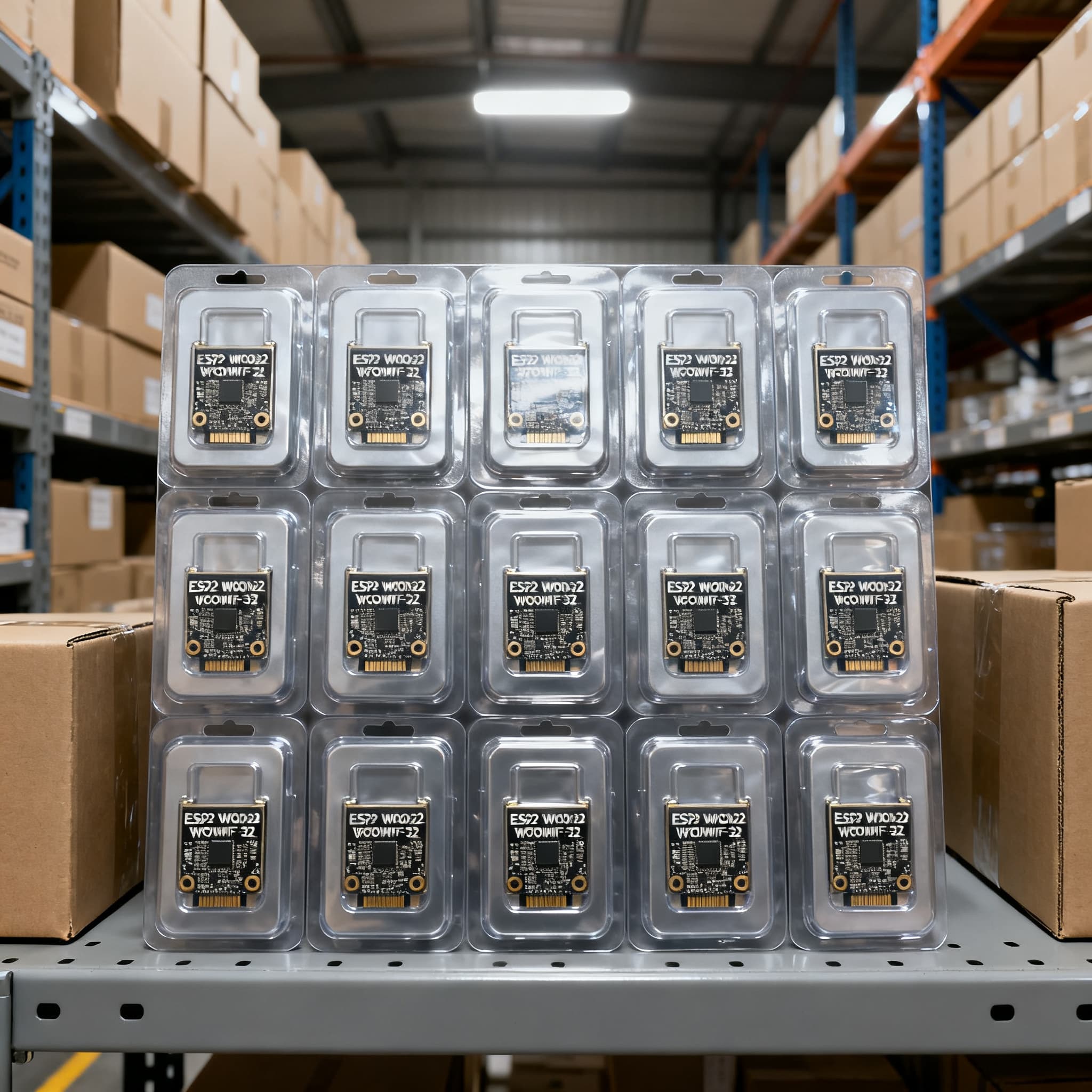
ESP32-WROOM-32 is NRND: What Procurement Teams Should Do
ESP32-WROOM-32 procurement and RFQ considerations for professional buyers. Need this part — or a full BOM? Request a quote on BOMNow.
When Espressif marks a module as Not Recommended for New Designs, it isn't a routine datasheet footnote — it's a signal that procurement teams need to act before the part enters its final phase. The ESP32-WROOM-32 datasheet v3.7 carries that exact NRND banner, and earlier revisions v3.5 and v3.4 confirm the same status. For OEM and EMS teams managing multi-line BOMs, the ESP32-WROOM-32 lifecycle shift demands a structured response — not panic, but deliberate planning across engineering, sourcing, and quality functions.
Why the ESP32-WROOM-32 NRND Flag Is a Procurement Wake-Up Call
The NRND designation on the ESP32-WROOM-32 module didn't appear overnight. Espressif's official documentation page now states plainly that the datasheet "is updated less frequently for products not recommended for new designs," while still distinguishing NRND from End of Life. For procurement managers, this creates a specific set of pressures that cascade across the entire BOM.
The module's longevity commitment — referenced in Espressif's forum discussions — means existing production lines aren't immediately at risk. But NRND status typically signals reduced production allocation, fewer manufacturing runs, and eventual supply tightening. The practical consequence: spot-buying the ESP32-WROOM-32 becomes increasingly unpredictable over a 12–24 month horizon. Procurement teams that treat NRND as a distant concern often find themselves scrambling when authorized distributors show zero stock and open-market pricing swings become the norm.
Key takeaway: The NRND flag is a procurement planning trigger, not a stop-ship order. It shifts the sourcing strategy from "business as usual" to "managed transition," with defined timelines, qualification budgets, and BOM revision gates.
| Driver | Mechanism | Procurement Impact |
|---|---|---|
| NRND datasheet declaration (v3.4–v3.7) | Espressif marks module as Not Recommended for New Designs; datasheet updates become less frequent | New design wins must use successor modules; existing BOMs need migration timeline |
| Reduced production allocation | Manufacturing priority shifts to 32E/32UE families; legacy WROOM-32 runs become smaller and less frequent | Lead times may extend; spot-buy availability narrows; pricing volatility increases |
| Successor chip availability (D0WD-V3) | The ESP32-D0WD-V3 chip underpins the 32E/32UE modules with improved silicon | New MPNs (32E-N4/N8/N16, 32UE) must be qualified; engineering validation required |
| Distributor inventory rotation | Authorized channels prioritize stocking current-generation modules over NRND lines | Fewer franchised sources carry inventory; open-market sourcing becomes more common |
| PCN and EOL notification risk | Espressif may issue Product Change Notifications or eventual EOL notice with defined last-time-buy windows | Teams must register for PCN alerts and budget for last-time-buy quantities |
What makes this transition particularly relevant for procurement teams is the sheer volume of designs that incorporated the ESP32-WROOM-32 over the past several years. The module became a default choice in IoT gateways, industrial sensors, consumer appliances, and building automation — often specified into BOMs without a second source. That single-source dependency, combined with NRND status, creates a concentrated risk that deserves attention at the procurement and engineering leadership level.
NRND vs. EOL: Reading the Lifecycle Signals on the ESP32-WROOM-32
Understanding the distinction between NRND and EOL is essential for making sound procurement decisions. The Espressif documentation page separates these lifecycle stages clearly: NRND means the product is not recommended for new designs but remains available for existing production, while EOL (a separate stage) signals the final phase with defined last-time-buy and end-of-delivery dates. The ESP32-WROOM-32 is currently in the NRND stage — not yet EOL — which gives procurement teams a window for orderly transition.
The module itself is based on the ESP32 chip with integrated Wi-Fi, Bluetooth, and Bluetooth LE, featuring a PCB antenna and 4 MB external SPI flash. The latest datasheet v3.7 provides the definitive ordering information for this exact MPN, and procurement teams should reference it directly when verifying specifications with suppliers.
| Parameter | Value/Range | Unit/Notes |
|---|---|---|
| Module dimensions | 18.0 × 25.5 × 3.1 | mm; PCB antenna integrated |
| SPI flash | 4 MB | External; embedded in module |
| Wi-Fi protocols | 802.11 b/g/n (2.4 GHz) | HT20/HT40 modes |
| Bluetooth | Bluetooth v4.2 BR/EDR + BLE | Shared antenna with Wi-Fi |
| Operating voltage | 2.3–3.6 | V; typical 3.3 V |
| Operating temperature range | –40 to +85 | °C; ambient temperature |
| Antenna type | PCB trace antenna | No external U.FL connector |
| Certification | FCC, CE, IC, TELEC, SRRC, NCC | Module-level; product-level recertification may apply |
| Lifecycle status | NRND (Not Recommended for New Designs) | Per datasheet v3.4–v3.7; not yet EOL |
| Ordering code (exact MPN) | ESP32-WROOM-32 | Legacy MPN; do not use for new designs |
What procurement teams should understand is that NRND modules typically follow a predictable trajectory: reduced production frequencies, consolidation of ordering codes, and eventually a formal EOL notice with a last-time-buy window. The Espressif forum discussion from March 2022 already indicated the NRND status was tied to the introduction of the ESP32-D0WD-V3 chip, meaning the transition has been in progress for several years. Teams that haven't yet started their migration planning are operating on borrowed time.
Note: The specific ordering code for the ESP32-WROOM-32 is the base MPN without flash-density suffixes. The successor modules use different ordering codes entirely — a detail that trips up procurement teams who attempt to order the newer part under the old MPN.
ESP32-WROOM-32E & 32UE: The Successor Modules You Should Evaluate Now
The recommended replacement path for the ESP32-WROOM-32 is the ESP32-WROOM-32E family, which uses the updated ESP32-D0WD-V3 chip. Espressif offers two variants: the ESP32-WROOM-32E with an integrated PCB antenna (matching the legacy module's antenna configuration), and the ESP32-WROOM-32UE with a U.FL connector for external antenna designs. Both are separate MPNs with their own datasheet (v2.1), and neither should be ordered under the legacy ESP32-WROOM-32 code.
The ESP32 forum advice confirms the 32E as the direct replacement, but procurement teams must treat this as a qualification exercise — not a simple MPN swap. The D0WD-V3 chip brings process improvements and silicon revisions that may affect timing, power consumption, and RF behavior in subtle ways. Engineering validation is essential, even when the footprint and pinout are identical.
| Comparison Metric | ESP32-WROOM-32 (NRND) | ESP32-WROOM-32E (Successor) | Selection Criteria & Failure Boundary |
|---|---|---|---|
| Chip inside | ESP32-D0WD (earlier revision) | ESP32-D0WD-V3 (updated silicon) | Verify firmware compatibility; the V3 chip may require updated SDK/libraries |
| Antenna | PCB trace antenna | PCB trace antenna (32E); U.FL connector (32UE) | If your design needs external antenna, select 32UE; otherwise 32E matches legacy |
| Footprint / pinout | 18.0 × 25.5 mm, 38 pins | Same footprint and pinout | Mechanically compatible; electrical differences must be validated |
| Flash density options | 4 MB (fixed) | 4 MB (–N4), 8 MB (–N8), 16 MB (–N16) | Ordering codes are separate MPNs; do not assume 4 MB default |
| Lifecycle status | NRND | Active (current production) | New designs must use 32E/32UE; existing designs should plan migration |
| Certification | FCC, CE, IC, TELEC, SRRC, NCC | Module-level certifications available; product-level may require re-evaluation | Consult regulatory team; RF performance differences may trigger recertification |
The flash density variants deserve special attention from procurement. The legacy ESP32-WROOM-32 came with a fixed 4 MB SPI flash. The successor modules introduce ordering code suffixes: ESP32-WROOM-32E-N4 (4 MB), -N8 (8 MB), and -N16 (16 MB). When transitioning a BOM, procurement teams must confirm with engineering which flash density the firmware requires — ordering the wrong variant can create a production-line failure that's far more expensive than the per-unit cost difference.
Tip: When requesting quotes for the successor modules, always specify the full ordering code including the flash-density suffix. A generic RFQ for "ESP32-WROOM-32E" may return mixed quotes or incorrect variants, creating downstream inspection and rework costs.
Procurement Playbook: Safeguarding Supply While Transitioning Away from ESP32-WROOM-32
Managing the NRND-to-EOL transition for the ESP32-WROOM-32 requires a coordinated approach across procurement, engineering, and quality. The goal isn't to rush the migration — it's to make the transition predictable, cost-controlled, and free of production interruptions. Drawing on the ESP32 series datasheet (v5.3) for chip-level details and the legacy datasheet v2.5 for historical context, procurement teams can build a practical playbook.
The following steps form a structured approach to managing the transition while keeping production lines running:
- Inventory audit and demand forecasting: Map every active BOM that includes the ESP32-WROOM-32. Calculate remaining production volume through the expected migration window (typically 12–18 months). Factor in buffer stock for qualification delays and potential last-time-buy quantities.
- Successor qualification kickoff: Order engineering samples of the ESP32-WROOM-32E (and 32UE if external antenna designs are in your portfolio). Schedule firmware validation, regulatory pre-screening, and production-line compatibility testing. The 32E/32UE datasheet provides the reference specifications for this exercise.
- Last-time-buy evaluation: If your production volumes extend beyond the expected availability window, work with authorized distributors and sourcing partners to negotiate a last-time-buy quantity. This locks in supply for legacy products while the successor qualification completes.
- PCN alert registration: Register for Espressif Product Change Notifications and monitor the official documentation page for updates. An EOL notice will typically include a defined last-time-buy date and final shipment date — missing that window forces a scramble.
- BOM revision and ECO process: Once the successor module is qualified, initiate the engineering change order to revise affected BOMs. Update the MPN to the correct 32E/32UE ordering code with the appropriate flash-density suffix. Ensure ERP and MRP systems reflect the new part number.
- Open-market sourcing controls: If you need to source the ESP32-WROOM-32 from non-authorized channels during the transition, implement stronger traceability requirements: date-code verification, visual inspection for counterfeits, and sample testing. NRND parts in the open market carry higher risk of mismarked or recycled components.
| Action | When to Use | Trade-off |
|---|---|---|
| Last-time-buy of ESP32-WROOM-32 | When production volumes extend beyond expected NRND availability; before EOL notice | Ties up working capital in inventory; requires accurate demand forecasting |
| Immediate BOM cutover to 32E/32UE | When qualification is complete and firmware/regulatory risks are resolved | Engineering effort and certification cost; eliminates NRND supply risk entirely |
| Parallel sourcing (legacy + successor) | During qualification period; when production can't stop but migration is in progress | Higher procurement complexity; two MPNs to manage with different supply dynamics |
| Open-market sourcing with inspection | When authorized channels have no stock; for short-term bridge supply | Higher per-unit cost; requires incoming inspection and traceability documentation |
| Multi-source BOM upload for consolidated quote | When managing full BOM transition across multiple lines simultaneously | Requires accurate BOM with correct MPNs; streamlines quoting and reduces line-item friction |
The historical datasheet v2.4 and the v3.4 NRND version serve as useful reference points for procurement teams that need to verify specifications on existing inventory. When receiving stock from non-authorized sources, comparing the physical module markings against these datasheet references can help identify potential mismatches before they reach the production line.
Note: The ESP32 series datasheet v5.3 covers the broader chip family and includes ordering information that may be relevant when evaluating chip-down designs as an alternative to module sourcing. However, this shifts significant design, certification, and manufacturing responsibility to the OEM — a path that typically only makes sense for very high-volume products.
ESP32-WROOM-32 NRND: Questions Procurement and Engineering Teams Ask
Q: Does the NRND status mean we must immediately stop using the ESP32-WROOM-32 in production?
No. NRND only advises against use in new designs. Existing products can continue to use the ESP32-WROOM-32, but procurement teams should plan a migration to the ESP32-WROOM-32E or 32UE to avoid future supply constraints. The NRND stage is a planning window — not a stop-production order. That said, the longer the migration is delayed, the higher the risk of supply disruption when the module eventually reaches EOL.
Q: Is the ESP32-WROOM-32E a evaluation candidate (verify before adopting) for the ESP32-WROOM-32?
The 32E shares the same footprint and pinout, but uses the newer ESP32-D0WD-V3 chip. While mechanically compatible, procurement teams should not treat it as a perfect drop-in without engineering validation. Verify electrical differences, firmware compatibility with the updated silicon, and any required certification updates. The 32E/32UE datasheet provides the reference specifications. Always test in your specific design before committing to a BOM revision.
Q: What are the exact ordering codes for the successor modules?
The 32E modules are ordered as ESP32-WROOM-32E (with embedded PCB antenna) and ESP32-WROOM-32UE (with U.FL connector for external antenna). Flash density variants append -N4 (4 MB), -N8 (8 MB), or -N16 (16 MB). These are separate MPNs from the ESP32-WROOM-32 and must not be used interchangeably. Do not use the legacy ESP32-WROOM-32 MPN for new orders — it will route to the NRND module, not the successor.
Q: How long will the ESP32-WROOM-32 remain available?
Espressif has a longevity commitment, but NRND modules may see reduced production frequencies and eventual EOL notification. The exact timeline depends on demand, manufacturing allocation, and Espressif's product roadmap. Procurement teams should regularly check the official product lifecycle page and sign up for PCN alerts. When the EOL notice arrives, it will typically include a last-time-buy window — but quantities may be limited, and demand from other legacy-product manufacturers will compete for the remaining supply.
Q: Do we need to recertify our product if we switch to the 32E?
While the modules are pin-compatible, the newer ESP32-D0WD-V3 chip and potential differences in RF performance may require re-evaluation for FCC, CE, IC, and other regulatory certifications. Module-level certifications exist for the 32E, but product-level compliance depends on your specific design, enclosure, and antenna configuration. Consult your regulatory team and leverage the 32E/32UE datasheet and test reports. Budget for recertification as part of the migration cost — it is often the longest-lead item in the transition timeline.
References & Further Reading
- ESP32-WROOM-32 Datasheet v3.7 — Espressif (NRND)
- ESP32-WROOM-32 Documentation Page — Espressif (Lifecycle Stages)
- ESP32-WROOM-32E & 32UE Datasheet v2.1 — Espressif (Successor Modules)
- Espressif Modules Product Page
- ESP32 Series Datasheet v5.3 — Espressif
- ESP32 Forum: Module Selection and Replacement Discussion
- ESP32-WROOM-32 Datasheet v3.5 — Mouser (NRND)
- ESP32-WROOM-32 Datasheet v3.4 — NRND
The NRND flag on the ESP32-WROOM-32 is a procurement decision point, not a crisis. For teams that act now — qualifying the 32E/32UE, forecasting demand, budgeting for last-time-buys, and registering for PCN alerts — the transition is manageable. For teams that delay, the risk compounds: tighter supply, higher open-market pricing, and compressed qualification timelines when the EOL notice eventually arrives. Whether you're managing a single BOM line or a multi-board product family with dozens of instances of this module, the procurement strategy is the same: plan the transition while supply is still available, validate the successor before you're forced to, and keep your BOM current with the correct MPNs.
If you're sourcing the ESP32-WROOM-32 for legacy production or evaluating the ESP32-WROOM-32E for your next build, Upload Your BOM for a consolidated quote across all your lines, or Request a Quote for a single MPN with traceability and inspection requirements included.