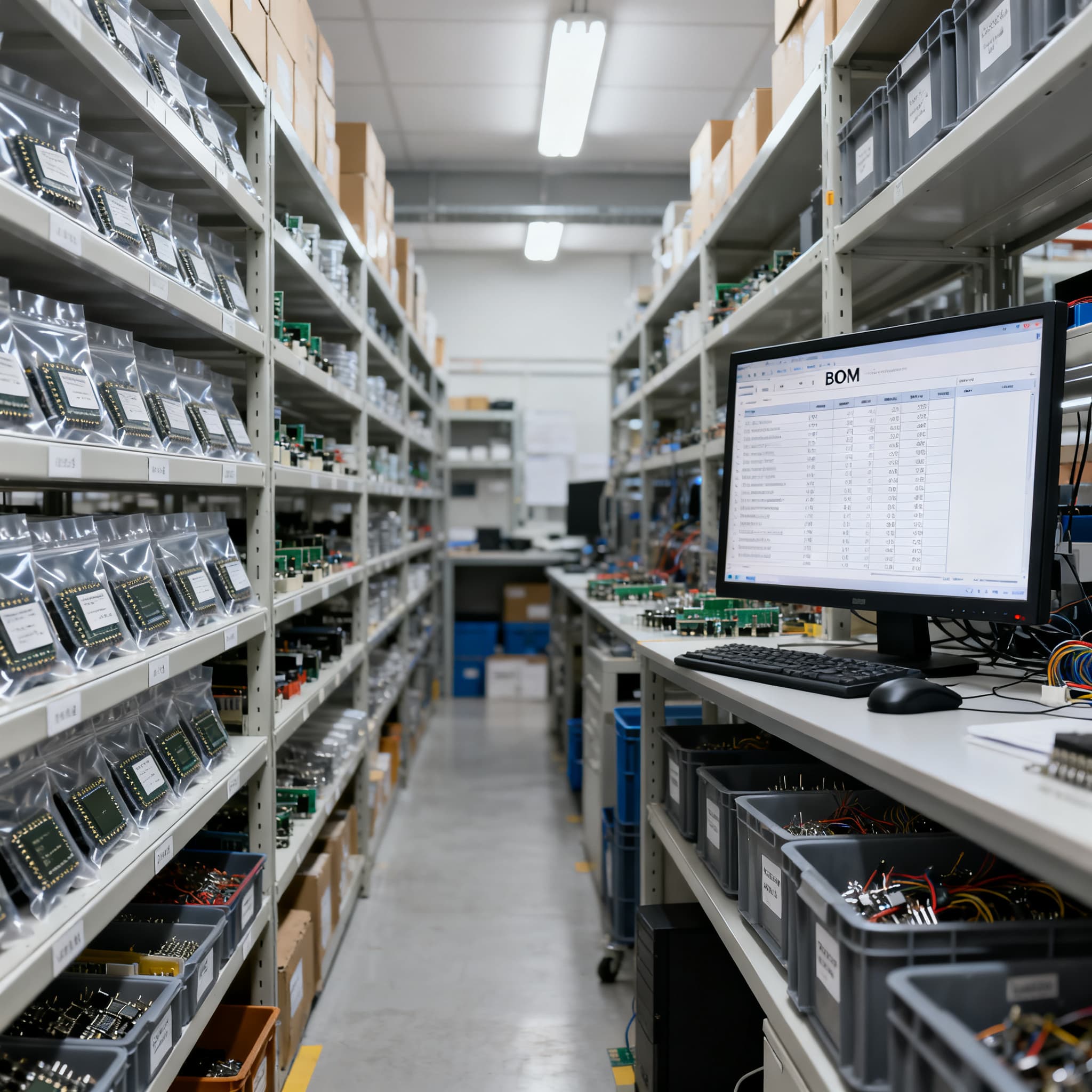
Hard-to-Find Electronic Components BOM Recovery: Procurement Program
How procurement teams handle shortage, EOL, and hard-to-find lines inside a multi-line BOM without inventing market claims.
Hard-to-Find Component BOM Recovery: A Procurement Program That Works
When BOMs Freeze: The Real Cost of Unavailable Components and the Case for a Recovery Program
Every procurement manager has felt the dread of a frozen bill of materials. The assembly line is scheduled, the test fixtures are ready, and then one line item—often a humble power management IC or a specific connector—shows zero stock across all authorized channels. Production doesn’t slow down; it stops. And when multiple lines turn red simultaneously, the financial impact shifts from a nuisance to a genuine crisis.
In today’s multi-line BOMs, hard-to-find parts are rarely a single-MPN problem. A sourcing team may need to confirm manufacturer, package, quantity, lead time, and available alternatives across dozens of items before issuing a purchase decision (EASYIEE Sourcing Guide). The parts that stall the process are not always obsolete—many are still active but limited by shortage, allocation, or regional constraints (EASYIEE Obsolete Supplier). Without a structured recovery program, companies end up paying inflated spot-market prices, absorbing last-time-buy premiums, or—worse—redesigning a board under duress.
The case for a BOM recovery program is built on hard economics: a missing $2 component can halt a $500,000 production run. The program transforms chaotic firefighting into a repeatable process that triages every line, identifies genuine dead-ends versus temporary gaps, and gives OEMs and EMS partners a clear path back to continuity.
Inside a BOM Recovery Program: Triage, Verification, and the Data That Drives Sourcing
At its core, a BOM recovery program treats the entire bill of materials as a datasheet of all components you need to buy—capturing quantity, reference, description, part number, and manufacturer (ICHOME Purchase Guide). The difference between a standard BOM and a recovery-ready BOM is the enrichment layer. Every line must be expanded with lifecycle status, verified alternate candidates, and parametric search parameters before a sourcing decision is made.
The workflow begins with triage. Each line is classified into one of three buckets: available (stock at authorized distributors with acceptable lead time), constrained (limited allocation, extended lead times, or regional stock only), and critical (EOL, NRND, or zero stock with no forecasted restock). This classification drives the action plan—standard procurement for available lines, deeper negotiation and buffer-stock planning for constrained lines, and a full recovery strategy for critical parts.
The table below maps the standard BOM fields to the expanded data set required when a line enters the recovery pipeline. Without this enrichment, a buyer is simply guessing.
| Standard BOM Field | Required Recovery Enrichment | Purpose |
|---|---|---|
| Manufacturer Part Number (MPN) | Full suffix, packing option, and date code range | Prevents mismatch; ensures drop-in compatibility |
| Manufacturer | Lifecycle status (Active, NRND, EOL) and PCN/EOL notice date | Triggers last-time-buy or redesign decisions |
| Description | Parametric essentials: operating voltage, package, pinout, key electrical specs | Enables alternate search via parametric tools |
| Quantity | Annual usage, minimum order quantity, and buffer requirements | Informs lot-buy and negotiation strategies |
| Reference Designator | Functional criticality (e.g., power path, high-speed data, simple pull-up) | Prioritizes qualification effort for critical functions |
| Lead Time (from quote) | Factory lead time vs. broker lead time; last-time-buy deadline | Sets procurement trigger dates |
With this enriched BOM, sourcing teams can confirm manufacturer, package, quantity, lead time, and alternatives before issuing a purchase decision (EASYIEE Sourcing Guide). The recovery program is no longer a reactive scramble; it becomes a data-driven operation that identifies the most cost-effective path for each line item.
Channel Choices: Authorized Distribution, Independent Brokers, and OEM Excess Side by Side
When a line goes critical, the first question is where to source. The answer isn’t always the same channel, and the wrong choice can introduce counterfeit risk, hidden costs, or unacceptable lead times. The table below compares the three primary sourcing channels for hard-to-find components, along with a hybrid approach that leverages a procurement partner specializing in BOM recovery.
| Channel | Strengths | Risks/Caveats | Best Use Case |
|---|---|---|---|
| Authorized Distributors | Full traceability, manufacturer warranty, consistent quality | Limited allocation during shortages; often no stock for EOL parts | Active, allocated parts with moderate lead times |
| Independent Brokers | Access to gray market, excess, and hard-to-find inventories | Higher counterfeit risk; requires chain-of-custody verification | EOL parts, short-notice urgent buys |
| OEM/Factory Excess | Genuine parts, often below market price | Unpredictable availability; no ongoing supply guarantee | One-time bridge buys, low-volume production |
| Procurement Partner (e.g., BOMNow) | Consolidated BOM-level sourcing, multi-channel access, recovery triage | Requires trust in partner’s qualification process | Multi-line BOMs with mixed availability |
For parametric search and alternate identification, the toolkit matters. Using a distributor’s parametric catalog, such as TME’s, lets you filter by operating voltage, package, pinout, and key electrical specs to locate functional matches (Ultra Librarian). Meanwhile, aggregator tools like Octopart’s BOM Tool help compare supplier pricing and avoid obsolescence risks by surfacing alternate parts and stock depth across multiple sources (Altium Strategies). The key is to never rely on a single channel’s promise of “in stock” without cross-verification, especially when the part is flagged as hard-to-find.
Recovery in Practice: How to Vet Alternative Parts, Avoid Counterfeits, and Manage Lead‑Time Risk
Turning a recovery program into a reliable sourcing engine demands strict qualification steps—especially when the original part is no longer available through authorized channels. The following actionable checklist serves as a practical gate for procurement leads:
- Verify the complete suffix and packing option. A seemingly minor change—such as AD9695BCPZ-1300 vs. AD9695BCPZRL7-1300—can mean a different packing quantity or tape-and-reel configuration that disrupts your EMS setup. Always confirm the ordering code against the manufacturer’s latest datasheet and your BOM requirement before accepting a substitute (EASYIEE Obsolete Supplier).
- Cross-check specs, circuits, and equivalents. Use platforms like Findchips to verify in‑stock status and compare parametric data, pinout, and circuit equivalents against the original part (Findchips Blog). This avoids the “paper match” that fails during qualification.
- Implement a gated qualification process for any component sourced outside authorized channels. Require a full chain of custody, visual inspection, and for high-value ICs, decapsulation or X-ray testing. Document the supplier’s adherence to industry counterfeit mitigation standards (e.g., IDEA‑STD‑1010, ERAI membership).
- Align EMS partners and plan buffer stock on long‑lead items. A recovery program fails if the factory floor rejects a substitute at the last minute. Share your enriched BOM with the EMS team early, and negotiate a shared risk buffer for the most constrained lines.
The mitigation actions below summarize when to apply each tactic and the trade-offs involved. No single approach works for all critical lines; the recovery program’s value lies in choosing the right combination.
| Action | When to Use | Trade-off / Consideration |
|---|---|---|
| Parametric alternate qualification | Original part is EOL or NRND, but functional equivalents exist | Requires engineering validation; may not match timing or power-on behavior exactly |
| Last-time buy | EOL notice issued, and redesign is not feasible in the short term | Ties up capital; risk of obsolescence if demand drops |
| Independent broker sourcing | Zero stock at authorized channels and no acceptable alternate | Higher counterfeit risk; demands rigorous incoming inspection |
| Buffer stock (safety stock) | Allocated or constrained parts with extended lead times | Increases inventory carrying cost; requires accurate forecast |
| EMS risk-sharing agreement | Multiple BOMs share the same constrained part | Complex negotiation; must define allocation rules clearly |
When a substitute is proposed, never assume it’s a drop-in. Extract the critical parameters from the original datasheet—operating voltage range, package type, pinout, and key electrical limits—and run a parametric search against the candidate. Verify stock depth and lead time before committing, and always loop in the engineering team to confirm qualification requirements. The recovery program succeeds when procurement and engineering speak the same parametric language.
Hard-to-Find BOM Recovery: Questions Procurement Leaders Ask
Q: How do I differentiate between a truly obsolete part and a temporary shortage?
Check the manufacturer’s official lifecycle status and product change notifications (PCN). If the part is listed as ‘Not Recommended for New Design’ (NRND) or an EOL notice has been issued with a last-time-buy date, it is obsolete. A temporary shortage shows no EOL notice but extended lead times and limited allocation; cross-reference with broadline distributors and factory lead-time forecasts to confirm. If the factory is still accepting orders, even with long lead times, the part is likely in a tight supply window rather than permanent end-of-life.
Q: What’s the first step when a BOM has 50% of lines with zero stock at authorized distributors?
Immediately triage the BOM by enriching each line with lifecycle status, alternate part numbers, and parametric requirements. Identify which parts have form‑fit‑function alternates that can be sourced in‑stock, and which require a last‑time buy or redesign. This triage drives the recovery program’s priorities and prevents panic buying that inflates costs on parts that might have simple second-source options.
Q: Can I use independent brokers without increasing counterfeit risk, and what verification steps are required?
Yes, but only with rigorous qualification. Require a full chain of custody, insist on visual inspection and decapsulation testing for high‑value ICs, and verify the broker’s adherence to industry standards such as ERAI or IDEA (ERAI). Include incoming inspection protocols that match the original part’s date code, packaging, and marking specifications. For sensitive components, consider third-party test labs to perform electrical verification before accepting the shipment.
Q: How do I evaluate a drop-in alternative when the original part is EOL and the datasheet doesn’t match exactly?
Extract the critical parameters from the original datasheet: operating voltage range, package type, pinout, and key electrical specs. Use a parametric search engine (e.g., TME, Octopart) to find functional matches. Then verify the candidate’s stock depth, lead time, and any qualification differences with your engineering team. The steps are:
- Export the original part’s parametric values from a trusted catalog.
- Filter for candidates that match supply voltage, output current, switching frequency, and package footprint.
- Check electrical characteristics like dropout voltage or ripple rejection that could affect circuit performance.
- Confirm the candidate is not itself NRND or at risk of obsolescence.
- Procure a small sample lot for bench validation before committing to a production order.
Q: How do I structure a recovery program to avoid production line stoppages when multiple BOMs are affected?
Create a centralized BOM recovery dashboard that tracks all affected lines across BOMs, assigns ownership, and sets trigger dates for each action (e.g., alternate qualification, broker negotiation, last‑time buy). Align with EMS partners to share risk buffers and agree on a priority‑based allocation of scarce components. Schedule regular cross‑functional reviews to adapt to changing lead times, and keep a single source of truth for part status—this prevents duplicate buying and reduces the risk of a single constrained part shutting down multiple products simultaneously.
References & Further Reading
- Electronic Components Sourcing Guide for OEM BOM Procurement – EASYIEE
- Obsolete Electronic Components Supplier for OEM BOM Sourcing – EASYIEE
- Guide for Electronic Components Purchase – ICHOME
- Findchips: Specs, Circuits, Equivalents & In‑Stock Parts – Ersa Electronics
- Strategies for Sourcing Hard To Find Electronic Components – Altium
- Sourcing Obsolete and Hard-to-Find ICs – Ultra Librarian
- ERAI – Electronics Reseller Association International
A well-executed BOM recovery program doesn’t just fix a single shortage—it builds the muscle memory to handle the next one faster. When you stop treating hard-to-find components as one-off emergencies and start managing them as a structured workflow, you protect your production lines and your margins. Upload your BOM for a consolidated quote, or request a quote for a single MPN to see how a recovery-driven approach can stabilize your supply chain.