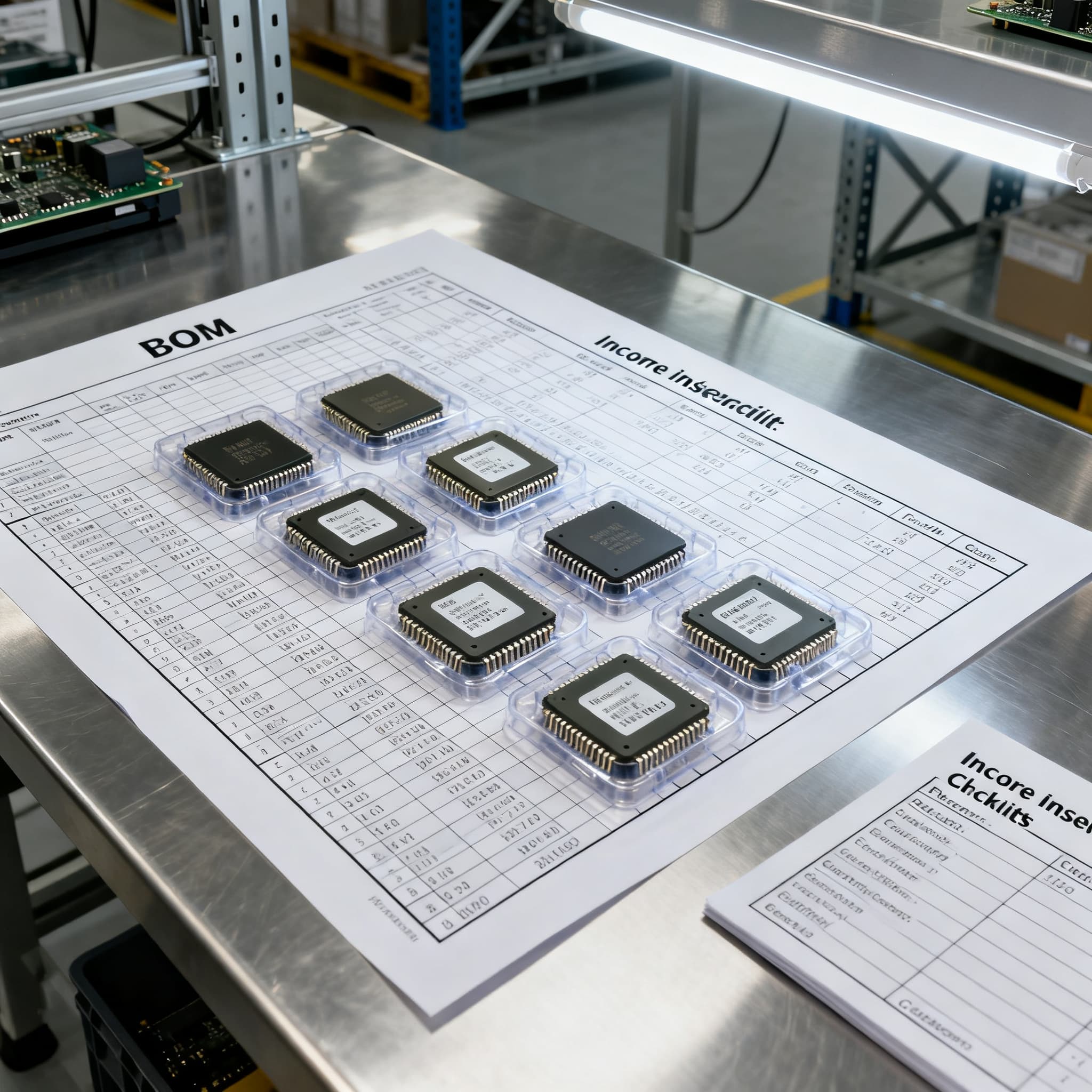
Incoming inspection checklist for electronic components
Incoming inspection, date codes, and traceability practices for multi-line electronic BOM buys.
Why Your Incoming Inspection Checklist Is a Supply Chain Imperative in 2026
Procurement teams entering 2026 don’t need another reminder that the component supply chain remains fragile. What they need is a practical, auditable first line of defense — and that starts at the receiving dock. Unauthorized channels are funneling counterfeit, refurbished, and mixed‑date‑code parts into production lines, and the consequences are no longer hypothetical. IC Online’s 2026 shortage update explicitly warns that “hard‑to‑find components attract unauthorized supply; without inspection and traceability, buyers may receive refurbished, remarked, or mixed‑date‑code parts that fail in the field.” Meanwhile, the U.S. Consumer Product Safety Commission’s electronics recalls page catalogues device failures where substandard components — some of them counterfeit — escaped detection and triggered costly field returns.
An incoming inspection checklist is not a bureaucratic checkbox. It is a structured risk‑mitigation tool that can stop a single reel of remarked STM32F407VGT6 microcontrollers from populating an entire production batch. When your team handles multi‑line BOMs with semiconductors, passives, and electro‑mechanical parts sourced from different tiers, the checklist becomes the only consistent quality gate. This guide walks you through the anatomy of that checklist, shows how to adapt it for standard versus high‑risk substitutes, and gives you component‑specific additions that reflect real procurement experience — not generic auditor language.
The Anatomy of an Electronic Component Incoming Inspection Checklist
A well‑built checklist groups inspections into categories that mirror the physical flow of a component from package to board. You are not just verifying that a box looks acceptable; you are systematically confirming that what you bought is what you received, and that it hasn’t been tampered with. NTChip’s practical component inspection checklist emphasizes visual, marking, and packaging checks, while the ESCC external visual inspection criteria (specifically ESCC 20500) and the SAE AS5553 authenticity verification checklist provide the rigor needed for high‑reliability environments. The table below distills these into a procurement‑ready reference.
| Inspection Category | Key Checks | Common Defects | Reference Standard |
|---|---|---|---|
| Visual (external) | Body cracks, chip‑outs, corrosion, bent/coplanarity issues, lead finish uniformity | Mechanical damage, re‑plated leads, blacktopping residue | ESCC 20500, NTChip checklist |
| Dimensional | Package outline, lead pitch, terminal length, stand‑off height (sample audit) | Wrong package variant, out‑of‑tolerance dimensions that affect pad fit | ESCC 20500, manufacturer datasheet |
| Marking legibility & permanency | MPN, date code, lot code, country of origin; acetone/rubbing‑alcohol rub test | Inconsistent font, ghost markings, missing date code, mismatched marking vs. documentation | SAE AS5553, NTChip checklist |
| Packaging integrity | Moisture‑barrier bag (MSL) intact, desiccant present, humidity indicator card, ESD packaging, reel/tray condition | Punctured bags, missing desiccant, non‑ESD packaging for ESD‑sensitive devices, re‑used moisture‑sensitive packaging | NTChip checklist, ESCC 20600 |
| Documentation review | Certificate of Conformance, test reports, statement of origin, date code traceability, packing slip vs. BOM line items | Missing or mismatched CoC, date code not matching physical parts, altered documentation | SAE AS5553, NTChip checklist |
| Electrical (sampling) | Curve‑trace, capacitance, or basic functional test on a sample basis; full parametric testing only when risk warrants | Open/short, out‑of‑spec leakage, functional failure, wrong speed grade | SAE AS5553, internal procurement thresholds |
Each category feeds into a pass/fail decision that must be documented. When a STM32F407VGT6 lot shows marking permanency failure or a date code that doesn’t align with the CoC, the entire lot gets quarantined — no exceptions. The checklist turns ambiguous supplier behavior into a measurable, repeatable process that protects your assembly line and your customers.
Standard Lots vs. High‑Risk Substitutes: How to Adapt Your Incoming Inspection Checklist
Procurement teams know that not all incoming lots are equal. A reel of Yageo chip resistors from a franchised distributor carries a different risk profile than a batch of microcontrollers sourced from an independent broker to bridge a gap. BestPCBs’ analysis of alternative component risks warns that “alternative electronic components are only safe after technical review” — and that incomplete substitution reviews often lead to late‑stage PCBA failures. The pre‑shipment inspection guide from The Inspection Company documents how factories routinely swap high‑quality capacitors for cheaper, unbranded alternatives to recover margins, a practice that directly causes premature product failure. When you’re forced to consider substitute parts, your incoming inspection checklist must expand beyond the basics.
The table below contrasts the inspection scope for standard, trusted‑supplier lots with the heightened requirements for high‑risk substitutes. Use it to decide when to escalate a line item from a simple visual check to a full authenticity verification.
| Inspection Aspect | Standard Lot (Trusted Source) | High‑Risk Substitute (Alternative/Open Market) | Additional Checks & Rationale |
|---|---|---|---|
| Visual & marking | Standard visual for damage, marking consistency | Acetone rub test, high‑magnification inspection for laser‑etch inconsistencies, blacktop edges | Counterfeiters often sand and re‑mark parts; ESCC 20500 and SAE AS5553 require marking permanency. One failed rub test quarantines the lot. |
| Dimensional & packaging | Sample dimensional check, packaging integrity per MSL | Full dimensional audit on a larger sample, X‑ray for internal lead frame anomalies, check for non‑original packaging (re‑sealed bags, missing vendor labels) | Substitute parts may use different package houses or refurbished devices. X‑ray reveals missing bond wires or die size mismatches. |
| Authenticity verification | Verify CoC and date code traceability | Decapsulation, die‑marking correlation, SEM/EDS if suspect materials, pure tin detection (ESCC 25500), full traceability audit | BestPCBs warns that incomplete substitution reviews lead to field failures. ESCC guidelines mandate pure tin avoidance for high‑reliability. |
| Electrical testing | Sample curve‑trace or functional test | Full parametric testing at temperature, burn‑in if required, comparison with golden samples | Refurbished parts may show degraded performance. IC Online’s counterfeit risk alerts stress that electrical anomalies often appear only under load. |
| Documentation & traceability | CoC, packing slip, delivery note | Full chain of custody, supplier audit reports, third‑party test reports, validated date‑code consistency across the lot | Mixed‑date‑code lots are a red flag. Escalate if documentation doesn’t match physical parts. |
Adapting your checklist in this way doesn’t mean you reject all open‑market parts. It means you apply a risk‑appropriate inspection effort. When you work with a sourcing partner that can consolidate multi‑line BOMs, you can flag which lines are candidates for enhanced inspection up front, saving time at the dock.
What to Add to Your Checklist for Semiconductors, Passives, and High‑Reliability Parts
Generic checklists treat all components identically, but procurement teams handling mixed BOMs know that a 0402 capacitor and a BGA FPGA have very different failure modes. The following additions are drawn from industry practice and standards such as the API guide for quality surveillance of electrical equipment, which emphasizes source inspection and material verification, and the SAE AS5553 framework for counterfeit detection.
| Component Type | Additional Checklist Items | Rationale | Reference |
|---|---|---|---|
| Semiconductors (ICs, MCUs, FPGAs) | Date code verification (all parts in sample), marking permanency test, electrical curve‑trace on sample, X‑ray for bond wire integrity, verify firmware version if applicable | Remarks and refurbished parts are common in allocation cycles. Date code mismatches can indicate counterfeits. | SAE AS5553, IC Online alerts |
| Passives (MLCCs, resistors, inductors) | Termination integrity (visual and solderability test), capacitance/resistance measurement on sample, check for micro‑cracks (Dye & Pry if risk warrants), verify voltage rating marking | Termination damage or sub‑par materials can cause field failures under mechanical or thermal stress. | NTChip checklist, ESCC 20500 |
| High‑reliability / Mil‑Aero parts | Pure tin detection (ESCC 25500 methodology), enhanced external visual per ESCC 20500, source inspection per API guide, full traceability to wafer lot, burn‑in records | Tin whiskers can short leads; military and space applications prohibit pure tin finishes. | ESCC 25500, API guide, SAE AS5553 |
Beyond these technical additions, procurement teams are increasingly using digital IQC tools to reduce human error. iFactory’s AI‑powered receiving inspection platform digitizes checklist flows, captures images, and enforces sign‑off steps — turning a paper‑based process into a searchable audit trail. When you’re inspecting a pallet of mixed passives from a single BOM upload, digital tools can automatically flag the lines that need a higher inspection level based on supplier risk scores and component criticality.
Tip: For a multi‑line BOM, add these five actions to your incoming inspection process:
- Tag each line with a risk level (standard, high‑risk substitute, high‑reliability) at the RFQ stage.
- Require digital photos of date codes and markings for every high‑risk substitute before acceptance.
- Build a small library of golden samples for critical semiconductors to speed up electrical comparisons.
- Automate the CoC vs. physical marking check — many digital IQC platforms can cross‑reference supplier data.
- Escalate any lot that fails marking permanency or shows mixed date codes to a third‑party lab for X‑ray/decapsulation.
Incoming Inspection FAQ for Procurement Teams
Q: What documentation should we require from the supplier before inspecting components?
A: Request a Certificate of Conformance, a statement of origin, and any relevant test reports. NTChip’s checklist and SAE AS5553 emphasize cross‑checking the paper trail against physical parts. Any discrepancy — a date code that doesn’t match the CoC, for example — triggers a deeper inspection and quarantine.
Q: How can we detect counterfeit components without a full test lab?
A: Start with high‑magnification visual checks for inconsistent markings, surface texture, and lead finish. Use acetone or rubbing alcohol to test marking permanency; genuine laser‑etched markings resist solvent, while remarked parts often wipe away. IC Online warns that even these simple tests catch many remarked parts. Quarantine any suspect lot immediately.
Q: Should we accept mixed‑date‑code parts?
A: Generally avoid mixed‑date‑code lots, as they can hide refurbished or failed components. IC Online notes that mixed date codes are a red flag for unauthorized supply. If you must accept them due to allocation, add extra electrical testing and traceability checks to your checklist, and treat the lot as high‑risk.
Q: What is the recommended AQL for electronic components?
A: AQL 0.65 or 0.4 for critical defects is common, but the exact level depends on product risk. The pre‑shipment inspection guide from The Inspection Company explains how to select a statistically valid sampling plan based on lot size and acceptable quality level, and the same principles apply to incoming inspection.
Q: When should we escalate to third‑party failure analysis?
A: Escalate when you find multiple visual anomalies, unexpected electrical behavior, or evidence of remarking. Third‑party labs can perform X‑ray, decapsulation, and SEM/EDS to confirm authenticity, as recommended by SAE AS5553 and the ESCC guidelines. Acting early prevents a single suspect lot from infecting multiple production runs.
Q: How can digital tools improve incoming inspection efficiency?
A: Digital IQC platforms like iFactory’s AI‑powered receiving inspection automate checklist flows, capture images, and enforce sign‑off steps, reducing human error. They provide a searchable audit trail that simplifies traceability and supplier scorecards — a benefit when you’re managing hundreds of line items across multiple BOMs.
Whether you’re inspecting a single high‑risk MPN or a full multi‑line BOM, a structured incoming inspection checklist is the most cost‑effective quality gate you can deploy. Every hour spent refining that checklist pays back in avoided field failures, production stoppages, and damaged supplier relationships. When you’re ready to streamline sourcing and inspection for your entire BOM, Upload Your BOM for a consolidated quote, or Request a Quote for a single MPN. We’ll help you identify the lines that need extra scrutiny before they ever reach your dock.
References & Further Reading
- 2026 Electronic Component Shortage Update for Buyers: How to Secure Your Supply Chain – IC Online
- Electronics Recalls – U.S. Consumer Product Safety Commission
- Electronic Components Inspection Checklist for Incoming QC – NTChip
- GUIDELINES FOR INCOMING INSPECTION OF EEE COMPONENTS (ESCC 20500, 20600, 25500) – ESCIES
- Free SAE AS5553 Incoming Inspection and Testing Checklist – Audit-Now
- Alternative Electronic Components for Safer PCBA Builds – BestPCBs
- Electronics Pre-Shipment Inspection: 2026 Importer Guide – The Inspection Company
- Guide for Source Inspection and Quality Surveillance of Electrical Equipment – API
- Incoming Quality Inspection (IQC) Checklist for Manufacturers – iFactory