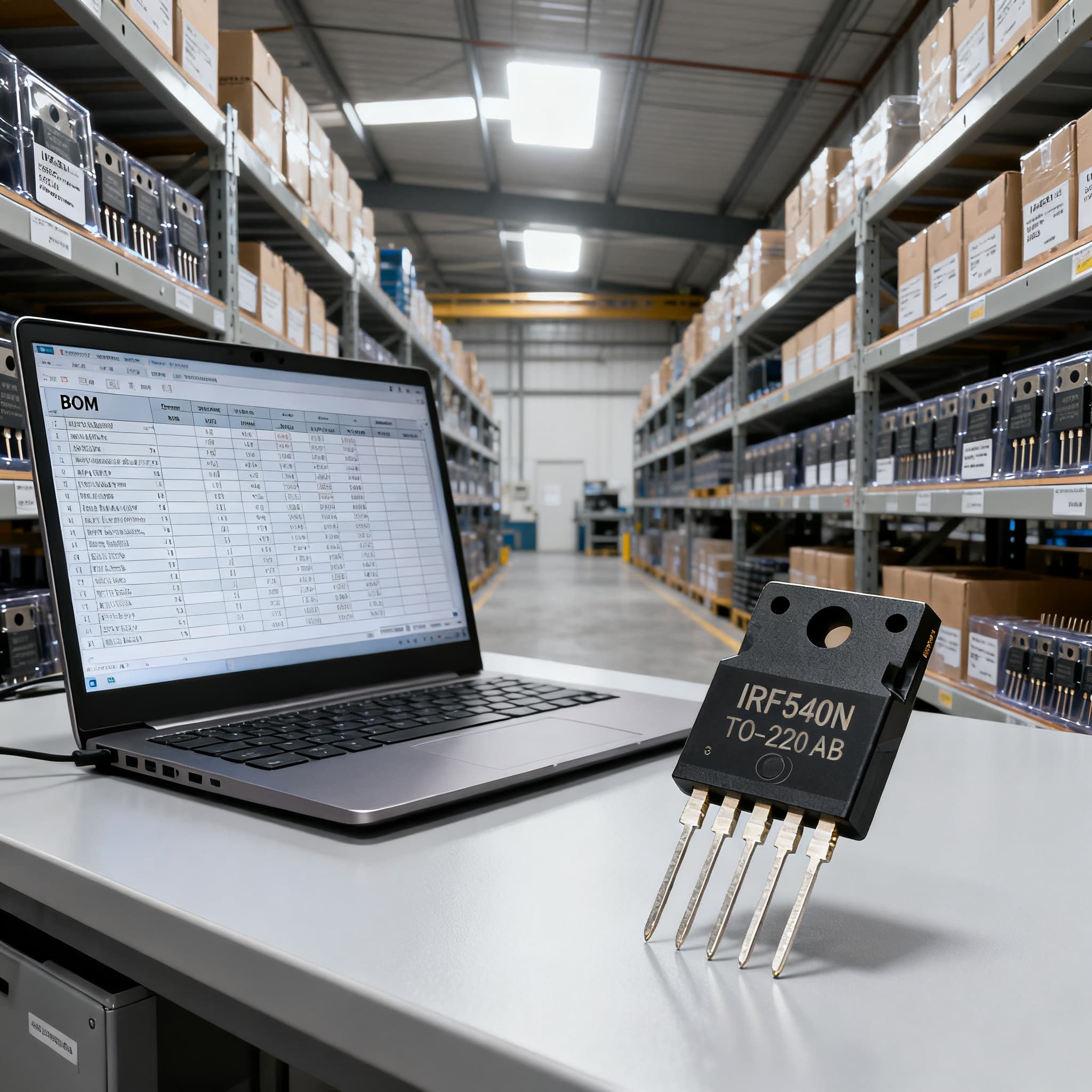
IRF540N Procurement Guide: Pinout and Spec Checks for RFQ
IRF540N procurement checklist: datasheet specs and pinout fields to verify on RFQ, plus BOM upload path on BOMNow.
Why IRF540N Procurement Demands Urgent Attention Now
The IRF540N sits in a precarious position that every procurement manager needs to understand before placing another order. Major manufacturers — including Texas Instruments — have flagged this N-channel power MOSFET as Not Recommended for New Designs (NRND). That designation is not a gentle suggestion; it is the first formal signal on a path that ends with an EOL notice, final-time-buy windows, and permanently closed production lines (FPGACenter NRND/EOL explainer).
When a part enters NRND status, several things happen simultaneously. Distributor shelf stock begins thinning as manufacturers reduce wafer starts. Lead times stretch. Minimum-order quantities (MOQs) climb — sometimes to full wafer-lot levels — because foundries will no longer run partial batches for declining SKUs. The standard lifecycle progression moves from "growth" to "mature" to "NRND" and eventually to formal obsolescence, with each stage carrying progressively worse commercial terms (TT Electronics lifecycle guide).
For the IRF540N specifically, the situation is compounded by its multi-manufacturer history. Originally produced by International Rectifier (later acquired by Infineon), the part also appeared under Intersil and Fairchild markings. Some of those legacy supply lines are already cold. If distributor stock is depleted, direct foundry orders can exceed 52 weeks, often with MOQs that make no economic sense for moderate-volume production (Kynix IRF540N alert). Procurement teams that treat the IRF540N as a commodity item — assuming someone will always have inventory — are exposing their BOMs to significant disruption risk.
Tip: The NRND designation window can last anywhere from one to many years, but final shipment dates and order cutoffs can appear with little advance warning in a formal PCN (Product Change Notification). If your design still carries this part, start evaluating alternatives now — before a last-time-buy panic forces rushed engineering decisions (Industrial Monitor Direct NRND guide).
| Driver | Mechanism | Procurement Impact |
|---|---|---|
| NRND Lifecycle Status | Manufacturers (Infineon, Fairchild, Intersil, legacy IR) formally mark part as not recommended for new designs; wafer starts decline | Distributor inventory shrinks; lead times extend; MOQs rise; final order cutoffs may appear with minimal notice |
| Multi-Manufacturer Legacy Supply Fragmentation | Part historically sourced from Infineon, International Rectifier, Intersil, Fairchild; some lines already cold | Incoming stock may carry different date codes and traceability chains; verifying genuine manufacturer source becomes critical |
| Foundry-Level MOQ Escalation | When distributor stock is zero, foundry orders may require full wafer lots for a legacy TO-220 FET | Small and medium OEM volumes become uneconomical; procurement must either over-buy or qualify alternatives |
| TO-220 Package Market Dynamics | TO-220 remains widely used in power supplies, motor drives, and industrial controls; demand persists even as supply contracts | Spot-market pricing becomes volatile; counterfeit and remarked parts proliferate when genuine stock is scarce |
| PCN and YTEOL Opacity from Non-Authorized Channels | Open-market distributors may not proactively share PCN history or Year-to-End-of-Life estimates | Buyers risk placing orders for inventory that becomes obsolete during transit or within a single production cycle |
These converging pressures mean the IRF540N cannot be sourced on autopilot. Every RFQ must now incorporate lifecycle verification, manufacturer traceability, and explicit contractual protections — topics we will address in detail throughout this guide.
Decoding the IRF540N Datasheet for Accurate RFQ Specs
When you issue an RFQ for the IRF540N, the supplier needs more than a part number. You need to confirm that the quoted parts match the electrical and mechanical specifications your design depends on. The IRF540N is an N-channel enhancement-mode power MOSFET in a TO-220 package, but subtle variations across manufacturer datasheets can mean the difference between a working bill of materials and a batch of parts that underperform thermally or fail in-circuit.
The latest unified datasheet comes from Infineon (which acquired International Rectifier), with revision 2.1 dated July 2024 covering the IRF540NPbF variant (Infineon datasheet). Legacy datasheets from Fairchild (2002, Rev. C) and Intersil also exist, and the specifications are not always identical — particularly around RDS(on) maximum ratings and thermal resistance values (Fairchild datasheet, Intersil datasheet).
| Parameter | Infineon (IRF540NPbF) | Fairchild (IRF540N) | Intersil (IRF540N) | International Rectifier (IRF540N) |
|---|---|---|---|---|
| VDSS (Drain-Source Voltage) | 100 V | 100 V | 100 V | 100 V |
| ID (Continuous Drain Current @ 25°C) | 33 A | 33 A | 33 A | 33 A |
| RDS(on) Max @ VGS=10 V | 44 mΩ | 44 mΩ | 40 mΩ | 44 mΩ |
| VGS(th) (Gate Threshold Voltage) | 2.0–4.0 V | 2.0–4.0 V | 2.0–4.0 V | 2.0–4.0 V |
| Qg (Total Gate Charge) | 71 nC typ | 71 nC typ | 71 nC typ | 71 nC typ |
| RθJC (Thermal Resistance, Junction-to-Case) | 1.15°C/W | 1.0°C/W | 1.0°C/W | 1.0°C/W |
| Package | TO-220AB | TO-220 | TO-220AB | TO-220AB |
| Pb-Free / RoHS | PbF suffix (Pb-Free) | Pb-Free available | Varies | Varies |
The variations are small but meaningful. Intersil's datasheet lists an RDS(on) maximum of 40 mΩ versus the industry-standard 44 mΩ — a 10% difference that could affect power dissipation calculations in high-current designs. Thermal resistance values also shift slightly between manufacturers, which matters when your thermal management budget is tight. Always specify which manufacturer's datasheet governs your acceptance criteria in the RFQ, and include the exact MPN suffix (e.g., IRF540NPbF vs. IRF540N) to eliminate ambiguity.
The TO-220 pinout is consistent across all manufacturers: Pin 1 = Gate, Pin 2 = Drain, Pin 3 = Source, with the metal tab electrically connected to the drain terminal. This standardization is a double-edged sword — it makes pin-to-pin substitution seem trivial, but the electrical differences listed above mean a direct swap without parameter-level verification is risky (International Rectifier datasheet).
IRF540N Cross-Reference: Alternatives Worth Evaluating
When the IRF540N is NRND and supply is tightening, procurement teams need a shortlist of viable alternatives that balance electrical compatibility, availability, and lifecycle stability. Cross-reference databases from AllTransistors, El-Component, and Hotenda collectively identify over 30 potential substitutes — but not all are created equal (AllTransistors IRF540N, El-Component substitution list, Hotenda cross reference).
The candidate pool breaks into three categories: pin-to-pin replacements that share the TO-220 footprint and gate/drain/source pinout; functional equivalents that match key electrical ratings but may differ in package or dynamic behavior; and near-family alternatives like the older IRF540 (non-N), which has a lower current rating of 28 A and higher RDS(on) (AllTransistors IRF540). The table below focuses on parts most likely to still be in active production.
| Candidate MPN | Type | VDSS / ID / RDS(on) | Lifecycle Note | Procurement Caution |
|---|---|---|---|---|
| IRFB4110 / IRFB4110G | Pin-to-Pin | 100 V / 180 A / 4.5 mΩ | Active (Infineon) | Far lower RDS(on) means different switching dynamics; verify gate drive compatibility |
| IRFB4310Z / IRFB4310ZG | Pin-to-Pin | 100 V / 120 A / 6.0 mΩ | Active (Infineon) | Higher current rating; larger die size may alter thermal mass |
| IRF3710 / IRF3710Z | Functional Equivalent | 100 V / 57 A / 23 mΩ | Active (Infineon) | Lower RDS(on); confirm TO-220 footprint matches heatsink layout |
| IRF3415 | Functional Equivalent | 150 V / 43 A / 42 mΩ | Varies by source | Higher VDSS headroom but different gate charge profile |
| IRF540 (non-N) | Near-Family | 100 V / 28 A / 77 mΩ | Likely NRND/EOL | Lower current rating; higher RDS(on) — not a drop-in for all designs |
Key takeaway from the cross-reference analysis: Several Infineon TO-220 MOSFETs offer the same basic voltage rating and pinout while delivering significantly lower RDS(on). That lower on-resistance sounds like a pure upgrade — less conduction loss, less heat — but it can also mean higher gate charge, different switching speeds, and altered EMI signatures. Prototype-testing under worst-case load and temperature is non-negotiable before approving any alternative on a production BOM. The Hotenda cross-reference tool identifies 15 alternatives across Toshiba, Infineon, Fairchild, ON Semiconductor, and STMicroelectronics, giving buyers multiple potential supply paths to explore (Hotenda cross reference).
RFQ Playbook: Sourcing IRF540N Without Getting Burned
Issuing an RFQ for an NRND part like the IRF540N requires more rigor than a standard component purchase. The goal is to surface reliable inventory with full traceability while building contractual protections against the specific risks of a part in lifecycle decline. Below are the procurement practices that separate a robust RFQ from one that invites post-order headaches.
Start by demanding lifecycle transparency. Every distributor or broker quoting the IRF540N should be required to populate two fields that are often left blank on routine quotes: the YTEOL (Year-to-End-of-Life) estimate and the date of the latest PCN (Product Change Notification) applicable to the quoted lot. The YTEOL gives you a horizon — typically reviewed annually by manufacturers and capped at a five-year forecast — for how long the part can realistically be procured. The PCN date tells you whether the supplier is current on manufacturer change notices or selling inventory from a batch assembled before a critical revision (TT Electronics PCN & lifecycle practice).
Next, insist on manufacturer-level traceability. The IRF540N's history across International Rectifier, Intersil, Fairchild, and now Infineon means incoming inventory can come from multiple fabs and assembly sites with different quality baselines. An RFQ should specify the acceptable manufacturer markings (Infineon preferred for active production; legacy IR/Intersil may be older date codes) and require lot-level documentation that ties the parts back to a specific wafer fab and assembly location.
The TO-220 package deserves special attention. It is one of the most counterfeited through-hole packages in power electronics due to its wide industrial use and simple external appearance. Your incoming inspection clause should include:
- Laser marking verification: Check font consistency, alignment, and pin-1 indentation against the Infineon package outline drawing (page 8 of the latest Infineon datasheet). Counterfeit TO-220 parts often show inconsistent marking depth or curved edges under magnification.
- Electrical sampling: Measure RDS(on) at VGS = 10 V and ID = 16 A on a sample from each lot. Genuine parts should fall within the 44 mΩ maximum (or to the specific manufacturer's datasheet limit). Parts measuring above 50 mΩ at room temperature are suspect.
- Date-code validation: Cross-reference the date code with the manufacturer's PCN history. A 2023 date code from a manufacturer line that went cold in 2020 is a red flag.
- Gate charge correlation: Measure total gate charge (Qg) at VDS = 50 V, ID = 33 A. Genuine IRF540N parts typically measure around 71 nC; significant deviations indicate die substitution.
Finally, address the MOQ and lead-time reality head-on in your commercial terms. When distributor stock is depleted, foundry orders for the IRF540N can exceed 52 weeks with MOQs that reflect full wafer-lot economics — potentially thousands of units even for a single production run (Kynix lead time & MOQ alert). Your RFQ should request a firm lead-time commitment with a penalty clause for delays exceeding two weeks, and a minimum-order-quantity breakdown that distinguishes between shelf stock (immediate) and factory-direct (extended lead time).
Include language that gives you the right to refuse lots where lifecycle status information was not disclosed at the time of quotation, or where parts arrive with date codes older than the agreed window (Industrial Monitor Direct NRND ordering cutoffs). For an NRND part, the risk of receiving inventory that becomes formally obsolete before your production run is complete is real — and your contract terms should reflect that.
IRF540N Sourcing FAQs for Senior Engineers and Buyers
Q: Is it safe to use the IRF540N in a new design right now?
A: No. Texas Instruments and multiple second-source manufacturers have marked the IRF540N as Not Recommended for New Designs (NRND). Selecting an NRND component for a new design exposes your BOM to unreliable supply, escalating cost, and the risk of a final-time-buy window appearing with short notice. Start evaluating active-production alternatives immediately — ideally before your design freeze, not after.
Q: What is the realistic lead time if I place an order today?
A: It depends entirely on whether distributor shelf stock exists. If stock is available, standard logistics timelines apply. If not, direct foundry orders can exceed 52 weeks with high minimum-order quantities — potentially full wafer lots. Every RFQ should explicitly request the YTEOL estimate and latest PCN date so you can assess whether the quoted lead time aligns with the part's remaining production window.
Q: How can I verify I'm getting a genuine IRF540N, not a remarked or substandard part?
A: Require full traceability to Infineon, International Rectifier, or Intersil — whichever manufacturer is claimed for the lot. Inspect date codes, laser marking quality, and the package outline against the official Infineon datasheet (Infineon spec). For safety-critical or high-volume batches, perform third-party electrical testing for RDS(on) and gate charge at rated conditions. The TO-220 package's simplicity makes it a frequent target for counterfeiters, and NRND supply pressure only intensifies that risk.
Q: Which direct alternatives should I evaluate first?
A: Start with the IRFB4110, IRFB4310Z, and IRF3710 series from Infineon — all offer 100 V VDSS with comparable or superior current ratings and have active production status. Always match the full set of dynamic parameters (gate charge, switching times, thermal resistance) relevant to your application. Do not assume a better RDS(on) specification automatically qualifies a part; differences in gate drive requirements can cause unexpected switching behavior. Cross-reference tools from AllTransistors and Hotenda provide broader candidate lists to work through.
Q: What must I include in an RFQ to avoid post-order surprises?
A: An RFQ for the IRF540N — or any NRND part — should explicitly request: (1) the manufacturer part number with exact suffix (e.g., IRF540NPbF, not just "IRF540N"), (2) a populated lifecycle status field (active / mature / NRND) with the current YTEOL estimate, (3) the date of the latest applicable PCN, (4) factory lead-time broken out by shelf stock vs. factory-direct, (5) MOQ for both scenarios, and (6) country of origin and assembly site. Add a clause permitting lot refusal or penalty if lifecycle information is not disclosed or if parts arrive with non-conforming date codes outside the agreed window.
Q: Will pin-to-pin functional equivalents always work without circuit changes?
A: Not necessarily. Even when the pinout and basic voltage/current ratings match, differences in gate threshold voltage, on-resistance, and gate charge can alter switching performance, efficiency, and thermal behavior. A lower RDS(on) part like the IRFB4110 may appear to be an upgrade, but its different gate charge and capacitance characteristics can cause ringing, EMI issues, or gate-drive stress that did not exist with the original IRF540N. Always prototype-test any alternative under worst-case load and temperature conditions before committing it to your production BOM.
References & Further Reading
- Infineon IRF540NPbF Datasheet (Rev. 2.1, July 2024) — Current manufacturer datasheet with package outline, part marking, and electrical specifications.
- Fairchild Semiconductor IRF540N Datasheet (Rev. C, 2002) — Legacy Fairchild datasheet; useful for verifying older date-code parts.
- Intersil Corporation IRF540N Datasheet — Legacy Intersil variant with slightly different RDS(on) specifications.
- International Rectifier IRF540N Datasheet — Original IR datasheet before the Infineon acquisition.
- TT Electronics: Lifecycle and Obsolete Product Data (Application Note TN007) — Guide to lifecycle status interpretation, YTEOL estimates, and PCN practices.
- FPGACenter: EOL vs NRND vs Obsolete — IC Lifecycle Status Explained — Practical explanation of lifecycle transitions and their procurement implications.
- Kynix IRF540N Component Alert — NRND status confirmation and lead-time/MOQ advisory for the IRF540N.
- Industrial Monitor Direct: Understanding 'Not Recommended for New Designs' — Engineering and procurement guidance for NRND components, including final shipment and order cutoff practices.
- AllTransistors: IRF540N Cross-Reference and Specifications — Comprehensive MOSFET database with equivalents and replacement candidates.
- El-Component: IRF540N Complementary, Equivalent, and Replacement List — Extended substitution list covering multiple manufacturers.
- Hotenda Cross-Reference: IRF540N Alternatives — Cross-reference tool identifying pin-to-pin, functional, and compatible equivalents from Toshiba, Infineon, Fairchild, ON Semi, and STMicroelectronics.
- AllTransistors: IRF540 (Non-N) Specifications — Datasheet for the predecessor IRF540 part; useful when evaluating near-family alternatives.
The IRF540N remains a widely used power MOSFET in industrial power supplies, motor drives, and DC-DC converters — but its NRND status means procurement cannot run on assumptions. Treat every quote as a negotiation that must surface lifecycle data, traceability, and firm delivery commitments. If your BOM carries this part in production volumes, the time to qualify an active alternative is now.
When you are ready to source — whether you need a single lot of IRF540N with full traceability, or a consolidated quote across a multi-line BOM that includes this part alongside alternatives — Upload Your BOM at BOMNow for one consolidated quote from one sourcing partner.