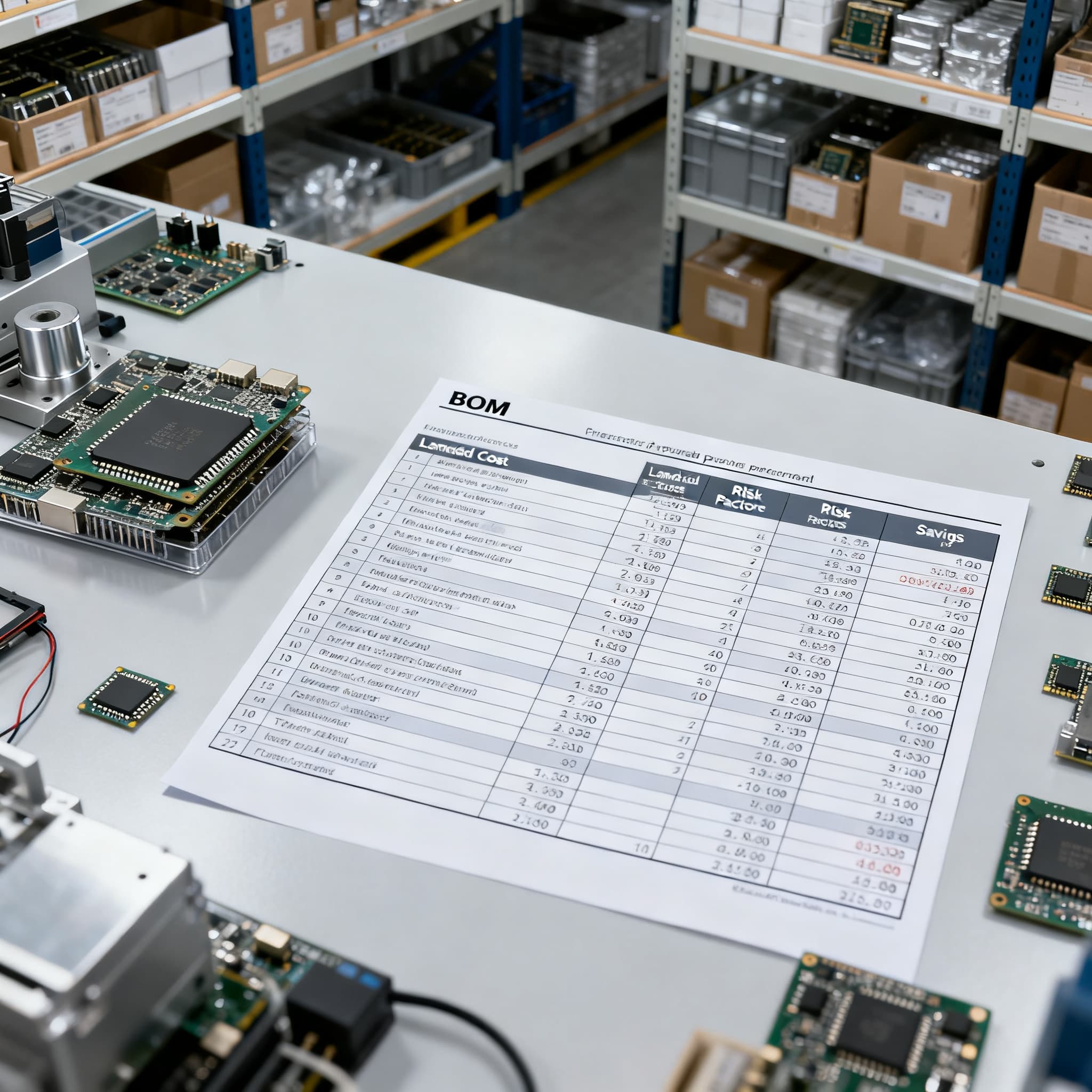
Landed Cost Considerations in Multi-Line BOM Quoting: Risk-Balanced Savings
BOM cost optimization and supplier consolidation strategies that balance savings with risk.
Why Landed Cost Miscalculations Are Blowing Up Procurement Budgets in 2026
For multi‑line BOMs that span dozens or hundreds of line items, procurement teams have traditionally relied on unit‑price comparisons. That habit is now a budget‑destroyer. Through most of 2025, many high‑demand semiconductor categories appeared stable at book price, yet by early 2026 those same components were changing hands at spot premiums of two to five times their original cost. At the same time, port congestion in Shanghai forced logistics teams to scramble for alternative routings—diverting through Busan or Singapore, which added modest freight cost but saved production lines from stalling according to 2026 supply‑chain updates. These shocks exposed a brutal truth: an invoice‑price comparison is a dangerous illusion unless it accounts for every freight, duty, and expediting charge. A BOM that looked 12% cheaper on paper can easily wind up 30% more expensive after the real landed cost is tallied. As OpenBOM’s cost analysis guide underscores, procurement decisions demand accurate BOM cost calculations that reflect total landed cost—not just purchase prices.
Tip: When you receive a multi‑line quote that shows only EXW or FOB unit prices, you are looking at roughly half the story. The other half is a stack of freight surcharges, customs brokerage, insurance, port fees, and even the carrying cost of inventory that stretches lead times.
The forces driving this misalignment are structural, not temporary. The table below captures the key drivers reshaping landed cost in multi‑line BOM quoting.
| Driver | Mechanism | Procurement Impact |
|---|---|---|
| Component spot‑price volatility | Allocation and capacity shifts push spot prices far above contract levels for the same MPN | Unit‑price quotes may be stale within days; landed cost spikes when short‑notice purchases require expedited air freight |
| Port congestion & rerouting | Delays at major hubs (e.g., Shanghai) force carriers to use alternative ports, adding transit time and handling fees | Blanked sailings and last‑minute diversions increase freight cost per line and create unpredictable delivery windows |
| Tariff and trade policy shifts | New or revised tariff codes can reclassify components overnight, raising duty rates | HTS assumptions made at quote time may be obsolete by shipment; landed cost must be trued‑up against actual customs declarations |
| Carrier surcharge creep | Fuel surcharges, peak‑season premiums, and security fees stack on top of base freight rates | Even fixed‑rate freight quotes often exclude surcharges that can add 15–25% to the ocean or air leg |
| Inventory carrying cost pressure | Holding safety stock for lines with long or erratic lead times ties up working capital | Carrying cost at 18–24% per annum per line is rarely modeled in BOM quotes, yet it directly erodes negotiated savings |
| Multi‑origin BOM fragmentation | Passives from one region, ICs from another, and connectors from a third each attract different freight and duty profiles | Aggregated landed‑cost estimates mask line‑level anomalies—a single high‑duty part can double the build’s true cost |
Each of these drivers interacts with the others. A tariff increase on a broad category like MLCCs, combined with a port rerouting that adds a week of lead time, may force a buyer to switch from ocean to air for a sub‑set of lines. The resulting landed cost is not a simple sum; it’s an emergent risk that only becomes visible when you quote line‑by‑line with full cost visibility.
What Makes Up a Multi-Line Landed Cost—Beyond Unit Price and Freight
Landed cost is the real cost of a component at your receiving dock. It stretches well beyond the EXW unit price. As Linton Group’s primer clarifies, total landed cost includes unit price plus freight, insurance, duty, fees, delivery, and margin. For a multi‑line electronics BOM, you need to add customs brokerage, port handling charges, terminal handling, and—if you’re holding buffer stock—the carrying cost of capital. When a single BOM mixes parts from multiple countries of origin, each line can carry its own duty rate and freight profile. Ignoring that granularity is how procurement teams accidentally sign off on quotes that blow their budgets.
Building a supplier‑ready BOM that yields accurate landed‑cost quotes starts with structure. Cofactr’s guide to Quote BOMs recommends including quantity, clear generic descriptions, manufacturer name, MPN, approved alternates, required delivery date, and HTS/tariff information. When that level of detail is present, a sourcing partner can price each line with its own freight and duty assumptions instead of throwing a blanket “delivered” number over the whole BOM.
Equally important, every critical component on the BOM should carry a documented Approved Alternate, engineering‑approved before volume release. Venture Manufacturing’s DFM and quoting guide states bluntly: confirm whether freight, customs, and tariff costs are fully included. When alternates are priced in parallel with the primary choice, procurement can compare total landed cost per line—not just per BOM—and spot where a slightly more expensive alternate sourced from a different region slashes duty or freight enough to yield net savings.
To make the stack concrete, consider a simplified two‑line BOM fragment. Even a small difference in origin and freight mode reshapes the ledger.
| Cost Element | Line 1: MCU from Taiwan (air freight) | Line 2: Connector from Germany (ocean freight) | Notes |
|---|---|---|---|
| EXW unit price | $4.80 | $1.20 | Base price before any logistics |
| Freight (air/ocean) | $0.55 | $0.08 | Assumes bundled consol; air surcharge adds 18% |
| Insurance (0.3% of CIF) | $0.016 | $0.004 | Marine cargo insurance |
| Customs duty (HTS‑applied) | $0.00 (0%) | $0.096 (8%) | Semiconductor vs. electromechanical tariff rates |
| Brokerage & handling | $0.12 | $0.07 | Per‑shipment fee allocated per line |
| Total landed cost | $5.49 | $1.37 | True cost at dock |
| Landed multiplier vs EXW | 1.14× | 1.14× | Despite different logistics profiles, overall uplift similar; but the MCU’s air freight dominated while duty drove the connector |
The table shows that two lines can carry nearly identical overall uplift ratios while hiding completely different cost drivers. If the connector were sourced from a region with a higher tariff rate or if air freight became necessary due to time pressure, the line‑level landed cost could spike well above the aggregate average. This is why BOM‑wide averaging is dangerous.
How Different Quoting Strategies Expose (or Hide) True Landed Costs
Not all quotes are built to reveal landed cost. Two EMS suppliers receiving the same BOM, Gerber files, and production requirements can deliver significantly different quotations because of hidden assumptions about reliability margins, testing, and supply‑chain stability. The difference often boils down to what is included in the “price.” One supplier may quote a low unit‑price number that excludes freight, duties, and any contingency for spot‑market buys, while another builds those in upfront. What looks like a bargain may actually be a stripped‑down quote that shifts all landed‑cost risk onto the buyer.
Conversely, a higher quote might already include expedited freight charges to achieve shorter lead times, extended warranty coverage, or the cost of holding buffer stock for allocated parts. Supply‑chain diversification—a critical risk mitigation—often adds a visible premium: qualifying a second source for single‑source lines trades a small cost premium for avoiding a single‑source disruption. That premium appears only in quotes that spell out the diversification cost line‑by‑line.
The table below contrasts four common quoting strategies and how they affect landed‑cost visibility.
| Quoting Strategy | How It Affects Landed‑Cost Visibility | Procurement Risk Notes |
|---|---|---|
| Unit‑price‑only (EXW or FOB) | Hides all logistics, duties, and surcharges. Buyer must model these independently, often with stale assumptions. | Highest risk of budget overruns; suitable only when buyer has firm control over freight forwarding and customs brokerage. |
| Landed‑cost quote (DAP/DDP, all‑in) | Supplier provides a single delivered price per line that bundles unit cost, freight, duty, insurance, and fees. | Easiest to compare but must be verified: ask for a line‑item breakdown to confirm HTS codes and freight assumptions aren’t padded. |
| Partial landed (freight added, duty excluded) | Quote includes estimated freight but leaves duties as “buyer’s responsibility.” True landed cost emerges only at customs clearance. | Common for cross‑border shipments. Mitigate with a tariff‑fluctuation clause that shares unexpected duty increases. |
| Risk‑adjusted quote with contingency | Supplier adds a premium for spot‑market buys, expedited freight, or alternative sourcing to guarantee delivery dates. | Premium is explicit; procurement can assess whether the risk mitigation is worth the line‑item uplift. Requires clear alternates to be priced alongside primary parts. |
Procurement teams that request only “best price” without defining the Incoterms and requesting a landed‑cost breakdown are essentially gambling that freight and tariff conditions won’t change between quote and shipment. In 2026, that gamble rarely pays off.
Risk-Balanced Savings: Practical Steps for Multi-Line BOM Quoting
Moving from invoice‑price comparisons to a risk‑balanced landed‑cost discipline is not about spending more—it’s about spending predictably. The following actions, drawn from real‑world procurement experience and the referenced analyses, help multi‑line BOM buyers capture savings without hiding risk.
- Build multisourcing into the design phase, not after shortages hit. Inline shortage updates stress that qualifying second sources must happen before production ramps, not as a panic reaction. Having an engineer‑approved alternate for each critical MPN lets you instantly price two landed‑cost scenarios and switch if one origin becomes cost‑prohibitive.
- Use cross‑referencing tools to find functional equivalents with better pricing or shorter lead times. AGS Devices’ BOM cost optimization guide emphasizes that alternates must meet voltage, tolerance, and package specs; don’t trade savings for compliance risk. Validate each alternate against the original datasheet and regulatory requirements before including it in a quote.
- Insist on fully‑costed landed quotes that spell out tariff treatment and freight by line. As Venture Manufacturing’s evaluation framework advises, confirm whether freight, customs, and tariff costs are fully included. Require the supplier to state the Incoterms and provide a column showing applied HTS code and duty rate for every line originating outside a free‑trade zone.
- Negotiate payment terms that offset cash‑flow pressure from expedited logistics. When air freight is unavoidable, extended payment terms such as net‑30 or net‑45 can true up final landed costs before payment is due. Pair these with a letter of credit referencing landed valuation to protect both sides.
- Model inventory carrying cost as a hard line in the BOM quote evaluation. If a component carries a 20‑week lead time, holding four weeks of buffer stock adds roughly 1.5–2% of the part’s landed value to the build cost. Carrying cost is rarely quoted, but capturing it in your comparison spreadsheet prevents “cheaper” lines from quietly inflating total program cost.
The table below translates these actions into a decision framework, pairing each move with the scenario where it yields the greatest impact and the trade‑off that must be accepted.
| Action | When to Use | Trade‑off |
|---|---|---|
| Multisource critical lines early | Lead time >14 weeks or single‑origin exposure to tariff/port risk | Engineering validation and qual costs upfront; may increase per‑part price if second source is more expensive |
| Cross‑reference for pin‑compatible alternates | Allocated lines or MPNs with steep spot premiums | Requires rigorous spec and compliance checks; not all alternates are truly drop‑in |
| Require landed‑cost breakdown per line | Every multi‑line BOM quote | Adds time to RFQ evaluation; some suppliers may resist granular breakdowns unless compelled |
| Negotiate net‑30+ / tariff‑fluctuation clause | Volatile trade policy environment or when freight mode is uncertain | Suppliers may price a slight risk premium into the offer; shared‑cost clauses need clear trigger definitions |
| Include inventory carrying cost in quote comparison | High‑mix BOMs with long‑lead lines that require safety stock | Demands finance‑procurement alignment; simplicity is lost but cost accuracy is gained |
Integrating these steps into your quoting process moves the conversation from “what’s your best price?” to “what’s my true cost at the dock?” When suppliers see that you evaluate on landed cost and risk, their quotes naturally become more transparent. That alignment alone can uncover 8–15% in hidden cost avoidance across a multi‑line BOM.
Landed Cost FAQ for Senior Procurement Engineers
Q: How can I verify that a supplier’s landed cost quote includes all duty, tariff, and freight contingencies?
Request a line‑item breakdown that separates EXW unit price, estimated freight, insurance, customs brokerage, and applied HTS tariff rates. Cross‑check the freight estimate against your own forwarder benchmarks and ask which Incoterms govern the quote. A quote that simply states “delivered” without this detail often hides risk; for example, a tariff line may be omitted, or a blanket duty rate may not reflect the correct HTS for a mixed‑origin BOM.
Q: When is it worth paying a 10–20% premium for a second source on a multi‑line BOM?
Pay the premium when a part exhibits a lead time exceeding 14–16 weeks, when it is marked as allocated by the manufacturer, or when its country of origin is subject to sudden export controls or recurring port disruptions. The cost of a line‑down event—idle SMT lines, missed shipment windows, and customer penalties—often dwarfs the sourcing premium. If the second source originates from a region with lower duty or shorter freight lanes, the net landed‑cost uplift may be far less than the initial unit‑price gap suggests.
Q: How can payment terms be structured to offset landed‑cost uncertainty from fluctuating tariffs or freight?
Negotiate net‑30 or longer terms so final landed costs can be trued‑up before payment is due. Use letters of credit that reference the landed valuation, or agree on a shared tariff‑fluctuation clause that splits unexpected cost increases—say, any duty change exceeding 2% of the line value—between buyer and supplier. This approach keeps both parties aligned on actual costs rather than fighting over a fixed quote that becomes obsolete before goods arrive.
Q: How do cross‑referencing tools fit into a risk‑balanced landed‑cost strategy without compromising compliance?
Cross‑reference tools can identify pin‑compatible alternates that may lower the unit price or reduce lead time, but the real power lies in landed‑cost comparison. You must validate that the alternate meets the original spec’s voltage, tolerance, package, and regulatory requirements (e.g., UL, RoHS). Document an engineering approval for each alternate before quoting, and incorporate the alternates into the BOM so suppliers can price them side‑by‑side with full landed cost visibility. This converts a speculative “maybe cheaper” into a defensible procurement decision.
Q: Should I always ask for landed cost on every BOM line, or is it enough to model it at the aggregate level?
For multi‑line BOMs, aggregated landed cost masks line‑level risk. A single high‑duty connector or an IC that must ship air freight can skew the entire build budget. Price each line with its own freight and tariff profile—especially if parts originate from different countries—then roll up to a total for negotiation. When suppliers see that you evaluate line‑by‑line, they are more likely to provide accurate HTS codes and freight assumptions rather than burying averages in a blanket quote.
The drive toward landed‑cost transparency isn’t about squeezing suppliers; it’s about equipping your organization with real numbers that can withstand the next supply‑chain shock. Multi‑line BOM quoting that stops at unit price is a relic. By folding freight, duty, carrying cost, and alternate sourcing into every quote, you build procurement resilience that protects both margins and production continuity. Start by uploading your BOM for a consolidated landed‑cost quote that treats every line with the granularity it deserves. Upload Your BOM to see how a single sourcing partner can turn landed‑cost complexity into risk‑balanced savings.
References & Further Reading
- BOM Cost Analysis: Formula, Example & Cost Rollup – OpenBOM
- Why Electronic Component Costs Are Rising in 2026 – Accuris
- Landed Cost Explained: From Factory Floor to Warehouse Door – Linton Group
- 2026 Electronic Component Shortage Update for Buyers – IC Online
- Manufacturing Product Costing BOM Management and Quote Pricing – Venture Outsource
- Why EMS Quotations Are Different – FumaxTech
- BOM Cost in 2025 [Calculations + How To Reduce It] – AGS Devices
- RFQ Process: What Happens After a BOM Hits Your Inbox – Elisa IndustriQ
- How to Evaluate a PCB Assembly Quote: BOM Pricing and DFM Review (2026) – Venture Manufacturing
- A Practical Guide to BOMs for Electronic Hardware – Cofactr