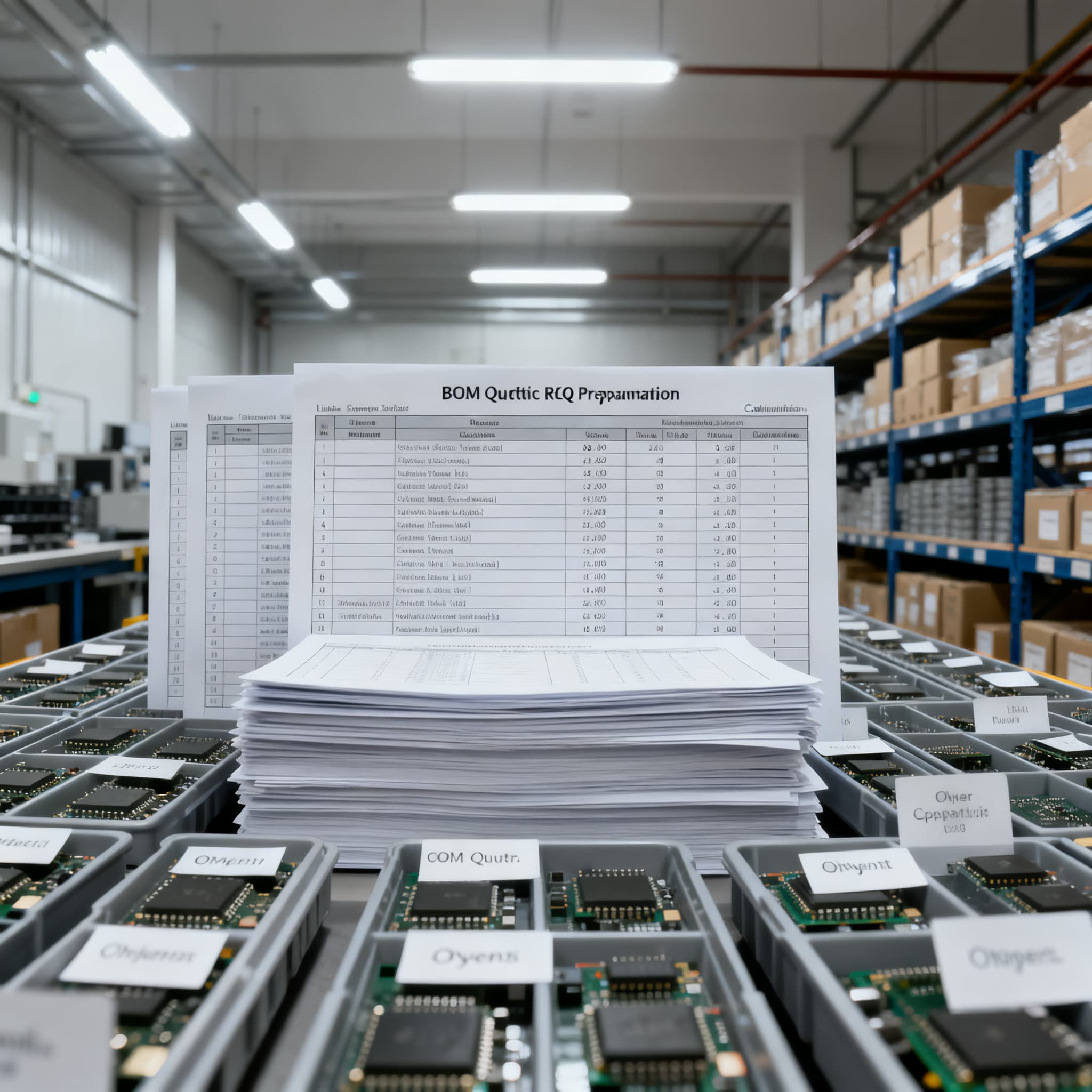
Multi-Line BOM Quotation Workflow for OEM Buyers: RFQ Prep & Consolidation
Practical BOM sourcing guidance for OEM and EMS buyers. Prepare your component list, consolidate suppliers, and upload a BOM for one quote.
For OEM and EMS procurement teams managing multi-line bills of materials, the gap between receiving a BOM and issuing a clean, actionable RFQ remains one of the costliest friction points in electronics sourcing. Every missing manufacturer part number, every ambiguous package code, and every line that hasn't been classified as "buy" versus "make" compounds across dozens or hundreds of line items—turning what should be a structured quoting process into a drawn-out email thread with engineering and suppliers alike. This article walks through the workflow that transforms a raw BOM into a consolidated RFQ that suppliers can quote against accurately, and that buyers can compare and award with confidence.
Why a Dirty BOM Derails RFQs Before They Start
Production material lead times remain elevated by historical standards. The Institute for Supply Management (ISM) reported average production material lead times of 85 days in July 2025 and 84 days in August 2025 (source). In that environment, every cycle lost to BOM clarification inside your own organization is time your suppliers aren't using to secure allocation, book fab capacity, or stage inventory.
When a multi-line RFQ lands in a supplier's inbox with missing MPNs, outdated package details, no revision identifiers, or—worse—no target build date, the supplier faces a binary choice: guess and risk delivering something unbuildable, or pause and ask. Most experienced distributors and EMS partners will pause. That means your RFQ sits in a queue while the supplier's sourcing desk sends clarification requests back upstream. Meanwhile, the buyer who sent the incomplete BOM is now chasing engineering for information that should have been embedded in the BOM from the start.
This pattern is well documented. One of the classic mistakes cited in OEM procurement strategy literature is that RFQs go out with a “dirty” BOM—missing MPNs, package, revision, quantities, or target build date—which creates mismatched quotes, wrong parts, and rework after the award (source). The rework isn't free. It consumes buyer hours, delays production schedules, and erodes supplier confidence. Over multiple RFQ cycles, suppliers learn which accounts send clean BOMs and which ones don't—and they price that risk accordingly.
Tip: Before any RFQ leaves your inbox, run a five-point completeness check on every line: manufacturer name, full MPN (including package suffix), internal revision, quantity per build, and target delivery date. If any of these five fields is blank, the BOM isn't ready to quote.
The cost of incomplete BOMs compounds with line count. A 12-line BOM with two ambiguous MPNs might generate four or five clarification emails. A 200-line BOM with 15% incomplete lines can stall an RFQ for a week or more. In a lead-time environment where 84 days is the average, losing a week to BOM hygiene means your parts arrive roughly 8% later than they otherwise would—before accounting for any supplier-side delays.
The BOM-to-RFQ Pipeline: Distinguishing Buy Lines and Mandatory Sourcing Fields
Not every line on an engineering BOM belongs in a supplier RFQ. Procurement teams typically work from the MBOM (Manufacturing Bill of Materials) because it clearly distinguishes buy items from make items (source). This distinction is foundational: you only request quotes for items you are purchasing externally, not for assemblies, sub-assemblies, or fabricated parts manufactured in-house. Sending an EBOM (Engineering Bill of Materials) that lumps together PCBAs, machined enclosures, and purchased ICs forces suppliers to either ignore the make lines or ask for clarification—both outcomes slow the RFQ cycle.
Once the MBOM isolates buy lines, each line must carry sourcing details sufficient for a supplier to return a firm, comparable quote. Industry guidance is explicit: add sourcing details so buyers do not chase engineering. Include manufacturer, MPN, supplier name, supplier part number, lead time if tracked, and lifecycle status. This cuts RFQ delays and reduces risky substitutions (source).
Controlled BOM lines—those where the part number bridges engineering intent, manufacturing process, and purchasing execution—deserve particular care. Take the TPS5430DDAR, a buck converter from Texas Instruments. For an OEM or EMS buyer, TPS5430DDAR should be handled as a controlled BOM line because the part number connects engineering selection, manufacturing process, and purchasing execution (source). The "DDAR" suffix encodes the package type (SOIC-8 with PowerPAD) and reel packaging—details that directly affect solder profile and pick-and-place feeder configuration. If a buyer truncates this to "TPS5430" or omits the package suffix, suppliers cannot confirm form-fit-function equivalence, and the quote becomes unreliable.
The table below captures the must-have fields for every buy line before an RFQ is issued. Treat it as a scrub checklist.
| Field | Why It Matters | Common Failure Mode |
|---|---|---|
| Manufacturer Name | Identifies the approved source; suppliers price from authorized or vetted channels. | Leaving this blank invites open-market substitution without traceability. |
| Full MPN (incl. package suffix) | Encodes package, temperature grade, and ordering options that affect board assembly and reliability. | Truncated part numbers force suppliers to guess, leading to mismatched quotes. |
| Internal Revision | Ties the quoted part to a specific design revision; critical when PCN or EOL events affect later builds. | Revision ambiguity causes re-quoting when the design changes mid-cycle. |
| Quantity per Build | Drives unit pricing, MOQ exposure, and reel quantity optimization. | Without it, suppliers can't tier pricing or flag MOQ gaps. |
| Total Program Quantity | Enables volume discounting, scheduled deliveries, and allocation requests above spot-buy levels. | Omitting total volume forfeits leverage that could reduce per-unit cost. |
| Package / Footprint | Confirms physical compatibility; SOIC-8 vs. WSON-10 changes the assembly process. | Package mismatches discovered after award require PCB respin or manual rework. |
| Lifecycle Status | Active, NRND, or EOL status changes sourcing strategy and risk profile. | Quoting an EOL part without lifecycle awareness locks in a supply that may not exist at build time. |
| Supplier Name / Part Number (if known) | Accelerates quote turnaround when an incumbent supplier relationship exists. | Omitting known supplier data forces redundant supplier discovery cycles. |
| Lead Time (if tracked) | Provides a baseline to validate supplier commitments against ISM averages. | Without a baseline, suppliers can quote optimistic lead times that slip post-award. |
| Target Delivery Date | Aligns supplier commitments with production schedules; enables schedule-based bid evaluation. | Missing dates mean suppliers quote standard lead times that may not meet your build window. |
Every field left blank transfers risk from the BOM owner to the supplier—and ultimately back to the buyer in the form of rework, schedule slips, or component substitutions that require requalification. A BOM that passes this field-level scrub before an RFQ is issued typically sees 40–60% fewer supplier clarification requests on the first pass.
Three Ways to Consolidate Multi-Line RFQs: Spreadsheets, ERP Modules, and Specialized Quoting Tools
Once the BOM is scrubbed, the buyer faces a consolidation decision: how to package multiple lines, manage supplier responses, and compare quotes without drowning in spreadsheet tabs. Three approaches dominate—manual Excel consolidation, ERP-based supplier portals, and dedicated quoting platforms. Each carries distinct trade-offs in speed, visibility, and change management.
Manual Excel consolidation is still the default for many mid-market OEMs. The buyer exports the MBOM to a spreadsheet, splits lines by commodity type or supplier, and emails separate RFQ sheets to each supplier. Responses come back in unstructured formats—PDFs, marked-up spreadsheets, email bodies. Reconciling five supplier responses across 80 lines becomes a multi-hour exercise in copy-paste and pivot-table gymnastics. When a component change hits mid-cycle, the buyer manually identifies which suppliers quoted the affected line and re-sends the revised sheet. It works for low-complexity BOMs under roughly 30 lines, but the error rate climbs sharply with line count.
ERP-based supplier portals offer more structure. Many Tier-1 ERP systems include supplier collaboration modules that let buyers post RFQs, collect structured bids, and compare responses within the platform. Integration with internal inventory and production planning data is a genuine advantage. The limitation is that these modules are typically designed for direct materials procurement across many categories—they aren't optimized for the granularity and speed of electronics component quoting, where pricing, availability, lead time, packaging, MOQ, and lifecycle status shift together in real time (source). ERP portals also tend to be rigid: adding a new supplier or an alternate MPN often requires IT involvement.
Specialized quoting platforms like CalcuQuote represent the third tier. These tools are purpose-built for electronics procurement. Quote Solution includes a supplier portal so you can send bid sheets, collect structured responses, and track what is pending (source). They pull pricing, stock, and lead-time data from distributor APIs, enabling real-time BOM costing that reduces the gap between RFQ intake and award—a supplier option that looks cheapest at RFQ intake may no longer be the most buildable option by the time the customer is ready to award the job (source). The platform approach also connects the full flow—from BOM intake to RFQs, supplier replies, award decisions, and PO handoff—so that every decision stays visible, and every build runs with fewer surprises (source).
The table below helps OEM buyers assess when to upgrade from spreadsheets to a more unified workflow.
| Consolidation Method | Best For | Speed | Visibility & Change Management | When to Upgrade |
|---|---|---|---|---|
| Manual Excel + Email | BOMs under 30 lines; 2–3 suppliers; stable designs with infrequent changes | Slow: multi-hour response consolidation | Low: version control risk; no audit trail | When line count exceeds 30 or supplier count exceeds 3, consolidation time dominates buyer workload |
| ERP Supplier Portal | Large OEMs with established supplier networks; direct materials procurement across categories | Moderate: structured but not electronics-optimized | Moderate: integrated with inventory but rigid for alternates | When electronics BOMs represent a growing share of total procurement spend and real-time costing matters |
| Specialized Quoting Platform (e.g., CalcuQuote) | EMS and OEM buyers managing 50+ line BOMs with frequent changes and multiple commodity types | Fast: API-based pricing/stock pulls; structured supplier responses | High: full BOM-to-PO traceability; real-time costing at award | When supplier response tracking, alternate management, and real-time costing become critical for margin control |
| Integrated Sourcing Partner (e.g., BOMNow) | Teams seeking consolidated multi-line quotes from a single vetted partner across the full BOM | Fast: single upload, consolidated response | High: one partner manages line-level consolidation, traceability, and documentation | When procurement bandwidth is constrained and multi-supplier management overhead exceeds the benefit of per-line bid optimization |
No single method fits every organization. The decision typically hinges on BOM complexity, procurement team bandwidth, and the cost of delay. A 12-line BOM for a low-mix production run may never outgrow Excel. A 200-line BOM for a high-mix EMS with quarterly design revisions demands the structured visibility that specialized tools provide. The key is recognizing the inflection point—when the time spent managing the RFQ process eclipses the time spent making sourcing decisions.
From Scrubbing to Award: Steps That Prevent Rework and Supplier Mismatches
A repeatable RFQ workflow reduces rework by enforcing consistency from BOM intake through supplier award. The following steps reflect practices used by procurement teams that consistently close multi-line RFQs with fewer than 5% line-item re-quotes.
Step 1: Scrub the BOM against the field checklist. Before any supplier sees a line, confirm that every buy line in the MBOM carries all ten fields from the table in Section 2. Missing fields at this stage are the single largest source of mid-cycle rework. The BOM is the foundation: it lists part numbers, revisions, and technical specifications that suppliers use to decide whether they can quote accurately (source). Preparation is where most of the effort sits—invest it early.
Step 2: Group lines strategically before sending bid sheets. Split the BOM by commodity group (passives, connectors, semiconductors, electromechanical) or by lead-time risk profile. High-risk, long-lead, and high-spend lines should go out first—they drive the critical path. Sending a consolidated RFQ that mixes MLCCs with FPGAs to a semiconductor specialist dilutes their focus and slows response time on the lines that matter most.
Step 3: Send structured bid sheets and track responses. Whether you use a spreadsheet or a portal, suppliers need identical fields in identical formats to enable side-by-side comparison. A quoting platform that includes a supplier portal for structured responses and tracks what is pending (source) eliminates the "who has responded?" ambiguity that plagues email-based RFQs. Set a response deadline tied to your production schedule, not an arbitrary date.
Step 4: Validate supplier commitments against current market baselines. When suppliers return lead times, compare them against independent data points. ISM's reported average of 84–85 days for production material lead times (source) provides a coarse benchmark. A supplier quoting 4 weeks on a commodity that typically runs 12 weeks deserves scrutiny—the quote may reflect outdated inventory data or an overly optimistic allocation assumption. Validate, don't assume.
Step 5: Manage changes without restarting the RFQ. Component changes happen mid-cycle—a PCN, an EOL notice, or an engineering-driven substitution. BOM procurement systems must accommodate change. When a component changes, procurement teams need to quickly identify affected RFQs and re-quote as needed (source). In practice, this means maintaining a traceable link between each BOM line and every supplier who received it. When line 47 changes from MPN A to MPN B, you know exactly which three suppliers need an updated bid sheet—and which lines are unaffected.
Step 6: Lock in the award using real-time costing. A quote received three weeks ago may no longer reflect current pricing or availability. Real-time BOM costing reduces the gap by treating costing as a live workflow, not a one-time export (source). Before cutting a PO, refresh pricing on the high-spend lines. Where a specialized platform isn't available, a quick manual spot-check on distributor APIs for the top 10 lines by spend is a pragmatic fallback.
The table below maps common RFQ friction points to preventive actions and their trade-offs.
| Friction Point | Preventive Action | When to Apply | Trade-off |
|---|---|---|---|
| Supplier requests MPN clarification | Full MPN scrub with package suffix verification before RFQ release | During BOM-to-RFQ prep, every cycle | Adds 15–30 minutes of prep per BOM; eliminates days of email back-and-forth |
| Quote variance >30% on same line | Ensure all suppliers quote against identical fields (MPN, qty, date code requirements, delivery date) | At bid-sheet creation; standardize template fields | Reduces flexibility for suppliers to offer creative alternatives; improves comparability |
| Mid-cycle component EOL or PCN | Maintain line-level traceability from BOM to supplier; flag affected RFQs and re-quote selectively | When any change hits a quoted line; ideally supported by platform tools | Requires disciplined BOM versioning; avoids full RFQ restart |
| Lead times spike between quote and award | Validate supplier commitments against ISM averages; refresh pricing on top-10 spend lines before PO | At award decision, immediately before PO issuance | Adds a final validation step; prevents production schedule surprises |
| Supplier quotes guessed MPN due to missing data | Reject quotes with non-exact MPN matches; feed the gap back into BOM hygiene process | During quote evaluation; also post-mortem after each RFQ cycle | May disqualify an otherwise competitive supplier; builds long-term data quality |
These six steps form a closed loop: scrub, send, track, validate, adapt, and lock. Organizations that run this loop consistently report fewer than one supplier clarification request per ten BOM lines—a substantial improvement over the industry norm of three to five per ten lines on first-pass RFQs.
Multi-Line BOM RFQ Consolidation: Questions Senior Buyers Ask
Q: How do I prioritize which lines to send for quote when my BOM has 200+ parts?
Group by commodity and lead-time risk, then send high-risk, long-lead, and high-cost items first. Use an ABC analysis based on spend and criticality: A-items (top 20% by spend, typically semiconductors and specialized modules) go in the first wave. B-items (mid-range connectors, certain passives with tightening supply) follow. C-items (commodity passives, standard hardware) can batch into a final wave. Critically, separate make items from buy items using the MBOM—quoting in-house parts to external suppliers wastes everyone's time and signals poor BOM discipline to your supply base.
Q: What is a realistic number of suppliers to include for a multi-line RFQ without drowning in data?
Target 3–5 qualified suppliers per commodity group. Three suppliers provide competitive tension; five gives you a safety margin if one or two decline to quote or come back with unacceptable lead times. Beyond five, the marginal pricing benefit shrinks while the analysis burden grows disproportionately—you end up spending more time normalizing response formats than making meaningful comparisons. A supplier portal that accepts structured responses keeps side-by-side comparison manageable even at the upper end of this range.
Q: How should I handle lines with alternate part suggestions without confusing suppliers?
List approved alternates on the same line with a clear preference rank and qualification status. Format it as: "Primary: [Mfr] [Full MPN] | Alt 1 (Drop-in, qualified): [Mfr] [MPN] | Alt 2 (Functional equivalent, requires qual): [Mfr] [MPN]." Suppliers need to know whether they can quote the alternate without triggering a requalification cycle on your end. Ambiguity here leads to quotes that mix primaries and alternates across suppliers, making true apples-to-apples comparison impossible.
Q: When should I split a multi-line BOM into separate RFQs by commodity type?
Split when you have distinct supplier bases—passives distributors rarely have competitive pricing on FPGAs, and vice versa—or when lead-time profiles differ significantly. A 52-week-lead FPGA should go to semiconductor specialists immediately, while a 6-week-lead connector can wait. Splitting also reduces quoting errors from mismatched expertise: a passives specialist quoting a complex MCU may miss critical configuration options encoded in the MPN suffix. The cost of splitting is managing more parallel RFQ tracks; the benefit is faster, more accurate quotes from suppliers who actually stock or source the commodity in question.
Q: What red flags in supplier responses indicate my BOM data was incomplete?
Watch for five signals: (1) frequent requests for MPN, package, or revision clarification; (2) quotes that contain guessed or truncated part numbers that don't match your submitted MPN exactly; (3) wildly divergent lead times—one supplier quotes 4 weeks, another quotes 26 weeks—for the same line, suggesting they interpreted the requirement differently; (4) outright refusals to quote citing insufficient data; and (5) line items returned with "TBD" or blank fields. Any one of these is a prompt to tighten BOM hygiene before the next RFQ cycle. Three or more across a single RFQ means your BOM isn't ready for supplier consumption.
Q: How often should I re-validate BOM sourcing details before each new RFQ cycle?
Before every new procurement wave, even if the design hasn't changed. Lifecycle statuses shift—a part that was Active six months ago may now be NRND or EOL. MPNs get discontinued or replaced by manufacturer successors. Supplier availability and allocation status change constantly. A quick scrub against current distributor APIs or a dedicated quoting tool can catch issues that would otherwise surface only in supplier responses, after days of delay. For BOMs supporting long-lifecycle industrial or medical products, validate quarterly at minimum; for consumer products with 12–18 month lifecycles, validate before each build cycle.
References & Further Reading
- RFQ Process: What Happens After a BOM Hits Your Inbox — Elisa IndustrIQ — ISM lead-time benchmarks and BOM preparation fundamentals.
- OEM Procurement Strategy: 10 Ways to Organize Supply Chains — Elisa IndustrIQ — Common RFQ mistakes including dirty BOMs and workflow integration with CalcuQuote.
- Bill of Materials (BOM) Procurement: The Complete Guide — AuraVMS — MBOM buy-vs-make distinction and change management in BOM procurement systems.
- Step-by-Step Guide to Make a Bill of Materials — Elisa IndustrIQ — Sourcing detail requirements to reduce RFQ delays and risky substitutions.
- Quoting Software for Electronics Manufacturing — CalcuQuote — Supplier portal, structured bid collection, and API-based pricing/stock pulls for electronics RFQs.
- How Real-Time BOM Costing Improves Quote Accuracy — Elisa IndustrIQ — Treating costing as a live workflow to close the gap between RFQ intake and award.
- TPS5430DDAR BOM RFQ Workflow for OEM and EMS Procurement Teams — Karina Dispatch — Controlled BOM line handling and the engineering-to-purchasing connection.
Multi-line BOM quotation is not a single-step handoff—it's a sequence of deliberate decisions about what to quote, how to structure the RFQ, and which tools to use for consolidation. Buyers who invest in BOM hygiene before the RFQ, classify lines by commodity and risk, and adopt structured response tracking consistently close quotes faster and with fewer post-award surprises. Whether you consolidate through spreadsheets, ERP modules, or a dedicated platform, the principle is the same: the quality of the RFQ determines the quality of the quotes you receive.
If your team is managing multi-line BOMs and wants to reduce RFQ cycle time without sacrificing coverage, upload your BOM for a consolidated quote or request a quote for individual MPNs that need immediate attention.