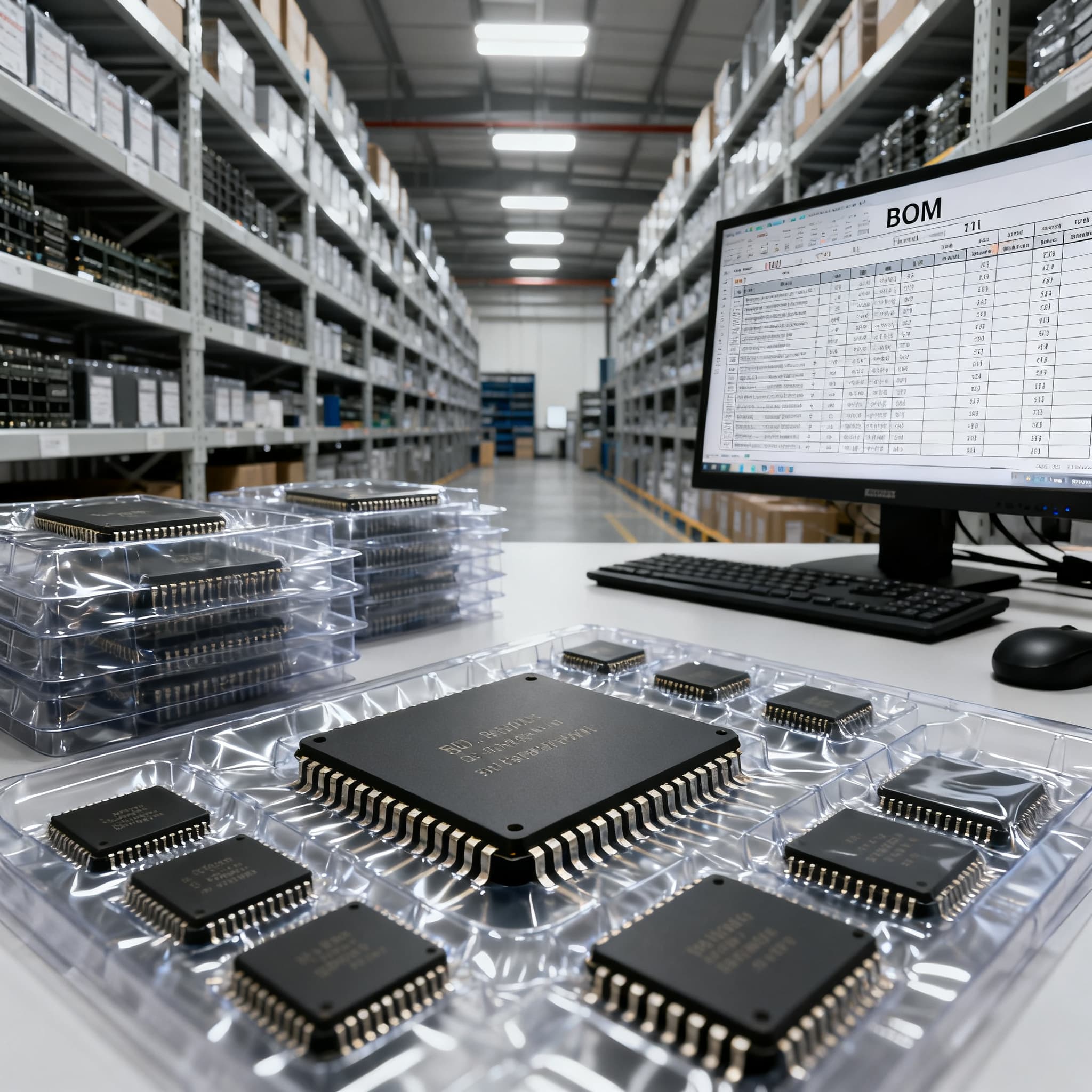
nRF52840-QIAA-R Procurement Guide: What to Include in Your RFQ
NRF52840 procurement and RFQ considerations for professional buyers. Need this part — or a full BOM? Request a quote on BOMNow.
Why the nRF52840’s Place in Your BOM Demands a Lifecycle Audit
Supply‑chain disruptions have turned everyday line items on a multi‑line BOM into risk items. The nRF52840-QIAA-R remains active, but procurement teams who treat “active” as a permanent guarantee risk being caught off‑guard when a PCN (Product Change Notification) or an NRND (Not Recommended for New Designs) flag surfaces. Manufacturers now refine lifecycle classifications more granularly—and Nordic Semiconductor’s status updates for the NRF52840 family need to be verified directly from the manufacturer’s portal before you commit to quantities or cut‑in dates.
NRND does not mean obsolete. As the FPGACenter lifecycle analysis explains, an NRND flag can last anywhere from one to many years, and the part is still produced and orderable. However, placing a new design on an NRND component is a classic procurement mistake—Industrial Monitor Direct’s NRND guidance strongly advises against it. For existing designs, the NRND window becomes a critical period for last‑time‑buy (LTB) planning and qualification of alternatives.
The takeaway: a lifecycle audit is not a one‑time check. The nRF52840-QIAA-R is actively shipping, but the component’s position in the growth/mature/decline curve must be confirmed with the latest PCN data and a YTEOL (Years to End‑of‑Life) estimate. Waiting until the EOL announcement creates a scramble. Instead, a prudent RFQ explicitly asks for the manufacturer’s lifecycle status, last PCN date, and the YTEOL horizon—data that is available from authorised channels and can be structured using the TT Electronics lifecycle data request model.
Decoding the nRF52840-QIAA-R Ordering Codes and Memory Variants Before You RFQ
The suffix QIAA-R is not arbitrary; it encodes the package, temperature grade, and factory‑programmed firmware variant. A misplaced character in a purchase order can lead to a completely different silicon that either fails to boot or violates the end‑product’s specification. The nRF52840 Product Specification v1.11 (as referenced in the DK documentation) includes the full ordering information for the SoC, including the marking codes that distinguish the QIAA-R from other suffixes such as QIAA (without the ‘‑R’ or with a different reel size) or QIA (a different package variant).
Before issuing an RFQ, buyers should confirm the following parameters with the supplier against the official Nordic datasheet and the v3.0 product brief:
| Parameter | nRF52840-QIAA-R Value | Procurement Verification Note |
|---|---|---|
| Package | QFN‑73 (7 mm × 7 mm) | Confirm the ‘QI’ in the suffix; a ‘QIA’ designation indicates a different package. |
| Temperature range | Industrial (–40 °C to +85 °C) | The ‘A’ suffix denotes industrial; commercial range starts with ‘C’. |
| Flash / RAM | 1 MB Flash / 256 kB RAM | Verified against the product brief; some variants may have different memory sizes. |
| Firmware variant | ‘R’ denotes a specific pre‑programmed firmware (check the order code table) | Request the firmware version from the distributor if your design relies on factory‑programmed soft device. |
| Reel size | Typically 7 inch reel, 500 pcs/reel | Verify the suffix ‘-R’ and ask for tape‑and‑reel details: reel diameter, orientation, and dry‑pack. |
| Device marking | Laser engraving per Nordic drawing | Cross‑reference against the NRF52840 datasheet and the official marking drawing to avoid counterfeit risk. |
Tip: A simple ‘QIAA’ vs ‘QIA’ mismatch can mean the difference between a QFN‑73 7 mm×7 mm package and a physically different footprint. Always cross‑reference the pinout on the NRF52840 datasheet and confirm the exact ordering code in the RFQ, not just the generic part number.
When the nRF52840-QIAA-R Lead Times Stretch: Evaluating PSoC 6 and Module‑Based BLE Alternatives
Lead times for the NRF52840 QIAA-R variant can fluctuate, and allocation may tighten during periods of high demand for industrial IoT and advanced wearables. When you cannot risk a line‑stop, the RFQ must evaluate credible alternatives that don’t force a complete board respin. The table below compares the native SoC with two alternative procurement paths: an SoC‑level replacement from Infineon and a pre‑certified module that reduces BOM complexity.
| Comparison Metric | nRF52840-QIAA-R (Nordic) | Infineon PSoC 6 BLE (CY8C63 Series) | ISC-nRF52840-A Module | Selection Criteria |
|---|---|---|---|---|
| Core architecture | Arm Cortex‑M4 + M0 radio | Arm Cortex‑M4 + M0+, dual‑core | Same Nordic SoC inside | Firmware portability; PSoC 6 requires platform migration. |
| Bluetooth 5.x / mesh / Thread | Full support | BLE 5.2, mesh possible via software | Same as SoC | If Thread/Zigbee is a must, Nordic remains the stronger stack. |
| Pin‑to‑pin compatibility | N/A | Not pin‑compatible; requires schematic change | Module footprint can be designed in parallel | PSoC 6 demands a new layout; module gives a drop‑in‑like option with reduced RF design effort. |
| Certification / RF design | Full RF design + certification needed | Full RF design + certification needed | Pre‑certified FCC/CE/IC; LDO & antenna integrated | For rapid prototyping or low‑volume production, the module lowers procurement risk. |
| Procurement complexity | Single active SoC; watch for PCN | Multiple ordering codes; verify BLE support | Fewer BOM lines; module supplier manages the SoC | Modules simplify the bill of materials but may have higher unit cost. |
The Infineon PSoC 6 family, specifically the CY8C63 BLE series, is frequently cited by the engineering community as a functional alternative. The Infineon developer community discussion provides guidance on part selection, but it also underscores that a direct pin‑to‑pin replacement is not realistic. For teams that need to get a product to market quickly while the nRF52840 lead time is uncertain, a pre‑certified module like the ISC-nRF52840-A—which bundles the Nordic SoC, antenna, and LDO—can reduce the BOM line count and shift the silicon procurement risk to the module supplier. The ISC module datasheet details the pinout and certification status, while the joric nrfmicro wiki demonstrates that even a bare nRF52840 module can be used with minimal external components, simply by soldering USB to VBUS/GND/D‑/D+ and supplying power to VDDH. Such a path can be a tactical short‑term fix while you negotiate a long‑term allocation for the exact QIAA‑R SoC.
RFQ Must-Haves for the nRF52840-QIAA‑R: From PCN Alerts to Packaging Code Verification
A robust RFQ for the nRF52840-QIAA‑R does more than ask for price and lead time. It forces the supplier to disclose the information that protects your production line from surprises. The PCNShark lifecycle status guide clarifies that NRND parts are still orderable, but the window to act is uncertain; a supplier who cannot provide a recent PCN alert or a YTEOL estimate is not worth the risk. The TT Electronics application note on lifecycle data offers a practical template for requesting a YTEOL with a maximum 5‑year horizon, and the latest PCN date.
Include the following items in every RFQ for this exact MPN:
- Manufacturer’s lifecycle status and YTEOL. Demand a written statement of the current status (Active/NRND/EOL) and the estimated years to end‑of‑life, reviewed annually. If the answer is “Active,” ask for the date of the last review.
- Latest PCN history. Request the date and content of the most recent PCN affecting the nRF52840‑QIAA‑R. Nordic frequently issues PCNs for die revisions, firmware updates, or packaging changes; even a harmless‑looking PCN can break your firmware.
- Full ordering code and reel detail. Do not accept the generic “NRF52840” in the quotation. Insist on the exact suffix “‑QIAA‑R,” the reel size, orientation, quantity per reel, and dry‑pack compliance.
- Certificate of Conformance and traceability. Require a CoC with date/lot codes, country of origin, and a link to the authorised distribution chain. For non‑authorised sources, add an incoming inspection step that compares the laser marking to the Nordic device marking drawing.
- NCNR stock option. If lead times are uncertain, ask for a non‑cancellable/non‑returnable stock option to secure allocation. This is standard practice for constrained parts and should be priced separately.
- MOQ and cut‑tape policy. Specify whether you need full reels, a minimum quantity of 250 pieces, or if cut tape is acceptable. The QIAA‑R variant is typically available in reels of 500, but cut‑tape can introduce date‑code mix risks.
Note: The RFQ is your first line of defense. Suppliers who hesitate to provide lifecycle data or insist on vague “per standard terms” responses should be red‑flagged, especially when the component in question sits at the heart of a BLE‑enabled product.
nRF52840-QIAA‑R Procurement Q&A: Lead Times, Counterfeit Red Flags, and MoQ Realities
Q: What is the current market lead time for the nRF52840‑QIAA‑R?
Lead times fluctuate with overall demand for low‑power SoCs. Recent authorised distributor data suggests a typical range of 8–12 weeks for standard reel volumes, but we recommend confirming the lead time in the RFQ and asking for a non‑cancellable/non‑returnable (NCNR) stock option to secure allocation. Some distributors maintain buffer stock for priority accounts; the RFQ should explicitly ask for a “best‑delivery” date and the date of the last stock receipt.
Q: How do I verify that the nRF52840‑QIAA‑R I receive is genuine and not a remarked unit?
Scrutinise the laser marking against the official drawing in the Nordic product specification. Genuine parts have a crisp, specific marking with the trace code and lot identifier. Insist on full traceability, a certificate of conformance, and date/lot codes that tie back to authorised distribution. If the source is outside the authorised channel, an incoming inspection using a simple Bluetooth boot‑up test can quickly expose non‑functional or counterfeit units.
Q: Should I buy the bare SoC or a module for my design?
The bare SoC gives you full layout control, lower BOM cost at volume, and the ability to customise the antenna matching. However, a pre‑certified module like the ISC‑nRF52840‑A (ISC module datasheet) simplifies certification, reduces RF engineering risk, and consolidates several BOM line items into one. The decision hinges on your design bandwidth, production volume, and whether you want to carry the regulatory certification burden. If your sourcing team is stretched thin, a module can reduce procurement complexity and insulate you from direct SoC lead‑time fluctuations.
Q: What minimum order quantity (MOQ) can I expect for the QIAA‑R variant?
Authorised distributors typically offer the nRF52840‑QIAA‑R in reels of 500 pieces, though smaller reels of 250 may be available. The RFQ should explicitly request the MOQ and tape‑and‑reel options; cut‑tape (partial reel) may be available but often carries a price adder and a risk of mixed date codes. For prototyping, some distributors will accommodate low‑quantity orders via their cut‑tape programme, but you must confirm that the parts are from the same lot to avoid firmware inconsistencies.
Q: Has the nRF52840 been subject to any recent PCN that could affect my design?
Nordic Semiconductor issues PCNs for die revisions, firmware updates, or packaging changes. The PCNShark lifecycle guide explains the NRND‑to‑EOL window, but PCNs can also appear while the part is Active. Always request the latest PCN alert list in your RFQ and monitor the Nordic Developer Zone for updates. A recent PCN could change the factory‑programmed soft device memory map, and your firmware may need an update to remain compatible.
Q: What should I do if the nRF52840‑QIAA‑R goes NRND?
If you see an NRND banner, halt any new design on this exact MPN. For existing designs, immediately plan a last‑time‑buy. The FPGACenter analysis shows that NRND can persist for years, but the sky‑high risk is that the manufacturer sets a short LTB window with little notice. Lock in quantities and delivery timelines with your supplier, and begin qualifying the alternative you identified in the RFQ phase—whether that is a PSoC 6 migration or a module‑based approach. The longer you wait, the fewer options you’ll have at a controlled price.
Bringing It All Together
The nRF52840‑QIAA‑R is a mature, capable SoC that sits in thousands of active BOMs. Its procurement is not inherently difficult, but it rewards supply‑chain professionals who treat the RFQ as a discovery tool. By demanding lifecycle data, PCN history, traceability, and exact ordering codes, you turn a simple quote request into a risk‑management instrument. Whether you stay with the bare SoC, pivot to a PSoC 6, or adopt a pre‑certified module, the decision must be grounded in the manufacturer’s official information and a clear view of the YTEOL horizon.
When you’re ready to consolidate multi‑line BOMs or need a single‑MPN quote with the lifecycle rigour described above, the BOMNow platform can help. Upload Your BOM for a consolidated quote, or Request a Quote for the nRF52840‑QIAA‑R with the exact RFQ must‑haves covered in this guide.
References & Further Reading
- Understanding ‘Not Recommended for New Designs’ Component Status – Industrial Monitor Direct
- EOL vs NRND vs Obsolete: IC Lifecycle Status Explained – FPGACenter
- Instant Access to Life Cycle and Obsolete Product Data – TT Electronics
- nRF52840 Product Specification v1.11 (DK documentation) – DigiKey
- nRF52840 SoC Product Brief Version 3.0 – Mouser
- NRF52840 Datasheet – Nordic Semiconductor (Alldatasheet)
- Best replacement part for nRF52840 RFSoC – Infineon Developer Community
- Alternatives · joric/nrfmicro Wiki
- Datasheet ISC-nRF52840-A – module datasheet
- Electronic Component Lifecycle Status: Active, NRND, EOL & Obsolete – PCNShark
- Nordic nRF52840 Product Specification v1.9