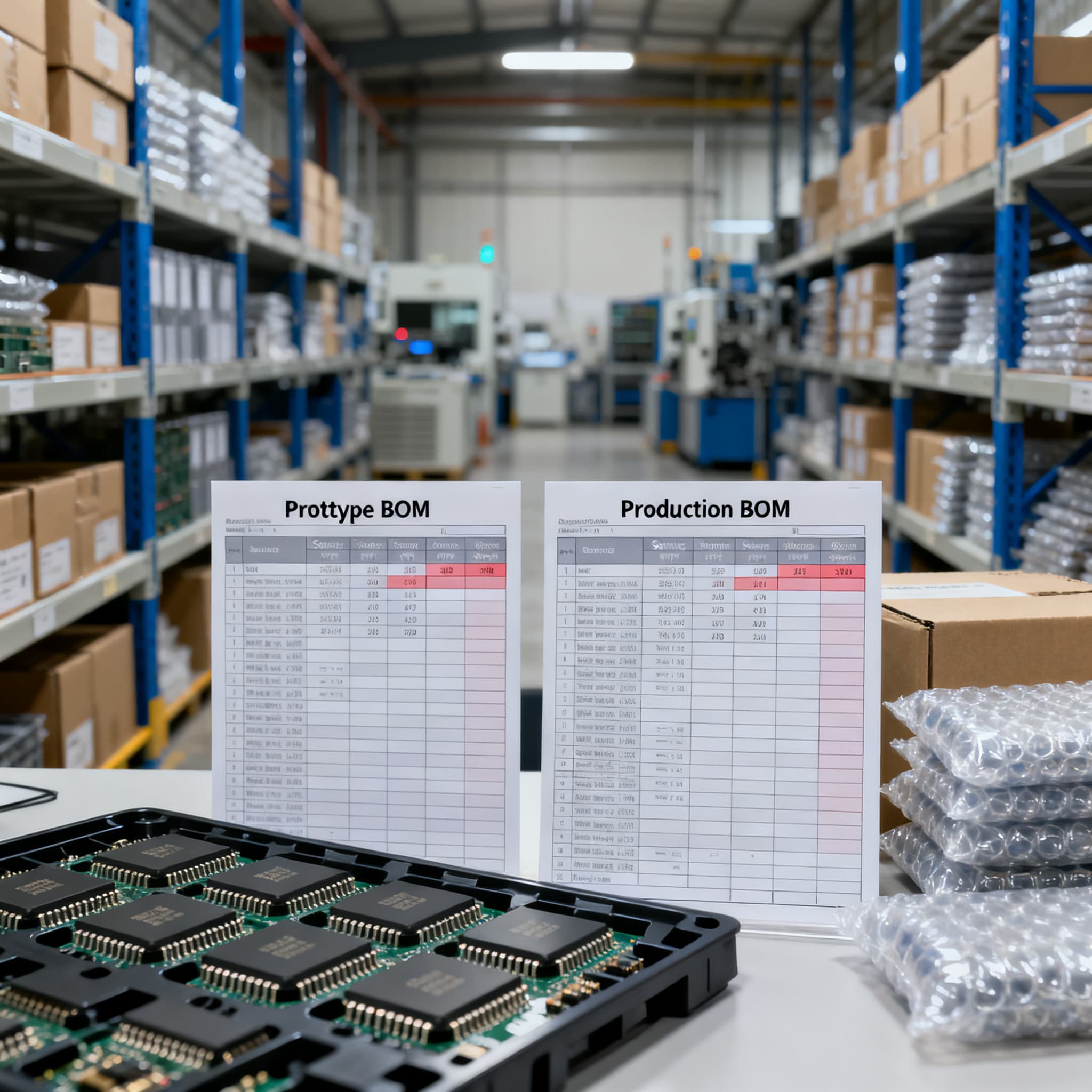
Prototype BOM vs production BOM sourcing priorities
Practical BOM sourcing guidance for OEM and EMS buyers. Prepare your component list, consolidate suppliers, and upload a BOM for one quote.
Why a Working Prototype Can Mask a Fragile Supply Chain
You bench‑test a prototype, all green LEDs, and the design team feels the final sprint is in sight. That confidence often evaporates the moment procurement runs the same BOM against production‑volume lead times. A $0.60 power supervisor that arrived in two weeks for a 10‑unit build can hit 52‑week lead times when you need 10,000 pieces. Hubble’s 2026 lead‑time analysis shows that teams stall at precisely this point—when a part moves from catalog availability to allocation. The prototype BOM validated the circuit, but it never validated the supply chain.
A real‑world case documented by Fumax illustrates the journey: a UK OEM transitioning a rally 4G data logger from a tested prototype to volume production had to wrestle BOM control, BGA quality, Quectel module sourcing, and functional test coverage—none of which were fully de‑risked during the prototype sprint. Meanwhile, buyers responsible for repeat orders are learning that a supplier who only assembles the boards isn’t enough. Bestpcbs highlights that procurement teams now expect their partners to watch EOL, NRND, shortage, and long‑lead risks between orders, because the same board re‑ordered six months later can face a wholly different supply landscape. The sourcing rules that governed the prototype phase simply break under production’s gravity.
Key takeaway: A working prototype proves the design, but a fragile BOM turns that success into a scheduling gamble. The moment you commit to production volumes, the priority shifts from “can we get one reel?” to “can we get 10,000 units every quarter for three years?”
How Prototype and Production BOMs Diverge from Day One
Prototype BOMs are built for speed and flexibility. You pull a few reels from a catalog distributor, accept extended temperature grades when the industrial version can be allocation-sensitive — confirm availability via RFQ, and rework a footprint if the exact package isn’t on the shelf. AGS Devices notes that prototype BOMs are refined when parts are sourced and builds are tested—they’re a living draft, not a locked document. A production BOM, in contrast, is a structured list of every component, sub‑assembly, and raw material needed to build the product consistently, as newbuyingagent explains, and it must freeze supply continuity, approved alternates, and life‑cycle checks before the first production order is placed.
The structural division goes deeper than a formatting exercise. Nextpcb’s PCB BOM guide and Haode’s assembly‑ready BOM practices underscore that production BOMs must embed minimum order quantities (MOQ), tape‑and‑reel orientation, approved manufacturer (AML) lists, and revision‑controlled manufacturer part numbers (MPNs). The prototype BOM rarely carries any of that. The table below captures the key drivers that force sourcing priorities to change.
| Driver | Mechanism | Procurement Impact |
|---|---|---|
| Volume step‑up | Quantities leap from 10–50 to 1,000–50,000, triggering allocation, tier pricing, and franchised distribution constraints | Parts that were in‑stock at catalog houses may require 16‑week factory lead times or become allocation‑only |
| Lifecycle momentum | NRND/EOL announcements accelerate between prototype and production; a part active during EVT can be EOL six months later | Requires ongoing PCN monitoring and quarterly BOM health checks, not a one‑time gate review |
| Approved vendor lock | Prototype BOM tolerates any source; production BOM mandates traceable suppliers and approved alternates for safety and compliance | Switching a supplier requires requalification; spot buys from non‑approved sources risk audit findings |
| Regulatory and customer compliance | Production volumes often trigger RoHS/REACH/conflict‑mineral reporting and country‑of‑origin constraints absent in prototype | BOM must include compliance flags; non‑compliant alternates become invisible to the production buyer |
| Contract manufacturing hand‑off | EMS partners require MRP‑ready data: package, MOQ, tape orientation, and approved alternates | An incomplete BOM causes quoting delays, line‑down risk, and pull‑in of design engineers |
These drivers aren’t theoretical. A buyer who hands an EMS the same spreadsheet used for a 10‑unit prototype build is essentially asking the CM to become a sourcing detective. The production BOM needs to be a living document that integrates manufacturer life‑cycle data, supplier part numbers, and approved alternates. Without that, every reorder becomes a fire drill.
Single‑Source Speed vs. Multi‑Source Resilience: The Real Cost of Waiting
During prototyping, grabbing a single available reel from any catalog is efficient. The clock is ticking, and the cost of a second source is a distraction. At volume, that same single‑source part can become the bottleneck that stops the line. PCBgogo warns that components easy to source in quantities of ten can face longer lead times or allocation issues at quantities of ten thousand. The 2025–2026 semiconductor shortage documented by Nextpcb proved the point: even after the November 2025 truce, buyers who wanted a genuine second source were still working through requalification well into 2026. Meanwhile, competitors who had pre‑qualified alternates during the prototype phase were already shipping.
OpenBOM’s three best practices emphasize early supplier engagement and second‑source qualification as non‑negotiable production priorities. The table below contrasts the two sourcing philosophies and the strategic options that procurement teams face.
| Segment / Option | Effect on Production BOM | Notes |
|---|---|---|
| Single‑source, no alternate | Maximum price and lead‑time risk; any disruption halts production | Common in prototype but untenable for volume; a single EOL notice can force a redesign |
| Single‑source with qualified pin‑compatible alternate | Reduces allocation risk; production can pivot within weeks if the primary goes on allocation | Requires schematic‑level validation during EVT; Hubble recommends qualifying second sources at schematic stage |
| Multi‑source with approved vendor list (AVL) | Spreads demand across franchised distributors; leverages competitive pricing and buffer stock | Adds BOM complexity; each alternate must carry the same form, fit, and function with verified traceability |
| Buffer stock / last‑time buy | Protects against EOL gaps but ties up cash and warehouse space | Useful for long‑life industrial products; needs accurate demand forecasting to avoid write‑offs |
The real cost of waiting isn’t the price of the component—it’s the line‑down time and the engineering hours burned to re‑qualify a replacement under duress. Buyers who treat second‑source qualification as a post‑production chore inevitably pay that cost when a seemingly stable part suddenly goes on allocation.
Actionable Steps to Steer a Prototype BOM into a Production‑Ready Bill
Moving from a prototype BOM to a production‑ready bill is a deliberate process, not a one‑time export. The following steps, drawn from industry practice and the resources cited, create a repeatable path that keeps design engineers from being pulled back into every reorder.
- Run a volume‑sensitivity check at the schematic stage. For every line item, ask: “Is this part available at 10×, 100×, and 1,000× the prototype quantity?” Hubble’s lead‑time analysis shows that potential schedule‑killers surface early when you rescore quarterly.
- Qualify pin‑compatible alternates before design freeze. If your power IC has a pin‑compatible alternate from a different manufacturer, validate it during prototyping. Nextpcb’s shortage data confirms that waiting until after the production ramp forces months of requalification.
- Lock supplier traceability, not just part numbers. Bestpcbs describes the EBest Circuit pre‑purchase audit: checking component quantity, package, lead time, and supplier traceability before every purchase order. That ritual belongs in your production BOM workflow.
- Adopt a digital BOM that gives manufacturers early visibility. OpenBOM’s digital BOM approach lets manufacturers flag sourcing issues, lead‑time risks, and cost surprises while the design is still fluid—avoiding costly last‑minute changes.
- Incorporate DFM and test coverage into the BOM hand‑off. The Fumax OEM case shows that BOM control, BGA quality, and functional testing are tightly coupled. A production BOM that includes test point requirements, package constraints, and assembly notes prevents a prototype‑only mindset from leaking into volume.
The table below outlines a timeline and trade‑off structure for these actions, helping procurement and engineering teams align on when to invest and what’s at stake.
| Action | When to Use | Trade‑off |
|---|---|---|
| Volume‑sensitivity scoring | During schematic review, before layout freeze | Adds engineering hours upfront but prevents a catastrophic stall later |
| Second‑source validation | At EVT, before production tooling | Requires bench time and potentially a small PCB spin; delays here are cheaper than line‑down days |
| Supplier traceability audit | Before first production PO and quarterly thereafter | Adds procurement overhead but guards against counterfeit and allocation surprises |
| Digital BOM implementation | Early prototype phase, integrated with PLM/ERP | Process change for design teams; high payoff when manufacturers catch issues before design freeze |
| BOM freeze with approved alternates | At DVT gate, after second‑source qualification | Freezes the design; any later change forces ECO and re‑qualification, so timing is critical |
These steps are not a one‑size‑fits‑all checklist. The appropriate depth depends on product complexity, regulatory environment, and production volume. What’s universal is the principle: production sourcing priorities must be built into the BOM before the first production PO is cut. Waiting until the ramp is the single most expensive sourcing decision a team can make.
When Sourcing Priorities Clash: Questions Sourcing Engineers Ask
Senior engineers and procurement leads often hit the same pinch points when a prototype BOM meets production reality. The questions below surface the most frequent friction zones and the practical answers that keep programs moving.
Q: At what point should I freeze my BOM and start locking in production quantities?
Freeze the BOM after the prototyping phase validates the design and second‑source qualification is complete—typically at the engineering validation test (EVT) gate. Waiting until production ramp to lock volumes will expose you to lead‑time escalation and allocation, especially for long‑lead ICs. The freeze should include approved alternates, package, and supplier part numbers so that MRP can run cleanly.
Q: How do I know if a prototype component is at risk of going EOL or NRND?
Cross‑reference the manufacturer’s product‑change notification (PCN) feeds and component life‑cycle databases quarterly. Hubble’s risk‑scoring approach and the EBest practice of checking EOL/NRND status before each purchase order show that active monitoring, not one‑time checks, is essential. A part active at design‑in can be NRND by the time you place the first production order.
Q: Should I trust a single supplier for a prototype run if the lead time is short?
Only if you’ve already qualified a pin‑compatible alternate and have a glide path. The 2025–2026 shortage proved that sole‑source parts with short lead times in small quantities can become 52‑week items when volume spools up, leaving production stranded. The prototype’s short lead time is not a guarantee of volume availability.
Q: What’s the real cost of delaying second‑source qualification until after production starts?
Delaying requalification can cost months of line‑down time and force expensive spot buys. As Nextpcb’s shortage analysis showed, buyers who began second‑source qualification only after the November 2025 truce were still working through requalification in 2026, while competitors with pre‑qualified alternates shipped. The cost is measured in lost revenue and market window, not just component price.
Q: How can a digital BOM reduce the friction between design and sourcing?
A digital BOM gives manufacturers early visibility into evolving designs, enabling them to flag lead‑time, EOL, and cost issues before design freeze. OpenBOM’s model shows that teams can catch sourcing risks during schematic review, avoiding costly last‑minute changes. The BOM becomes a collaborative living document rather than a static spreadsheet tossed over the wall.
Q: What checklist items should a contract manufacturer verify between prototype and production BOMs?
Key checks include: part availability at target volume, lead‑time stability, supplier traceability, approved alternates, and compliance with the latest DFM rules. Bestpcbs’s EBest Circuit pre‑purchase audit—checking quantity, package, lead time, and supplier traceability—is a good template. Any discrepancy between the prototype BOM and the production data pack should be resolved before the first production lot is released.
References & Further Reading
- Lead Times in 2026: How to Plan Your Hardware BOM for Reality – Hubble Network Community
- 2026 OEM Manufacturing Project Case: From Prototype to Production – Fumax
- PCB BOM Management for Reliable PCBA Production – Bestpcbs
- Shortage of Electronic Components in 2026: Causes and Sourcing Strategies – Nextpcb
- PCB Manufacturing Service for Prototypes vs Mass Production: What’s Different? – PCBgogo
- From Prototype to Production: The Three Best Practices – OpenBOM
- How a Digital BOM Takes you From Design to Production – OpenBOM
- BOM in Manufacturing: How It Works, Types and Usage – AGS Devices
- Want to Build a Killer PCBA BOM? Here’s Your Step‑by‑Step Guide – Nextpcb
- Product Specification Sheet for Manufacturing (2026 Complete Guide) – newbuyingagent
- PCB BOM: Complete Guide For Accurate PCB Assembly – Haode Pcba
The gap between a prototype BOM and a production‑ready bill is where many hardware programs lose months and margins. The rules change because volume, lead times, and life‑cycle risks compound. Teams that treat the BOM as a strategic sourcing document—not a post‑design afterthought—cross that gap with fewer disruptions. Whether you’re wrestling with a multi‑line BOM that needs consolidation or a single long‑lead part that threatens your ramp, a structured RFQ process that captures MPN, manufacturer, quantity, package, date‑code requirements, and traceability will surface the real supply picture. Upload Your BOM for a consolidated quote, or Request a Quote for a single MPN. The sooner you test the production rules, the fewer surprises you’ll face when the volumes climb.