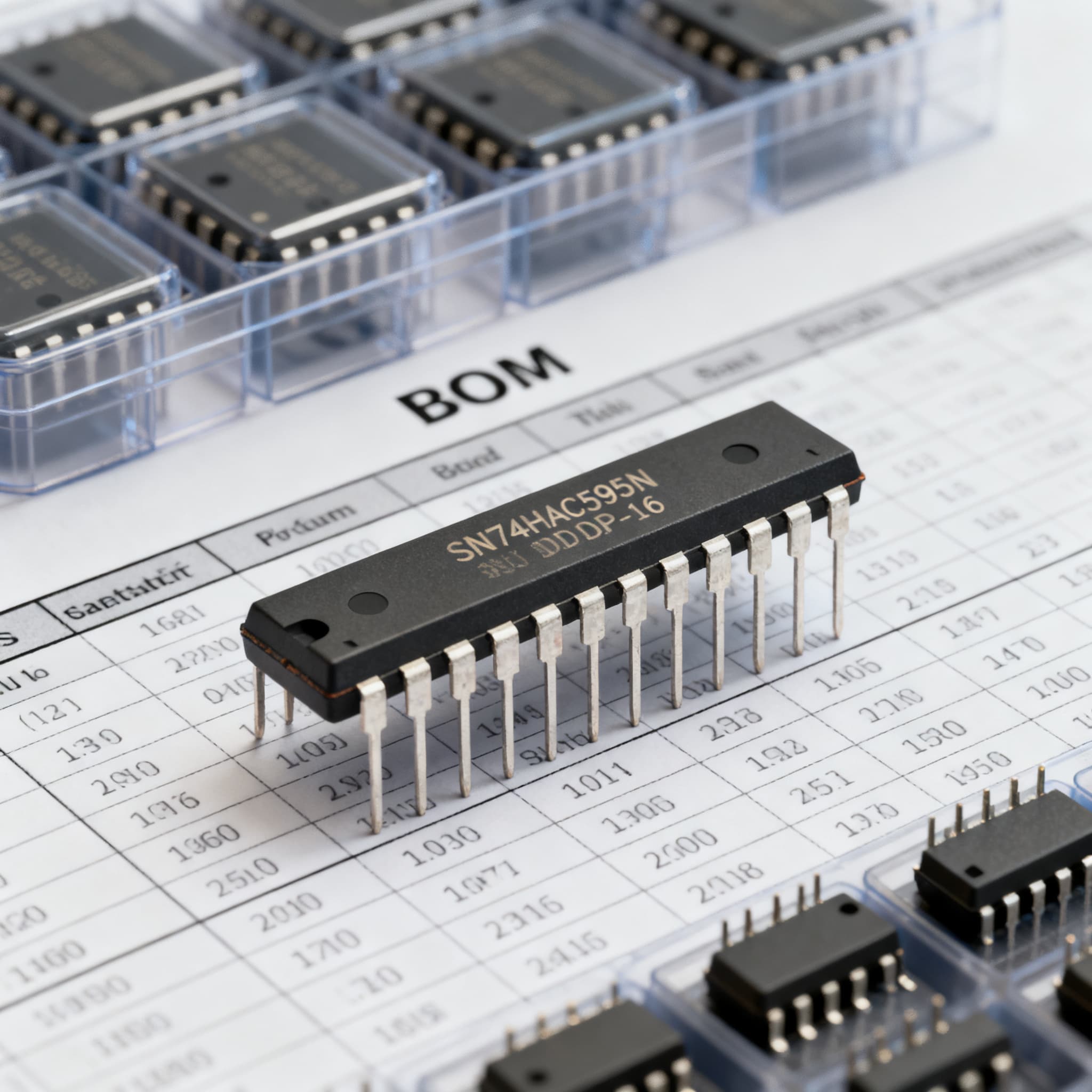
SN74HC595N Procurement Guide: Pinout and Spec Checks for RFQ
SN74HC595N procurement checklist: datasheet specs and pinout fields to verify on RFQ, plus BOM upload path on BOMNow.
Lifecycle First: Why a Jellybean Shift Register Like the SN74HC595N Can Still Go EOL
It is tempting to treat the SN74HC595N as a "forever part." After all, this 8-bit shift register has been a staple of logic design for decades — found in LED drivers, industrial control panels, and communication backplanes across virtually every electronics manufacturing sector. Procurement managers who have been ordering the SN74HC595N for years often assume it will always be available off the shelf.
That assumption is increasingly risky. Texas Instruments, like every major semiconductor manufacturer, regularly reviews its mature logic portfolio. A part that was "Active" during your last production run can move to NRND (Not Recommended for New Designs) with relatively short notice. As Industrial Monitor Direct cautions, final shipment dates and order cutoffs are explicitly specified in the formal PCN, and new designs should never select an NRND component — supply availability becomes unreliable and expensive once that status flips.
The lifecycle trajectory is well-documented across the industry. TT Electronics describes a five-stage model — growth, mature, decline, NRND, and obsolete — with an estimated EOL horizon reviewed at least annually and capped at five years. TDK similarly flags EOL and NRND status on product pages as a procurement signal, not just an engineering footnote. And FPGA Center notes that the NRND window can stretch anywhere from one to many years — making it a dangerous grey zone for buyers who assume "NRND means I still have time."
Tip: Before issuing any RFQ for the SN74HC595N, visit TI's official SN74HC595 product page and check the lifecycle status field directly. Do not rely on distributor stock levels as a proxy for active production — warehouses can carry inventory long after a part has been discontinued. If the status shows anything other than "Active," locate the associated PCN immediately and calculate your lifetime buy quantity.
SN74HC595N Pinout and the Specs That Make or Break an RFQ
The SN74HC595N is an 8-bit serial-in, parallel-out shift register with 3-state output registers, housed in a 16-pin DIP package. Its architecture splits into two internal stages: a shift register that accepts serial data clocked by SRCLK, and a storage register that latches the shifted byte onto the parallel outputs (QA through QH) on the rising edge of RCLK. The output-enable pin (OE) controls whether those outputs are actively driven or placed in a high-impedance state — a feature that allows multiple '595s to share a bus without buffer contention.
From a procurement perspective, the pinout is more than a schematic reference. Every pin function maps to a sourcing specification that must be verified before an RFQ is issued. The TI SNx4HC595 datasheet is the authoritative source for these parameters, and SparkFun's datasheet mirror offers a convenient cross-reference for the DIP-16 pinout diagram.
The table below captures the critical electrical and timing parameters that procurement teams should explicitly list in an RFQ for this part. Sending an RFQ with only the MPN and quantity leaves too much to chance — suppliers may quote based on outdated or incomplete datasheet revisions.
| Parameter | Datasheet Value (VCC = 5 V, TA = 25 °C unless noted) | RFQ Verification Notes |
|---|---|---|
| Supply Voltage (VCC) | 2 V to 6 V | Confirm supplier guarantees full 2–6 V range; some clones may narrow this to 4.5–5.5 V. |
| Output Drive (IOL / IOH) | ±6 mA at VCC = 5 V (standard drive) | If driving LEDs or long traces, verify actual sink/source capability against your load. |
| Maximum Shift Clock Frequency | ~30 MHz (typical at 5 V, 15 pF load) | Ask supplier to confirm minimum fmax across full temperature range. |
| Propagation Delay (SRCLK to QH') | Typ. 14 ns, max 30 ns at 5 V | Critical for cascaded configurations; request worst-case timing from the lot being quoted. |
| Output Enable (OE) Logic Level | Low = outputs enabled; High = high-Z | Confirm internal pull-up behaviour if OE is left floating. |
| Quiescent Current (ICC) | Max 8 µA at 25 °C, 160 µA across full temp range | Useful for counterfeit screening — abnormally high ICC can indicate remarked parts. |
| Input Leakage Current | Max ±1 µA | Verify for battery-powered designs where leakage accumulates. |
| Package | PDIP-16 (through-hole, 300-mil width) | Confirm "N" suffix = DIP. Do not accept SOIC-16 ("D" suffix) unless a board respin is planned. |
Notice that package type is not just a footnote — it is a hard procurement boundary. An SN74HC595D (SOIC-16) is electrically identical to the SN74HC595N, but the two are mechanically incompatible. We will return to this distinction when discussing alternatives.
Key takeaway: An RFQ that says only "SN74HC595N, qty 5,000" is incomplete. A robust RFQ specifies VCC range, minimum clock frequency, propagation delay grade, and package confirmation. This takes five extra minutes to prepare and can prevent a six-figure production line stoppage.
Drop-In or Not? Evaluating 74HC595 Family Alternatives When Supply Tightens
When TI lead times stretch or lifecycle status shifts, procurement teams instinctively look for second sources. The good news is that the 74HC595 function is widely manufactured. The bad news is that "functionally identical" does not mean "drop-in." Ersaelectronics notes that parts like the 74HC164 and 74HCT595 share similarities but differ in output structure and logic thresholds. Even when a part is described as a "direct replacement with identical functionality," the buyer must still verify the exact ordering code, package, and electrical corner cases against the incumbent design.
Kynix provides a practical migration checklist: before changing variants, review the enable source, PWM levels, external resistor requirements, dissipation, and worst-case output current. These are not academic concerns — a 74HCT595 with TTL-compatible inputs behaves differently on threshold voltages than an HC part with CMOS levels, and that difference can cause intermittent failures in noisy environments.
The IC-Components guide further emphasises that the 3-state outputs and modular input clocks are the architectural features that make the '595 series adaptable — but also the ones most likely to vary subtly between manufacturers. A clone that omits proper 3-state control or has different clock overlap specs may pass a bench test but fail in production.
The table below summarises the most commonly cited alternatives, what stays the same, and what must be verified before procurement signs off.
| Candidate | What Remains Similar | What Must Be Verified | Procurement Risk Level |
|---|---|---|---|
| Generic 74HC595 (DIP-16, other mfrs) | Function, pinout, VCC range (2–6 V), shift register architecture | ESD rating, ICC quiescent current, timing margins at temperature extremes, marking authenticity | Low if from authorized distributor; moderate from open market |
| 74HCT595 (DIP-16) | Function, pinout, output drive | Input threshold voltages (TTL vs CMOS) — may not be compatible with HC-level signals; VCC range narrower (4.5–5.5 V typical) | Moderate — requires design-level review of logic thresholds |
| SN74HC595D (SOIC-16, TI) | Identical silicon, identical electrical specs | Package footprint is completely different — requires PCB respin; thermal performance differs; hand-soldering not practical in production | High for existing DIP layouts — mechanical incompatibility is a hard stop |
| 74HC164 (DIP-14, various) | 8-bit serial-in parallel-out shift register core | No output register/latch — outputs update continuously during shifting; no 3-state outputs; different pinout and package | High — not a functional equivalent in latched applications |
No candidate in this table qualifies as a perfect drop-in without engineering review. The generic 74HC595 from a reputable second-source manufacturer comes closest, but even then, procurement should request the manufacturer's latest datasheet, compare timing diagrams, and prototype the part in the actual circuit before committing to a production order. Octopart's aggregated listings can help identify which manufacturers currently have active production for the DIP-16 74HC595 package, giving you a starting point for approved vendor list expansion.
PCN Traps and Sourcing Mistakes to Avoid on SN74HC595N Orders
Even experienced procurement teams make predictable errors when sourcing a part as familiar as the SN74HC595N. Familiarity breeds assumptions, and assumptions breed line-down situations. Below are the four most common traps — and how to avoid them.
Suffix confusion. The "N" in SN74HC595N designates the PDIP-16 through-hole package. The "D" suffix (SN74HC595D) is the SOIC-16 surface-mount version. The "NS" suffix is the SOP-16. All three share the same silicon, but ordering the wrong suffix means the parts will not fit the PCB. This mistake is surprisingly common when procurement teams copy-paste BOM lines from an older revision. Always verify the suffix against the physical board footprint before releasing the RFQ.
VCC range assumptions. The TI datasheet specifies 2–6 V operation. Some second-source manufacturers may guarantee only a narrower range. If your design runs at 3.3 V, a part specified for 4.5–5.5 V will cause intermittent register corruption. Ask the supplier to confirm the full VCC range in writing on the quote.
Output-enable floating. The OE pin on the '595 requires a defined logic level — floating it can cause unpredictable output states. Some designs rely on an internal pull-up; others use an external resistor. When qualifying an alternative source, verify that the OE pin behaviour (including internal pull-up presence and value) matches your design's expectations.
Ignoring the PCN window. As TT Electronics' lifecycle data model makes clear, the date of the latest PCN review is a critical procurement signal. If a PCN has been issued and the buyer does not act on the last-time-buy date, the window closes. Monitoring TI's product page for PCN activity should be a quarterly ritual for any procurement team managing a BOM that includes the SN74HC595N.
The table below outlines a practical mitigation timeline for procurement teams managing SN74HC595N risk.
| Action | When to Use | Trade-Off |
|---|---|---|
| Quarterly lifecycle check on TI product page | Always — part of standard BOM maintenance | Minimal effort; catches PCN/status changes early |
| Cross-check distributor stock via Octopart aggregation | Before every production RFQ | Reveals supply concentration risk; does not confirm manufacturer status |
| Request manufacturer datasheet revision confirmation from supplier | With every RFQ to a new or non-authorized source | Adds a day to sourcing cycle; prevents revision mismatches |
| Qualify a second-source 74HC595 and prototype it | When TI lead times exceed 12 weeks or NRND status appears | Engineering investment required; protects multi-year production continuity |
| Execute lifetime buy based on PCN dates | Within 30 days of a last-time-buy announcement | Capital outlay; avoids forced redesign under schedule pressure |
| Consider a board spin to accept both DIP and SOIC footprints | During next scheduled PCB revision | Upfront engineering cost; buys package flexibility for future sourcing |
These actions are not one-off tasks. They belong in a recurring procurement cadence — ideally documented in your ERP or PLM system as BOM-level flags for any single-source, mature-process IC.
SN74HC595N Sourcing Q&A: What Senior Buyers and Engineers Really Ask
Below are the six questions that surface most often when procurement and engineering teams sit down to discuss the SN74HC595N. Each answer is grounded in the manufacturer documentation and field experience — not generic advice.
Q: Is the SN74HC595N still in active production, and how can I confirm its lifecycle status?
Check TI's official SN74HC595 product page for the exact status — Active, NRND, or Last Time Buy. Do not rely on distributor stock alone; inventory can persist long after a part is discontinued. If NRND or EOL is flagged, locate the associated PCN immediately for final order and delivery dates. As noted earlier, lifecycle changes can move quickly once a formal PCN is issued, and the window for action is finite.
Q: What electrical parameters must I specify in an SN74HC595N RFQ to avoid a mismatch?
At minimum: VCC range (2–6 V), output drive (IOL/IOH ±6 mA at 5 V), maximum shift clock frequency (~25 MHz at 5 V), propagation delay values, and the output-enable logic level. Ask the supplier to confirm compliance with the specific TI datasheet revision applicable to your design. A one-line MPN RFQ is a gamble — a five-line spec RFQ is a safeguard.
Q: Can I replace an SN74HC595N through-hole DIP with an SN74HC595D SMD without changing the PCB?
No. The DIP-16 and SOIC-16 footprints are physically incompatible. Electrical parameters are identical, but the package change requires a board respin. Thermal performance and manufacturability also differ — SOIC parts are machine-placed and reflow-soldered, while DIP parts may be hand-assembled or wave-soldered in lower-volume production. Treat this as a package change with full design review, not a drop-in substitution.
Q: How do I protect against counterfeit or remarked SN74HC595N parts when buying from non-authorized sources?
Source from TI-authorized distributors whenever possible. When the open market is unavoidable, take these steps: verify date codes and package marking consistency against known-good photos; test output drive and quiescent current (abnormally high ICC is a red flag); for larger orders, use x-ray or decapsulation to confirm die authenticity. Compare pricing against Octopart's aggregated distributor listings — a price significantly below the market floor is itself a warning sign.
Q: What is the first step if TI issues a PCN that affects the SN74HC595N?
Read the PCN in full. It will specify last-time-buy and final shipment dates, and may recommend a replacement part number. Immediately calculate your lifetime buy quantity based on remaining production demand. Then begin evaluating drop-in candidates — such as the standard 74HC595 from other manufacturers — following the verification checklist outlined in the alternatives section above. Do not wait until the last-time-buy date to act; allocation tightens as that date approaches.
Q: Are there fully drop-in second-source ICs for the SN74HC595N from manufacturers other than TI?
Several vendors offer versions of the 74HC595 in DIP-16. Functionally they match the TI part, but you must verify logic-level thresholds, ESD ratings, timing margins, and output-enable behaviour against the exact datasheet you receive — not against an assumption of equivalence. Always prototype the candidate part in your actual circuit before qualifying it for production. A bench test with one unit is not qualification; run the part across temperature corners and under worst-case load conditions before signing off.
The procurement bottom line is straightforward: the SN74HC595N is a mature, well-understood part — but that maturity is precisely what makes lifecycle complacency dangerous. A quarterly review cadence, a complete RFQ spec block, and a pre-qualified second-source strategy together form a procurement safety net that costs far less than a line stoppage.
When you are ready to source the SN74HC595N — or need to consolidate a multi-line BOM that includes this part alongside dozens of others — Upload Your BOM for a consolidated quote, or submit a single-MPN Request for Quote. One BOM, one quote, one sourcing partner.
References & Further Reading
- Texas Instruments — SNx4HC595 Datasheet: 8-Bit Shift Registers With 3-State Output Registers (primary technical reference)
- Texas Instruments — SN74HC595 Product Page (lifecycle status, ordering codes, PCN history)
- Industrial Monitor Direct — Understanding 'Not Recommended for New Designs' Component Status (NRND procurement risk)
- TT Electronics — Instant Access to Life Cycle and Obsolete Product Data (lifecycle data model and PCN framework)
- FPGA Center — EOL vs NRND vs Obsolete: IC Lifecycle Status Explained (lifecycle window durations)
- Ersaelectronics — SN74HC595N Shift Register: LED Pinout, Features, and Datasheet (equivalent identification)
- Kynix — SN74HC595N: Pinout, Datasheet, Features, Applications (migration checklist and variant review)
- IC-Components — Your Guide to SN74HC595N: Characteristics, Alternatives, and Its Uses (3-state output and clock architecture)
- Octopart — SN74HC595N Texas Instruments: Distributors, Price Comparison, and Datasheets (aggregated supply visibility)
- TDK — Product Status Information: NRND, EOL Announced, and Obsolete (lifecycle status definitions)
- SparkFun — SN74HC595 Datasheet Mirror (supplementary DIP-16 pinout reference)
- Alldatasheet — SN74HC595N Datasheet from Texas Instruments