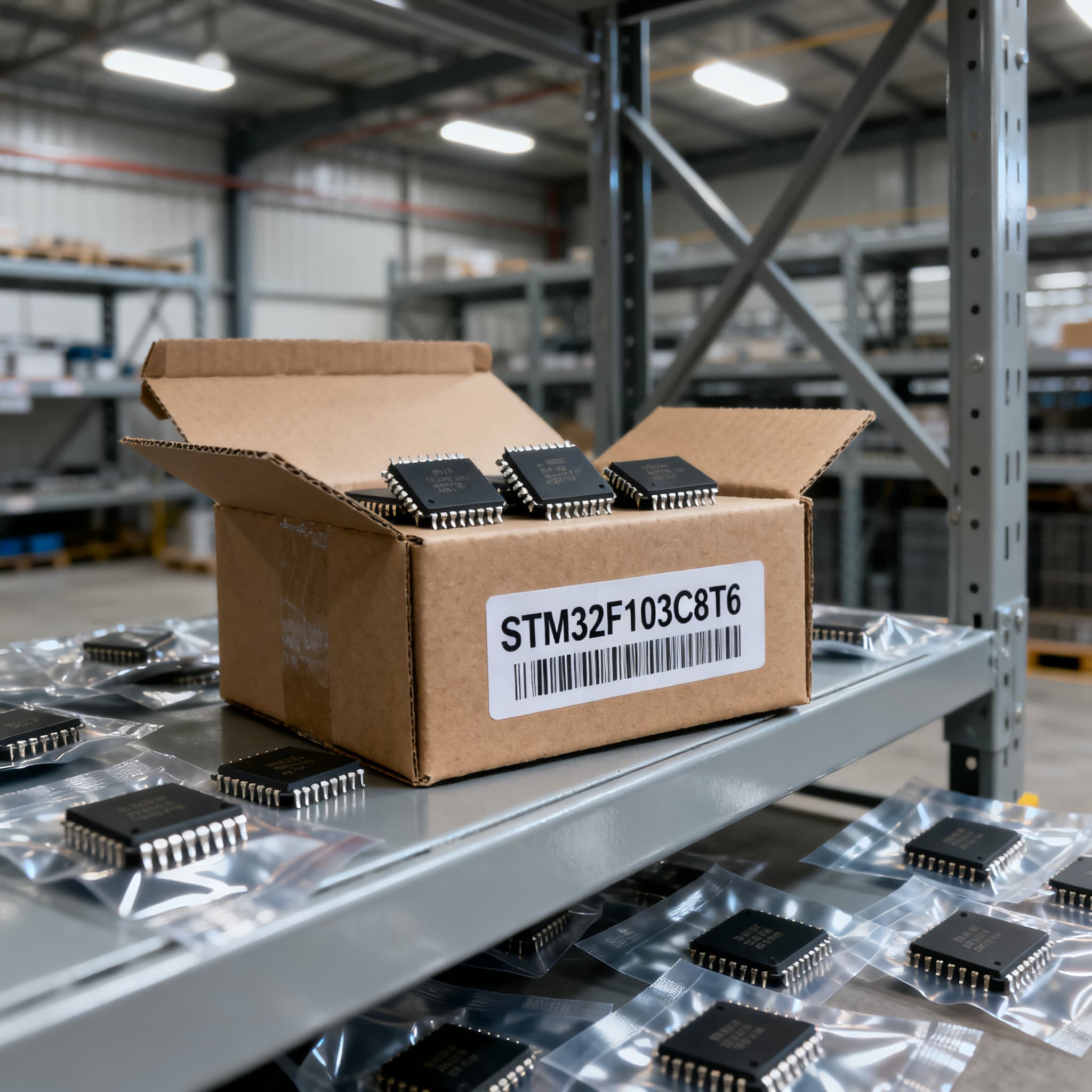
STM32F103C8T6 Procurement Guide: What to Include in Your RFQ
STM32F103C8T6 procurement and RFQ considerations for professional buyers. Need this part — or a full BOM? Request a quote on BOMNow.
Why the STM32F103C8T6 Still Demands a Tight RFQ in 2025
The ST datasheet DS5319 Rev 20 (July 2025) confirms what many procurement managers already know: STM32F103C8T6 remains in full production. But full production does not mean carefree sourcing. This Cortex-M3 workhorse, with its 64 KB Flash, 20 KB SRAM, and LQFP-48 package, powers everything from industrial controllers to consumer IoT hubs — and that ubiquity makes it a magnet for grey-market activity.
When a part ships in the millions across hobbyist projects and professional embedded systems alike, the supply chain fractures. You get tray-pack parts sold as tape & reel. You get commercial-temperature silicon re-marked as industrial grade. You get parts that pass visual inspection but fail at the first flash write cycle. None of these are hypothetical — they are documented failure patterns in mature, high-volume MCU lines.
Procurement teams that treat STM32F103C8T6 as a commodity part — same RFQ template, same three-line email — are the ones most likely to absorb these failures. The fix is not more supplier vetting on the back end. The fix is a tighter RFQ on the front end: exact ordering codes, explicit traceability requirements, and acceptance criteria that go beyond "looks like the photo on Digi-Key."
This guide walks through what belongs in that RFQ — from decoding the part number suffix to qualifying second-source alternatives — so you can buy with confidence even when lead times stretch and allocation tightens.
Decoding the STM32F103C8T6 Ordering Code Before You Send an RFQ
Every character in STM32F103C8T6 carries procurement significance. The ordering code is not a suggestion — it is a contractual specification. Sending an RFQ that reads "STM32F103C8T6 or equivalent" without specifying packaging, temperature range, or revision invites the supplier to interpret "equivalent" in their favor.
Here is what the code breaks down to, per the STM32F103x8/xB ordering information scheme (DS5319 Rev 20):
- STM32 — 32-bit ARM-based MCU family
- F103 — Performance line, Cortex-M3 core
- C — 48-pin LQFP package (7 × 7 mm)
- 8 — 64 KB Flash memory density
- T6 — Industrial temperature range (-40°C to +85°C), LQFP tray packaging
The "T6" suffix is where most RFQ errors occur. It specifies both the temperature range and the default tray packaging. If your assembly line uses pick-and-place machines, you need the TR suffix — tape & reel. If your application runs in an enclosure that sees 90°C ambient, the standard -40 to +85°C range may be marginal, and you should be quoting the extended-temperature variant. The Ultra Librarian breakdown of STM32F103C8T6 variants confirms that the extended temperature range (-40 to +105°C) uses a different order code suffix entirely — missing this detail in the RFQ can mean receiving parts rated for a narrower range than your design requires.
The table below maps the key ordering variants procurement teams should have on hand before quoting:
| Ordering Code | Temperature Range | Packaging | Procurement Notes |
|---|---|---|---|
| STM32F103C8T6 | -40°C to +85°C | Tray (default) | Standard industrial-grade MPN; confirm tray vs. TR before ordering |
| STM32F103C8T6TR | -40°C to +85°C | Tape & Reel | Specify TR suffix explicitly for automated SMT assembly lines |
| STM32F103C8T7 | -40°C to +105°C | Tray | Extended temperature; verify suffix with latest ST datasheet ordering table |
| STM32F103C8T7TR | -40°C to +105°C | Tape & Reel | Extended temp + tape & reel; less common — confirm availability at RFQ time |
Tip: Always include the full, exact MPN in your RFQ line item. If you write "STM32F103C8T6" but need tape & reel, the supplier may ship tray-pack parts that require manual rework before SMT placement — a cost you absorb on the factory floor, not on the invoice.
The functional description on Alldatasheet reinforces what this part delivers: ARM-based 32-bit MCU with USB, CAN, seven 16-bit timers, two ADCs, and nine communication interfaces. But the datasheet description does not replace the ordering code — and the ordering code is what your RFQ enforces.
Alternatives to STM32F103C8T6: When GD32, APM32, and CH32 Are Worth a Look
No procurement manager wants to qualify a second-source MCU under schedule pressure. But when STM32F103C8T6 lead times stretch past 26 weeks or allocation cuts your order, having a pre-vetted alternative in your RFQ can keep production lines running. The key is understanding that "pin-compatible" does not mean "firmware-compatible" — and the differences live in the clock tree, flash wait states, and peripheral register maps.
The Unibetter STM32F103C8T6 guide and the Kynix comparison of GD32, APM32, CH32, and MM32 alternatives provide a useful starting point. But procurement teams should treat these as candidates for qualification, not compatibility must be verified (package, pinout, firmware) replacements. The table below compares the most commonly cited alternatives against the ST baseline:
| Parameter | STM32F103C8T6 (Baseline) | GD32F103C8T6 | APM32F103C8T6 | Selection Notes |
|---|---|---|---|---|
| Core | ARM Cortex-M3 | ARM Cortex-M3 | ARM Cortex-M3 | All three use the same ARM core; instruction set compatibility is high |
| Max System Clock | 72 MHz | 108 MHz | 96 MHz | Higher clocks may require firmware timing adjustments; verify peripheral clock dividers |
| Flash | 64 KB | 64 KB | 64 KB | Same density; flash wait states may differ at equivalent frequencies |
| SRAM | 20 KB | 20 KB | 20 KB | Identical SRAM size; memory map should be verified against your linker script |
| Package | LQFP-48 | LQFP-48 | LQFP-48 | Pin-compatible footprint; verify pin 1 orientation and power pin assignments |
| VDD Range | 2.0 V – 3.6 V | 2.6 V – 3.6 V | 2.0 V – 3.6 V | GD32 has a narrower lower limit; battery-operated designs may be affected |
| Temperature Range | -40°C to +85°C (T6) | -40°C to +85°C | -40°C to +85°C | Industrial range matches; confirm extended-temp variants separately |
| Firmware Compatibility | Full ST HAL/SPL support | Mostly compatible; clock tree and flash timing differ | High compatibility claimed; peripheral registers may diverge | Always budget 2–4 weeks of firmware validation; never assume 100% binary compatibility |
The APM32F103C8T6, as documented by Geehy, runs at 96 MHz and supports VDD from 2.0 V to 3.6 V — closer to the ST baseline on voltage than the GD32 alternative. But peripheral register differences can still break firmware that accesses hardware directly rather than through abstraction layers. If your engineering team uses bare-metal register access or a lightweight RTOS with custom drivers, the validation burden increases.
Procurement takeaway: When you include an alternative in your RFQ, add a line item that explicitly states: "Alternative MPN is for second-source qualification only. Supplier must provide a qualification sample lot and the manufacturer's migration guide. Firmware validation is the buyer's responsibility and must be completed before production orders." This clause protects you from the assumption that pin-compatible equals drop-in — an assumption that has burned more than one production schedule.
What to Put in Your STM32F103C8T6 RFQ: Specifications, Testing, and Authenticity Clauses
A well-structured RFQ for STM32F103C8T6 does more than ask for a price. It sets the evidentiary standard the supplier must meet before you accept delivery. For a mature, high-volume MCU, the RFQ should address three layers: exact part identification, traceability documentation, and acceptance criteria. Below is a procurement checklist built from the ST datasheet DS5319 Rev 20 ordering information, the Ultra Librarian variant notes, and Datasheets.com part specifications:
- Exact MPN with suffix: Write STM32F103C8T6TR if you need tape & reel. Do not assume the supplier will infer packaging from your assembly requirements. The TR suffix is part of the order code, not a shipping preference.
- Temperature range and revision: Specify the exact temperature suffix (T6 or T7) and reference the datasheet revision — "STM32F103C8T6 per ST datasheet DS5319 Rev 20 (July 2025)." This locks the supplier to the current specification and prevents them from shipping older revision silicon without disclosure.
- Packaging type: Tray, tape & reel, or cut tape. For production volumes, tray and full reels are standard. Cut tape may be acceptable for prototype or NPI builds but carries higher handling risk.
- Date/lot code traceability: Require the supplier to provide date code and lot code documentation with the shipment. For high-value production runs, request that all parts within a single line item come from the same date/lot code to minimize parametric variation.
- Visual inspection criteria: Specify that markings must be consistent with the ST datasheet package drawings — correct ST logo, consistent font, legible pin 1 indicator, and no signs of sanding or re-marking. Include a reference photo from a known-good lot if available.
- Anti-counterfeit measures: For non-authorized sources, state that parts are subject to X-ray inspection for die consistency and, at the buyer's discretion, third-party decapsulation for die marking verification. Authorized distribution parts typically do not require this level of inspection.
- Certificate of Conformance (CoC): Require a CoC that traces back to STMicroelectronics or an authorized distribution chain. This is your first line of defense against grey-market infiltration.
The table below organizes these requirements by procurement phase, so you can tailor the RFQ to the risk profile of the buy:
| Action | When to Use | Trade-off |
|---|---|---|
| Full MPN specification with suffix and datasheet revision | Every RFQ, regardless of volume or source | Adds 30 seconds to RFQ preparation; eliminates ambiguity on packaging, temperature, and silicon revision |
| Single date/lot code requirement | Production runs of 1,000+ units where parametric consistency matters | May slightly reduce available stock; protects against mixed-revision lots that cause intermittent field failures |
| Third-party decapsulation clause | High-value or safety-critical applications; non-authorized sources | Adds cost and lead time (typically 1–2 weeks); provides definitive authenticity verification |
| Qualification sample lot for alternatives | When quoting GD32, APM32, or other second-source MCUs | Delays production qualification by 2–4 weeks; prevents firmware-incompatibility surprises on the SMT line |
| Partial shipment flexibility | When lead times exceed 16 weeks or allocation is active | Increases logistics overhead; keeps production lines running at reduced throughput rather than stopping entirely |
Note: The depth of your RFQ requirements should scale with the sourcing channel. Authorized distribution — where the parts trace directly to STMicroelectronics — typically requires less aggressive inspection clauses. Open-market or independent distribution buys benefit from stronger traceability and acceptance criteria. Neither channel is inherently "bad," but the RFQ should reflect the verification burden appropriate to the source.
STM32F103C8T6 RFQ FAQ: Answers for Sourcing Managers and Engineers
Q: What is the difference between STM32F103C8T6 and STM32F103C8T6TR?
The 'TR' suffix indicates tape & reel packaging for automated pick-and-place assembly. The bare part number — STM32F103C8T6 without TR — typically refers to tray packaging. Both use the same silicon die; the only difference is how the parts are presented for manufacturing. Specify the correct suffix in your RFQ to avoid receiving tray-pack parts when your SMT line expects reels. The cost of manual rework to transfer tray parts to reels can erase any per-unit savings from a tray-pack quote.
Q: How can I verify that the STM32F103C8T6 parts I receive are genuine?
Request date/lot code traceability documentation from the distributor — this should trace back to STMicroelectronics or an authorized distribution partner. Perform visual inspection of markings: the ST logo should be crisp and consistent, the font should match the official datasheet package drawings, and the pin 1 indicator (a small dimple or dot) should be clearly visible. Look for signs of sanding, blacktopping, or inconsistent laser etching. For high-risk buys — particularly from non-authorized sources — consider electrical testing on a sample lot (flash programming, ADC linearity, oscillator startup) or third-party decapsulation to confirm the die markings match the STM32F103 design. The official datasheet package drawings are your reference for marking verification.
Q: What is the typical lead time for STM32F103C8T6, and how can I avoid allocation shortages?
Lead times for STM32F103C8T6 can fluctuate significantly depending on foundry capacity, wafer allocation, and market demand. Always check with authorized distributors and request a current lead time quote at the time of RFQ — do not rely on a quote from six months ago. To mitigate allocation risk, include a qualified second-source alternative in your RFQ (such as GD32F103C8T6) after validating firmware compatibility with your engineering team. Also, ask suppliers about partial shipment flexibility: receiving 40% of your order now and 60% in eight weeks may keep your line running when a full shipment is not available.
Q: Does the STM32F103C8T6 have an extended temperature range option, and what is the order code?
Yes. The extended temperature range from -40°C to +105°C uses a different order code suffix. Consult the STM32F103x8 datasheet ordering information (DS5319 Rev 20) — the extended-temperature variant uses a '7' suffix (e.g., STM32F103C8T7). The standard 'T6' suffix covers -40°C to +85°C. Always specify the exact temperature code in your RFQ. Do not assume the supplier will substitute the extended-temperature variant if the standard part can be allocation-sensitive — confirm availability via RFQ — the order codes are different, and the price and availability may differ as well.
Q: Can I use the GD32F103C8T6 as a drop-in replacement without firmware changes?
GD32F103C8T6 is pin-compatible and often runs existing STM32 code without modification, but it is not guaranteed to be a drop-in replacement. The clock tree, flash wait states, and some peripheral registers may differ from the ST baseline. The GD32 runs at a higher maximum clock (108 MHz vs. 72 MHz), which can affect timing-dependent code. Thorough testing on your specific firmware build is mandatory. In your RFQ for alternatives, request a qualification sample lot and the manufacturer's migration guide, and specify that the part must be fully verified against your firmware before production orders are placed.
Q: Which datasheet revision should I reference in my RFQ?
Always reference the latest official ST datasheet revision. As of mid-2025, DS5319 Rev 20 (July 2025) is the current version for STM32F103x8/xB. Specify "STM32F103C8T6 per ST datasheet DS5319 Rev 20" in your RFQ to ensure suppliers use the up-to-date specifications. Referencing an older revision can mean receiving parts that do not meet the latest errata fixes or electrical characteristics. If a supplier cannot confirm the datasheet revision their stock was manufactured under, that is a traceability red flag.
References & Further Reading
- STMicroelectronics STM32F103x8/xB Datasheet — DS5319 Rev 20 (July 2025) — Official datasheet with ordering information, electrical characteristics, and package drawings.
- STM32F103C8T6 Datasheet — Alldatasheet — Functional description and key specifications for the STM32F103C8T6 MCU.
- STM32F103C8T6 Datasheet: Explained — Ultra Librarian — Breakdown of ordering codes, temperature variants, and packaging options.
- STM32F103C8T6 Microcontroller Guide — Unibetter — Comprehensive guide covering datasheet specs, pinout, development boards, and alternative MCUs.
- STM32F103C8T6 Alternatives: GD32, APM32, CH32 and MM32 Compared — Kynix — Detailed comparison of pin-compatible alternatives with clock, voltage, and firmware considerations.
- STM32F103C8T6 Datasheet, Pinout, Schematic, Pins, and Development Board — AIChipLink — Application-focused guide spanning hobbyist to professional embedded use cases.
- STM32F103C8T6 Datasheet — Datasheets.com — Technical specifications, pricing information, and part details for procurement reference.
A tight RFQ is the difference between a smooth production run and a line-down investigation. Whether you are sourcing STM32F103C8T6 as a single line item or managing a multi-line BOM with dozens of passives, connectors, and MCUs, the same principle applies: specify exactly what you need, document the evidence you require, and leave no room for the supplier to guess. Upload your BOM for a consolidated quote across all your line items, or Request a Quote for STM32F103C8T6 and let our sourcing team handle the verification.