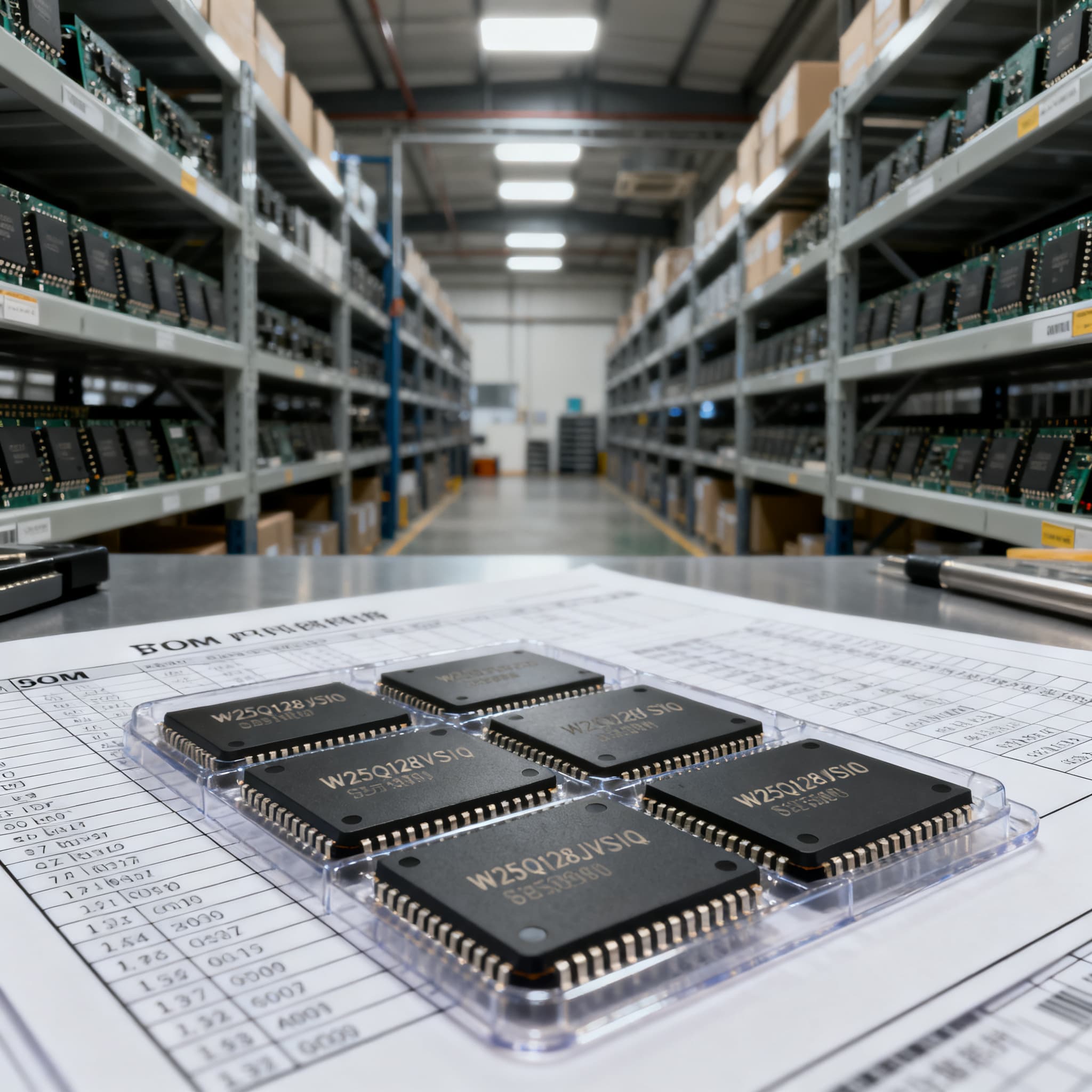
W25Q128JVSIQ Procurement Guide: What to Include in Your RFQ
W25Q128JVSIQ procurement and RFQ considerations for professional buyers. Need this part — or a full BOM? Request a quote on BOMNow.
Here is the complete HTML article for the W25Q128JVSIQ Procurement Guide, following the exact approved outline, table templates, and citation rules.
Why Lifecycle Status Belongs at the Top of Your W25Q128JVSIQ RFQ
Procurement professionals who treat lifecycle status as an afterthought in their RFQs often learn an expensive lesson when a production line halts because a part quietly shifted to NRND or EOL. The Winbond W25Q128JVSIQ is a 128-Mbit SPI NOR flash memory device that remains widely used in embedded systems, industrial controls, and networking hardware. Yet no component stays in full production forever, and the gap between "Active" and "Not Recommended for New Designs" can close faster than most procurement calendars account for.
According to PCNShark's lifecycle guide, NRND means the part is still produced and orderable, but the manufacturer advises against using it in new designs. Industrial Monitor Direct goes further: for new designs, never select an NRND component. The reasons are straightforward — once a part reaches NRND, the manufacturer's engineering support diminishes, PCN notifications may become less proactive, and the path to EOL shortens considerably.
The TT Electronics application note on lifecycle data explains that a YTEOL (Years to End of Life) estimate should be reviewed at least annually, with a maximum horizon of five years. TDK's product status framework reinforces the importance of distinguishing between growth, mature, decline, NRND, and obsolete phases. For procurement teams managing multi-line BOMs where W25Q128JVSIQ appears, these distinctions are not academic — they directly affect contract terms, safety stock calculations, and redesign budgets.
Key Takeaway: Before you finalize any RFQ for W25Q128JVSIQ, confirm the part's lifecycle status directly from Winbond's official product page or through your authorized distributor. The five minutes you spend verifying this data can prevent months of supply chain disruption.
| Driver | Mechanism | Procurement Impact |
|---|---|---|
| NRND Declaration | Manufacturer advises against new designs; production continues but support wanes | Redesign costs escalate; limited future supply availability; weaker PCN coverage |
| EOL Announcement | Discontinuation notice with last-time-buy (LTB) and last-time-ship (LTS) dates | Rush orders, inventory stockpiling, and inflated pricing on remaining stock |
| PCN (Product Change Notice) | Changes to die revision, package material, test flow, or fab location | Unplanned qualification rework; production line downtime if changes are missed |
| YTEOL Horizon | Estimated years until end of life, reviewed annually; max five-year window | Long-term planning certainty; informs whether to pre-qualify alternatives now |
| Counterfeit Infiltration | Constrained supply drives buyers to unauthorized channels | Reliability failures, field returns, and potential safety recalls |
Each of these drivers can be addressed in your RFQ by requesting explicit lifecycle data, the latest PCN date, and a supplier commitment to notify you of any status changes. Procurement teams that embed these requirements in their RFQ template avoid the reactive scramble that follows an unexpected EOL announcement.
W25Q128JVSIQ at a Glance: Critical Specs to Quote in Your RFQ
An RFQ that omits key electrical and mechanical parameters invites ambiguity — and ambiguity invites incorrect shipments. The W25Q128JVSIQ is a 128-Mbit serial NOR flash memory device from Winbond, supplied in an 8-pin SOIC-8 208-mil package. According to the official Winbond datasheet (Rev. F, March 2018) available through Mouser, and corroborated by the LCSC datasheet PDF and AllDatasheet listing, the device supports single, dual, and quad SPI interface modes with clock frequencies up to 133 MHz.
When you specify this part in your RFQ, include the parameters below. Even minor deviations — a different voltage tolerance, a slower speed grade, or a package variant — can render the delivered parts incompatible with your board's existing qualification. The table that follows distills the specifications that matter most at the procurement stage.
| Parameter | Value/Range | Unit/Notes |
|---|---|---|
| Density | 128 Mbit (16 MB) | Organized as 65,536 pages of 256 bytes each |
| Supply Voltage (VCC) | 2.7 to 3.6 | V; single supply |
| Interface | Single / Dual / Quad SPI | Command-set dependent; verify mode requirements |
| Maximum Clock Frequency | 133 (Quad SPI read) | MHz; standard SPI read at 104 MHz |
| Package | SOIC-8 208-mil | 8-pin; the "SIQ" suffix denotes this package |
| Temperature Range | -40 to +85 | °C; industrial grade |
| Sector Architecture | 4 KB uniform sectors | 32 KB and 64 KB block erase also supported |
| Endurance | 100,000 program/erase cycles | Minimum per sector |
| Data Retention | 20 years | Typical at rated temperature |
Tip: When quoting W25Q128JVSIQ in your RFQ, always include the full manufacturer part number with suffix, the package type, and the required temperature range. Avoid generic descriptions like "Winbond 128Mb flash" — these leave too much room for a supplier to substitute a different variant that may not fit your application.
Alternative 128-Mbit SPI NOR Flash Parts: What to Evaluate When W25Q128JVSIQ Isn't Available
Supply chain volatility can push even well-established parts into allocation. When W25Q128JVSIQ lead times stretch or inventory tightens, procurement teams need a pre-approved list of alternatives. The Unibetter alternative guide notes that the W25Q128JVSIQ is commonly selected for embedded systems, industrial controls, consumer electronics, networking hardware, and IoT devices — and that engineers often search for replacement options when sourcing availability becomes constrained.
However, the LCSC product insight warns that while other 128-Mbit SPI NOR flash devices share the same SOIC-8 footprint, full compatibility is not guaranteed. Timing parameters, command-set support, and voltage specifications must be verified against the original Winbond datasheet. The Bettlink ESP32 tutorial illustrates that even within the same application ecosystem, subtle differences in sector architecture or Quad SPI instruction formats can break firmware compatibility.
The table below compares W25Q128JVSIQ with several alternatives that may appear in cross-reference searches. None of these are compatibility must be verified (package, pinout, firmware) replacements — each requires engineering evaluation against your specific board design and firmware stack.
| Comparison Metric | W25Q128JVSIQ (Reference) | W25Q128JVSIM (Winbond) | GD25Q128C (GigaDevice) | Selection Criteria & Failure Boundary |
|---|---|---|---|---|
| Density | 128 Mbit | 128 Mbit | 128 Mbit | Density must match exactly; under- or over-sized parts break memory maps |
| Package | SOIC-8 208-mil | SOIC-8 150-mil | SOIC-8 208-mil | Not footprint compatible; verify pin 1 orientation and pad dimensions |
| Supply Voltage | 2.7–3.6 V | 2.7–3.6 V | 2.7–3.6 V | Voltage range must match; verify brown-out behavior |
| Quad SPI Read Frequency | 133 MHz | 133 MHz | 120 MHz (typical) | Slower max frequency may limit throughput; verify timing closure |
| Command Set | Winbond proprietary | Winbond (same family) | Similar but not identical | Verify QPI enable sequence, read-ID, and status register mapping |
| Sector Erase Time | ~45 ms (typ.) | ~45 ms (typ.) | ~60 ms (typ.) | Longer erase times may violate real-time constraints in firmware |
For procurement teams, the practical implication is clear: build your RFQ with an approved alternative list, but never assume pin-to-pin compatibility without engineering sign-off. The LCSC NOR Flash product page reinforces that engineers should consult the Winbond datasheet and carefully compare electrical characteristics and instruction sets when evaluating any replacement part.
| Segment | Effect | Notes |
|---|---|---|
| OEM Procurement Teams | Must qualify alternatives early in the design cycle | Timing and command-set verification is mandatory before BOM lock |
| EMS Providers | Need cross-compatible parts across multiple customer builds | Footprint trap is common — SOIC-8 is not always interchangeable |
| Industrial System Designers | Long lifecycle requirements (10+ years) | Avoid NRND parts; plan for redesign if YTEOL drops below 5 years |
| IoT and Consumer Electronics Developers | Cost-sensitive but reliability-critical | Verify voltage tolerance and speed grade; counterfeit risk is higher in cost-driven channels |
How to Write an RFQ That Gets the Right W25Q128JVSIQ — Every Time
A well-structured RFQ for W25Q128JVSIQ does more than list a part number and quantity. It sets expectations for lifecycle data, traceability, delivery commitments, and quality assurance — all before the first purchase order is cut. The IC Components listing emphasizes "100% New Original" parts, but procurement professionals know that documentation, not marketing claims, is what protects your production line.
Below is a step-by-step structure for building an RFQ that minimizes ambiguity and reduces the risk of receiving incorrect, relabeled, or incompatible parts.
- Exact Manufacturer Part Number and Package: Write
W25Q128JVSIQin full, including the SOIC-8 208-mil package designation. Do not truncate to "W25Q128" or substitute family-level ordering codes. The suffix "SIQ" encodes package, temperature grade, and green/RoHS compliance — omitting it invites incorrect substitutions. - Lifecycle Status Confirmation: Require the supplier to state the current lifecycle status (Active, NRND, or EOL) at the time of quotation, with the date of verification. If the part is NRND or EOL, request the last-time-buy date and YTEOL estimate as described in the TT Electronics application note.
- PCN Subscription Requirement: Ask the supplier to confirm they will forward any Winbond PCN affecting this MPN for the duration of your production run. The latest PCN date should be included in the RFQ response.
- Approved Alternative List: If you have pre-qualified alternatives (such as the W25Q128JVSIM or GD25Q128C), list them in the RFQ and ask the supplier to quote availability and pricing for each. This gives you a fallback if the primary part is constrained.
- Delivery Date and Destination: Specify a required delivery date, shipping terms (Incoterms), and destination. Vague phrases like "ASAP" or "standard lead time" give suppliers too much latitude — lock in a firm commitment.
- Traceability and Authenticity: Require full lot-code traceability back to Winbond or its authorized franchised distributors. Request documentation that demonstrates the chain of custody, and reserve the right to perform incoming inspection including date-code verification and marking analysis.
Note: The AllDatasheet PDF and LCSC datasheet provide the official specifications you can reference in your RFQ as the technical baseline. Any deviation from these specs should be explicitly flagged by the supplier and approved by your engineering team before acceptance.
| Action | When to Use | Trade-off |
|---|---|---|
| Request YTEOL Estimate in RFQ | At initial quotation stage for every new production order | Must be reviewed annually; supplier estimates may carry uncertainty beyond three years |
| Pre-Qualify Alternative Parts | Before the primary part becomes constrained | Engineering time investment; firmware may need modification for command-set differences |
| Subscribe to Manufacturer PCN Alerts | Ongoing throughout the production lifecycle | Monitoring overhead; PCN emails can be missed if not routed to the right team |
| Multi-Source RFQ with Approved Vendor List | For competitive pricing and supply diversification | Relationship management across multiple suppliers; volume pricing may be diluted |
| Incoming Inspection with Date-Code Cross-Check | Every shipment receipt | Adds labor and time to receiving; catches counterfeits and relabeled parts before they reach the line |
W25Q128JVSIQ Sourcing FAQ: What Procurement and Engineering Teams Ask
Q: Is the W25Q128JVSIQ currently NRND, and should I use it in a new design?
As of this writing, Winbond has not declared the W25Q128JVSIQ as NRND. However, you must check the official Winbond product page for the latest status before locking your BOM. TDK's product status framework and PCNShark's lifecycle guide both explain that if NRND status appears, the manufacturer will still produce the part but advises against new adoption. Industrial Monitor Direct recommends never selecting an NRND component for new designs — the reasons include diminishing engineering support, reduced PCN coverage, and a shorter path to full EOL.
Q: What are the most common pitfalls when substituting another 128-Mbit SPI NOR flash for the W25Q128JVSIQ?
The package footprint (SOIC-8) is often identical, but differences in timing, command-set support, voltage tolerance, and sector architecture can break compatibility. The LCSC product note warns that full verification of electrical characteristics and instruction sets is mandatory before qualifying a substitute. Specific failure points include: Quad SPI enable sequences that differ between manufacturers, status register bit mappings that don't align, and erase times that exceed the firmware's polling timeout. The Bettlink ESP32 tutorial illustrates how these differences surface in real embedded applications — even when the parts appear pin-compatible on paper.
Q: What PCN and EOL guarantees should I demand in my RFQ?
Request the latest PCN date, the YTEOL (years to end of life) estimate, and a written commitment from the supplier to notify you of any EOL announcement affecting the W25Q128JVSIQ. The TT Electronics application note explains that a YTEOL horizon of up to five years is typical and should be reviewed annually. If the supplier cannot provide a YTEOL estimate, that itself is a red flag — it may indicate limited visibility into the manufacturer's roadmap or a part approaching end-of-life without formal notice.
Q: How can I verify the authenticity of W25Q128JVSIQ parts?
Buy from Winbond's authorized franchised distributors whenever possible. Require traceability documentation that links the lot codes on your shipment back to the manufacturer's production records. Cross-check date codes and package markings against Winbond's lot history — inconsistencies in font, logo placement, or date-code format are common indicators of counterfeit or relabeled parts. The IC Components listing emphasizes "100% New Original" parts, but independent inbound inspection — including electrical testing on a sample basis — is still recommended before the parts reach your production line.
Q: What is the typical lead time for W25Q128JVSIQ, and how can I mitigate supply risk?
Lead times for the W25Q128JVSIQ fluctuate with market demand and fab allocation. In your RFQ, specify a required delivery date and ask the supplier to confirm current availability and lead time in writing. Platforms like LCSC provide real-time stock indicators, but always lock in a firm commitment — verbal or website-based inventory figures are not binding. Consider including pre-approved alternative parts in your RFQ as a buffer, and negotiate a safety-stock agreement with your supplier if this part is sole-sourced on a production BOM.